| Date Issued: | 1st May 2024 |
| Latest version: | http://www.imsglobal.org/activity/afa/latest/ |
IPR and Distribution Notices
Recipients of this document are requested to submit, with their comments, notification of any relevant patent claims or other intellectual property rights of which they may be aware that might be infringed by any implementation of the specification set forth in this document, and to provide supporting documentation.
1EdTech takes no position regarding the validity or scope of any intellectual property or other rights that might be claimed to pertain to the implementation or use of the technology described in this document or the extent to which any license under such rights might or might not be available; neither does it represent that it has made any effort to identify any such rights. Information on 1EdTech's procedures with respect to rights in IMS specifications can be found at the 1EdTech Intellectual Property Rights web page: https://www.1edtech.org/ipr/1edtechipr_policyFinal.pdf.
Copyright © 2024 1EdTech Consortium. All Rights Reserved.
Use of this specification to develop products or services is governed by the license with 1EdTech found on the 1EdTech website: https://www.1edtech.org/speclicense.html.
Permission is granted to all parties to use excerpts from this document as needed in producing requests for proposals.
The limited permissions granted above are perpetual and will not be revoked by 1EdTech or its successors or assigns.
THIS SPECIFICATION IS BEING OFFERED WITHOUT ANY WARRANTY WHATSOEVER, AND IN PARTICULAR, ANY WARRANTY OF NONINFRINGEMENT IS EXPRESSLY DISCLAIMED. ANY USE OF THIS SPECIFICATION SHALL BE MADE ENTIRELY AT THE IMPLEMENTER'S OWN RISK, AND NEITHER THE CONSORTIUM, NOR ANY OF ITS MEMBERS OR SUBMITTERS, SHALL HAVE ANY LIABILITY WHATSOEVER TO ANY IMPLEMENTER OR THIRD PARTY FOR ANY DAMAGES OF ANY NATURE WHATSOEVER, DIRECTLY OR INDIRECTLY, ARISING FROM THE USE OF THIS SPECIFICATION.
Public contributions, comments and questions can be posted here: www.1edtech.org/forums/1edtech-public-forums-and-resources.
© 2024 1EdTechConsortium, Inc.
All Rights Reserved.
Trademark information: http://www.1edtech.org/copyright.html
Document Name: 1EdTech Access for All (AfA) Personal Needs and Preferences (PNP) Service Model v1.0
Revision: 1st May 2024
The Access For All Specification (AfA) is intended to promote an inclusive user experience by enabling the matching of the characteristics of resources to the needs and preferences of individual users. The AfA specification consists of a common language for describing:
The original AfA PNP data model specification is intended to meet the needs of learners with disabilities and of anyone in a disabling context. The purpose of the AfA PNP Specification is to provide a machine-readable method of stating user needs and preferences with respect to digitally based education or learning. The AfA PNP specification can be used independently, for example to deliver the required or desired user interface to the user, or in combination with the AfADRD [AFADRD-DM-30] to deliver digital resources that meet a user's needs and preferences.
The 1EdTech Access for All Personal Needs and Preferences Service, defined and described in this document, creates an API wrapper that surrounds the original AFA PNP data model [AFAPNP-OVW-30]. This new AfA PNP service specification consists of:
In this document the data exchange is described in an implementation-independent format i.e. using a profile of the Unified Modeling Language (UML). The service description includes the definition of the data formats that are exchanged using a set of service operations.
1. Introduction
1.2 Conventions
1.3 Compability with AfA PNP Data Models
1.4 Structure of this Document
1.5 Nomenclature
2. Access for All Personal Needs and Preferences
3. Service Architecture and Specification Model
4.2 "AfAPNPRecordManagement" Interface Description
4.2.1 "getAllAfAPNPRecords" Operation
4.2.2 "getAfAPNPRecordForUserForActivity" Operation
4.2.3 "getAfAPNPRecordSetForUser" Operation
4.2.4 "deleteAfAPNPRecordSetForUser" Operation
4.2.5 "deleteAfAPNPRecordForUserForActivity" Operation
5.1 "AccessForAllPNPRecordSet" Class Description
5.1.1 "access-for-all-pnp-record" Attribute Description
5.2 "ActivitySourcedId" Class Description
5.3 "PersonSourcedId" Class Description
5.4 "SingleAFAPNPRecord" Class Description
5.4.1 "access-for-all-pnp-record" Attribute Description
5.5 "SingleUserAFAPNPRecord" Class Description
5.5.1 "access-for-all-pnp-record" Attribute Description
5.6 "imsx_StatusInfo" Class Description
5.6.1 "imsx_codeMajor" Attribute Description
5.6.2 "imsx_severity" Attribute Description
6.1.1 "AccessForAllPNP" Class Description
6.1.1.1 "access-mode-required" Attribute Description
6.1.1.2 "adaptation-type-required" Attribute Description
6.1.1.3 "at-interoperable" Attribute Description
6.1.1.4 "educational-complexity-of-adaptation" Attribute Description
6.1.1.5 "hazard-avoidance" Attribute Description
6.1.1.6 "input-requirements" Attribute Description
6.1.1.7 "language-of-adaptation" Attribute Description
6.1.1.8 "language-of-interface" Attribute Description
6.1.1.9 "adaptation-detail-required" Attribute Description
6.1.1.10 "adaptation-media-required" Attribute Description
6.1.1.11 "educational-level-of-adaptation" Attribute Description
6.1.1.12 "linguistic-guidance" Attribute Description
6.1.1.13 "keyword-emphasis" Attribute Description
6.1.1.14 "keyword-translation" Attribute Description
6.1.1.15 "simplified-language-portions" Attribute Description
6.1.1.16 "simplified-graphics" Attribute Description
6.1.1.17 "item-translation" Attribute Description
6.1.1.18 "sign-language" Attribute Description
6.1.1.19 "encouragement" Attribute Description
6.1.1.20 "additional-testing-time" Attribute Description
6.1.1.21 "line-reader" Attribute Description
6.1.1.22 "magnification" Attribute Description
6.1.1.23 "spoken" Attribute Description
6.1.1.24 "tactile" Attribute Description
6.1.1.25 "braille" Attribute Description
6.1.1.26 "answer-masking" Attribute Description
6.1.1.27 "keyboard-directions" Attribute Description
6.1.1.28 "additional-directions" Attribute Description
6.1.1.29 "long-description" Attribute Description
6.1.1.30 "captions" Attribute Description
6.1.1.31 "environment" Attribute Description
6.1.1.32 "transcript" Attribute Description
6.1.1.33 "alternative-text" Attribute Description
6.1.1.34 "audio-description" Attribute Description
6.1.1.35 "high-contrast" Attribute Description
6.1.1.36 "layout-single-column" Attribute Description
6.1.1.37 "text-appearance" Attribute Description
6.1.1.38 "calculator-on-screen" Attribute Description
6.1.1.39 "dictionary-on-screen" Attribute Description
6.1.1.40 "glossary-on-screen" Attribute Description
6.1.1.41 "thesaurus-on-screen" Attribute Description
6.1.1.42 "homophone-checker-on-screen" Attribute Description
6.1.1.43 "note-taking-on-screen" Attribute Description
6.1.1.44 "visual-organizer-on-screen" Attribute Description
6.1.1.45 "outliner-on-screen" Attribute Description
6.1.1.46 "peer-interaction-on-screen" Attribute Description
6.1.1.47 "spell-checker-on-screen" Attribute Description
6.1.1.48 "activate-at-initialization-set" Attribute Description
6.1.1.49 "activate-as-option-set" Attribute Description
6.1.1.50 "prohibit-set" Attribute Description
6.1.1.51 "extensions" Attribute Description
6.1.2 "AccessForAllPNPRecord" Class Description
6.1.2.1 "personSourcedId" Attribute Description
6.1.2.2 "activitySourcedId" Attribute Description
6.1.2.3 "access-for-all-pnp" Attribute Description
6.1.3 "AccessForAllPNPRecordSet" Class Description
6.1.3.1 "access-for-all-pnp-record" Attribute Description
6.1.4 "AccessModeRequired" Class Description
6.1.4.1 "existing-access-mode" Attribute Description
6.1.4.2 "adaptation-request" Attribute Description
6.1.5 "AdaptationDetailRequired" Class Description
6.1.5.1 "existing-access-mode" Attribute Description
6.1.5.2 "adaptation-request" Attribute Description
6.1.6 "AdaptationMediaRequired" Class Description
6.1.6.1 "existing-access-mode" Attribute Description
6.1.6.2 "adaptation-request" Attribute Description
6.1.7 "AdaptationTypeRequired" Class Description
6.1.7.1 "existing-access-mode" Attribute Description
6.1.7.2 "adaptation-request" Attribute Description
6.1.8 "AdditionalTestingTime" Class Description
6.1.8.1 "time-multiplier" Attribute Description
6.1.8.2 "fixed-minutes" Attribute Description
6.1.8.3 "unlimited" Attribute Description
6.1.9 "Braille" Class Description
6.1.9.1 "language" Characteristic Description
6.1.9.2 "delivery-mode" Attribute Description
6.1.9.3 "grade" Attribute Description
6.1.9.4 "braille-type" Attribute Description
6.1.9.5 "math-type" Attribute Description
6.1.10 "Environment" Class Description
6.1.10.1 "description" Attribute Description
6.1.10.2 "medical" Attribute Description
6.1.10.3 "software" Attribute Description
6.1.10.4 "hardware" Attribute Description
6.1.10.5 "breaks" Attribute Description
6.1.11 "FeatureSet" Class Description
6.1.11.1 "linguistic-guidance" Attribute Description
6.1.11.2 "keyword-emphasis" Attribute Description
6.1.11.3 "keyword-translation" Attribute Description
6.1.11.4 "simplified-language-portions" Attribute Description
6.1.11.5 "simplified-graphics" Attribute Description
6.1.11.6 "item-translation" Attribute Description
6.1.11.7 "sign-language" Attribute Description
6.1.11.8 "encouragement" Attribute Description
6.1.11.9 "additional-testing-time" Attribute Description
6.1.11.10 "line-reader" Attribute Description
6.1.11.11 "magnification" Attribute Description
6.1.11.12 "spoken" Attribute Description
6.1.11.13 "tactile" Attribute Description
6.1.11.14 "braille" Attribute Description
6.1.11.15 "answer-masking" Attribute Description
6.1.11.16 "keyboard-directions" Attribute Description
6.1.11.17 "additional-directions" Attribute Description
6.1.11.18 "long-description" Attribute Description
6.1.11.19 "captions" Attribute Description
6.1.11.20 "transcript" Attribute Description
6.1.11.21 "alternative-text" Attribute Description
6.1.11.22 "audio-description" Attribute Description
6.1.11.23 "high-contrast" Attribute Description
6.1.11.24 "input-requirements" Attribute Description
6.1.11.25 "language-of-interface" Attribute Description
6.1.11.26 "layout-single-column" Attribute Description
6.1.11.27 "text-appearance" Attribute Description
6.1.11.28 "calculator-on-screen" Attribute Description
6.1.11.29 "dictionary-on-screen" Attribute Description
6.1.11.30 "glossary-on-screen" Attribute Description
6.1.11.31 "thesaurus-on-screen" Attribute Description
6.1.11.32 "homophone-checker-on-screen" Attribute Description
6.1.11.33 "note-taking-on-screen" Attribute Description
6.1.11.34 "visual-organizer-on-screen" Attribute Description
6.1.11.35 "outliner-on-screen" Attribute Description
6.1.11.36 "peer-interaction-on-screen" Attribute Description
6.1.11.37 "spell-checker-on-screen" Attribute Description
6.1.11.38 "extensions" Attribute Description
6.1.12 "FontFace" Class Description
6.1.12.1 "font-name" Attribute Description
6.1.12.2 "generic-font-face" Attribute Description
6.1.13 "LanguageMode" Class Description
6.1.13.1 "language" Characteristic Description
6.1.14 "LineReader" Class Description
6.1.14.1 "highlight-color" Characteristic Description
6.1.15 "LongDescription" Class Description
6.1.15.1 "hide-visually" Characteristic Description
6.1.16 "Magnification" Class Description
6.1.16.1 "all-content" Attribute Description
6.1.16.2 "select-magnification" Attribute Description
6.1.17 "ReplacesAccessMode" Class Description
6.1.17.1 "replace-access-mode-auditory" Attribute Description
6.1.17.2 "replace-access-mode-color" Attribute Description
6.1.17.3 "replace-access-mode-item-size" Attribute Description
6.1.17.4 "replace-access-mode-olfactory" Attribute Description
6.1.17.5 "replace-access-mode-orientation" Attribute Description
6.1.17.6 "replace-access-mode-position" Attribute Description
6.1.17.7 "replace-access-mode-tactile" Attribute Description
6.1.17.8 "replace-access-mode-text-on-image" Attribute Description
6.1.17.9 "replace-access-mode-textual" Attribute Description
6.1.17.10 "replace-access-mode-visual" Attribute Description
6.1.18 "SelectMagnification" Class Description
6.1.18.1 "text" Attribute Description
6.1.18.2 "non-text" Attribute Description
6.1.19 "SingleAFAPNPRecord" Class Description
6.1.19.1 "access-for-all-pnp-record" Attribute Description
6.1.20 "SingleUserAFAPNPRecord" Class Description
6.1.20.1 "access-for-all-pnp-record" Attribute Description
6.1.21 "Spoken" Class Description
6.1.21.1 "reading-type" Attribute Description
6.1.21.2 "restriction-type" Attribute Description
6.1.21.3 "speech-rate" Attribute Description
6.1.21.4 "pitch" Attribute Description
6.1.21.5 "volume" Attribute Description
6.1.21.6 "link-indication" Attribute Description
6.1.21.7 "typing-echo" Attribute Description
6.1.22 "TextAppearance" Class Description
6.1.22.1 "color-theme" Attribute Description
6.1.22.2 "background-color" Attribute Description
6.1.22.3 "font-color" Attribute Description
6.1.22.4 "font-size" Attribute Description
6.1.22.5 "font-face" Attribute Description
6.1.22.6 "line-spacing" Attribute Description
6.1.22.7 "line-height" Attribute Description
6.1.22.8 "letter-spacing" Attribute Description
6.1.22.9 "uniform-font-sizing" Attribute Description
6.1.22.10 "word-spacing" Attribute Description
6.1.22.11 "word-wrapping" Attribute Description
6.1.22.12 "extensions" Attribute Description
6.1.23 "UserAFAPNPRecord" Class Description
6.1.23.1 "personSourcedId" Attribute Description
6.1.23.2 "activitySourcedId" Attribute Description
6.1.23.3 "user" Attribute Description
6.1.23.4 "access-for-all-pnp" Attribute Description
6.1.24 "UserId" Class Description
6.1.24.1 "type" Attribute Description
6.1.24.2 "identifier" Attribute Description
6.1.25 "UserRecord" Class Description
6.1.25.1 "userIds" Attribute Description
6.1.25.2 "extensions" Attribute Description
6.1.26 "imsx_CodeMinor" Class Description
6.1.26.1 "imsx_codeMinorField" Attribute Description
6.1.27 "imsx_CodeMinorField" Class Description
6.1.27.1 "imsx_codeMinorFieldName" Attribute Description
6.1.27.2 "imsx_codeMinorFieldValue" Attribute Description
6.1.28 "imsx_StatusInfo" Class Description
6.1.28.1 "imsx_codeMajor" Attribute Description
6.1.28.2 "imsx_severity" Attribute Description
6.1.28.3 "imsx_description" Attribute Description
6.1.28.4 "imsx_codeMinor" Attribute Description
6.2 Derived Class Descriptions
6.2.1 "ActivitySourcedId" Class Description
6.2.2 "Calculator" Class Description
6.2.2.1 "calculator-type" Characteristic Description
6.2.3 "ExtensionString" Class Description
6.2.3.1 "pattern" Attribute Description
6.2.4 "Hex" Class Description
6.2.4.1 "pattern" Attribute Description
6.2.5 "Identifier" Class Description
6.2.6 "PersonSourcedId" Class Description
6.2.6.1 "source-system" Characteristic Description
6.2.7 "Volume" Class Description
6.2.7.1 "maxInclusive" Attribute Description
6.2.8 "ZoomAmount" Class Description
6.2.8.1 "zoom-amount" Characteristic Description
6.3 Enumerated Vocabulary Descriptions
6.3.1 "AccessModeEnum" Vocabulary Description
6.3.2 "AdaptationDetailEnum" Vocabulary Description
6.3.3 "AdaptationMediaTypeEnum" Vocabulary Description
6.3.4 "AdaptationTypeEnum" Vocabulary Description
6.3.5 "BrailleTypeEnum" Vocabulary Description
6.3.6 "CalculatorTypeEnum" Vocabulary Description
6.3.7 "ColorThemeEnum" Vocabulary Description
6.3.8 "ControlFexibilityEnum" Vocabulary Description
6.3.9 "DeliveryModeEnum" Vocabulary Description
6.3.10 "EducationalComplexityEnum" Vocabulary Description
6.3.11 "FontFaceEnum" Vocabulary Description
6.3.12 "GradeEnum" Vocabulary Description
6.3.13 "HazardVocabularyEnum" Vocabulary Description
6.3.14 "LinkIndicationEnum" Vocabulary Description
6.3.15 "MathTypeEnum" Vocabulary Description
6.3.16 "ReadingTypeEnum" Vocabulary Description
6.3.17 "RestrictionTypeEnum" Vocabulary Description
6.3.18 "TypingEchoEnum" Vocabulary Description
6.3.19 "imsx_CodeMajorEnum" Vocabulary Description
6.3.20 "imsx_CodeMinorValueEnum" Vocabulary Description
6.3.21 "imsx_SeverityEnum" Vocabulary Description
6.4.1 "AccessModeValue" Class Description
6.4.2 "AdaptationDetailValue" Class Description
6.4.3 "AdaptationMediaTypeValue" Class Description
6.4.4 "AdaptationTypeValue" Class Description
6.4.5 "BrailleType" Class Description
6.4.6 "CalculatorType" Class Description
6.4.7 "ColorThemeExtEnum" Class Description
6.4.8 "ControlFlexibilityValueExtEnum" Class Description
6.4.9 "EducationalComplexityValueExtEnum" Class Description
6.4.10 "HazardValueExtEnum" Class Description
6.4.11 "MathType" Class Description
7.1 AccessForAllPNP Class Privacy Details
7.2 AccessForAllPNPRecord Class Privacy Details
7.3 UserAFAPNPRecord Class Privacy Details
9. Extending and Profiling the Data Model
9.1 Extending the Specification
9.1.1 Proprietary Operations
9.1.2 Proprietary Data Elements
Appendix A Modelling Terms and Concepts
A1 Behavior Model Description Definitions
A1.1 Service Diagrams
A2 Interface Model Description Definitions
A2.2 Class Descriptions
A3 Data Model Description Definitions
A3.1 Data Model Diagrams
A3.2 Class Descriptions
A3.3 Attribute and Characteristic Descriptions
A3.4 Enumerated Vocabulary Descriptions
A3.5 External Vocabulary Descriptions
A3.6 Import Class Descriptions
Appendix B Service Status Codes
B1 Definition of the Status Codes
B1.1 Definition of the "CodeMajor" Values
Figure 4.1 Service interface definitions
Figure 5.1 AccessForAllPNPRecordSet class definitions
Figure 5.2 ActivitySourcedId class definitions
Figure 5.3 PersonSourcedId class definitions
Figure 5.4 SingleAFAPNPRecord class definitions
Figure 5.5 SingleUserAFAPNPRecord class definitions
Figure 5.6 imsx_StatusInfo class definitions
Figure 6.1.1 AccessForAllPNP class definitions
Figure 6.1.2 AccessForAllPNPRecord class definitions
Figure 6.1.3 AccessForAllPNPRecordSet class definitions
Figure 6.1.4 AccessModeRequired class definitions
Figure 6.1.5 AdaptationDetailRequired class definitions
Figure 6.1.6 AdaptationMediaRequired class definitions
Figure 6.1.7 AdaptationTypeRequired class definitions
Figure 6.1.8 AdditionalTestingTime class definitions
Figure 6.1.9 Braille class definitions
Figure 6.1.10 Environment class definitions
Figure 6.1.11 FeatureSet class definitions
Figure 6.1.12 FontFace class definitions
Figure 6.1.13 LanguageMode class definitions
Figure 6.1.14 LineReader class definitions
Figure 6.1.15 LongDescription class definitions
Figure 6.1.16 Magnification class definitions
Figure 6.1.17 ReplacesAccessMode class definitions
Figure 6.1.18 SelectMagnification class definitions
Figure 6.1.19 SingleAFAPNPRecord class definitions
Figure 6.1.20 SingleUserAFAPNPRecord class definitions
Figure 6.1.21 Spoken class definitions
Figure 6.1.22 TextAppearance class definitions
Figure 6.1.23 UserAFAPNPRecord class definitions
Figure 6.1.24 UserId class definitions
Figure 6.1.25 UserRecord class definitions
Figure 6.1.26 imsx_CodeMinor class definitions
Figure 6.1.27 imsx_CodeMinorField class definitions
Figure 6.1.28 imsx_StatusInfo class definitions
Figure 6.2.1 ActivitySourcedId class definitions
Figure 6.2.2 Calculator class definitions
Figure 6.2.3 ExtensionString class definitions
Figure 6.2.4 Hex class definitions
Figure 6.2.5 Identifier class definitions
Figure 6.2.6 PersonSourcedId class definitions
Figure 6.2.7 Volume class definitions
Figure 6.2.8 ZoomAmount class definitions
Figure 6.3.1 AccessModeEnum class definitions
Figure 6.3.2 AdaptationDetailEnum class definitions
Figure 6.3.3 AdaptationMediaTypeEnum class definitions
Figure 6.3.4 AdaptationTypeEnum class definitions
Figure 6.3.5 BrailleTypeEnum class definitions
Figure 6.3.6 CalculatorTypeEnum class definitions
Figure 6.3.7 ColorThemeEnum class definitions
Figure 6.3.8 ControlFexibilityEnum class definitions
Figure 6.3.9 DeliveryModeEnum class definitions
Figure 6.3.10 EducationalComplexityEnum class definitions
Figure 6.3.11 FontFaceEnum class definitions
Figure 6.3.12 GradeEnum class definitions
Figure 6.3.13 HazardVocabularyEnum class definitions
Figure 6.3.14 LinkIndicationEnum class definitions
Figure 6.3.15 MathTypeEnum class definitions
Figure 6.3.16 ReadingTypeEnum class definitions
Figure 6.3.17 RestrictionTypeEnum class definitions
Figure 6.3.18 TypingEchoEnum class definitions
Figure 6.3.19 imsx_CodeMajorEnum class definitions
Figure 6.3.20 imsx_CodeMinorValueEnum class definitions
Figure 6.3.21 imsx_SeverityEnum class definitions
Figure 6.4.1 AccessModeValue class definitions
Figure 6.4.2 AdaptationDetailValue class definitions
Figure 6.4.3 AdaptationMediaTypeValue class definitions
Figure 6.4.4 AdaptationTypeValue class definitions
Figure 6.4.5 BrailleType class definitions
Figure 6.4.6 CalculatorType class definitions
Figure 6.4.7 ColorThemeExtEnum class definitions
Figure 6.4.8 ControlFlexibilityValueExtEnum class definitions
Figure 6.4.9 EducationalComplexityValueExtEnum class definitions
Figure 6.4.10 HazardValueExtEnum class definitions
Figure 6.4.11 MathType class definitions
Figure 6.4.12 RestrictionType class definitions
Figure 8.1 User link data definition.
Table 4.1 The set of interfaces.
Table 4.2 The set of operations for the "AfAPNPRecordManagement" interface.
Table 5.1 "AccessForAllPNPRecordSet" Class Description
Table 5.1.1 "access-for-all-pnp-record" Attribute Description
Table 5.2 "ActivitySourcedId" Class Description
Table 5.3 "PersonSourcedId" Class Description
Table 5.4 "SingleAFAPNPRecord" Class Description
Table 5.4.1 "access-for-all-pnp-record" Attribute Description
Table 5.5 "SingleUserAFAPNPRecord" Class Description
Table 5.5.1 "access-for-all-pnp-record" Attribute Description
Table 5.6 "imsx_StatusInfo" Class Description
Table 5.6.1 "imsx_codeMajor" Attribute Description
Table 5.6.2 "imsx_severity" Attribute Description
Table 5.6.3 "imsx_description" Attribute Description
Table 5.6.4 "imsx_codeMinor" Attribute Description
Table 6.1.1 AccessForAllPNP class definitions
Table 6.1.1.1 Description of the "access-mode-required" attribute for the "AccessForAllPNP" class
Table 6.1.1.2 Description of the "adaptation-type-required" attribute for the "AccessForAllPNP" class
Table 6.1.1.3 Description of the "at-interoperable" attribute for the "AccessForAllPNP" class
Table 6.1.1.4 Description of the "educational-complexity-of-adaptation" attribute for the "AccessForAllPNP" class
Table 6.1.1.5 Description of the "hazard-avoidance" attribute for the "AccessForAllPNP" class
Table 6.1.1.6 Description of the "input-requirements" attribute for the "AccessForAllPNP" class
Table 6.1.1.7 Description of the "language-of-adaptation" attribute for the "AccessForAllPNP" class
Table 6.1.1.8 Description of the "language-of-interface" attribute for the "AccessForAllPNP" class
Table 6.1.1.9 Description of the "adaptation-detail-required" attribute for the "AccessForAllPNP" class
Table 6.1.1.10 Description of the "adaptation-media-required" attribute for the "AccessForAllPNP" class
Table 6.1.1.11 Description of the "educational-level-of-adaptation" attribute for the "AccessForAllPNP" class
Table 6.1.1.12 Description of the "linguistic-guidance" attribute for the "AccessForAllPNP" class
Table 6.1.1.13 Description of the "keyword-emphasis" attribute for the "AccessForAllPNP" class
Table 6.1.1.14 Description of the "keyword-translation" attribute for the "AccessForAllPNP" class
Table 6.1.1.15 Description of the "simplified-language-portions" attribute for the "AccessForAllPNP" class
Table 6.1.1.16 Description of the "simplified-graphics" attribute for the "AccessForAllPNP" class
Table 6.1.1.17 Description of the "item-translation" attribute for the "AccessForAllPNP" class
Table 6.1.1.18 Description of the "sign-language" attribute for the "AccessForAllPNP" class
Table 6.1.1.19 Description of the "encouragement" attribute for the "AccessForAllPNP" class
Table 6.1.1.20 Description of the "additional-testing-time" attribute for the "AccessForAllPNP" class
Table 6.1.1.21 Description of the "line-reader" attribute for the "AccessForAllPNP" class
Table 6.1.1.22 Description of the "magnification" attribute for the "AccessForAllPNP" class
Table 6.1.1.23 Description of the "spoken" attribute for the "AccessForAllPNP" class
Table 6.1.1.24 Description of the "tactile" attribute for the "AccessForAllPNP" class
Table 6.1.1.25 Description of the "braille" attribute for the "AccessForAllPNP" class
Table 6.1.1.26 Description of the "answer-masking" attribute for the "AccessForAllPNP" class
Table 6.1.1.27 Description of the "keyboard-directions" attribute for the "AccessForAllPNP" class
Table 6.1.1.28 Description of the "additional-directions" attribute for the "AccessForAllPNP" class
Table 6.1.1.29 Description of the "long-description" attribute for the "AccessForAllPNP" class
Table 6.1.1.30 Description of the "captions" attribute for the "AccessForAllPNP" class
Table 6.1.1.31 Description of the "environment" attribute for the "AccessForAllPNP" class
Table 6.1.1.32 Description of the "transcript" attribute for the "AccessForAllPNP" class
Table 6.1.1.33 Description of the "alternative-text" attribute for the "AccessForAllPNP" class
Table 6.1.1.34 Description of the "audio-description" attribute for the "AccessForAllPNP" class
Table 6.1.1.35 Description of the "high-contrast" attribute for the "AccessForAllPNP" class
Table 6.1.1.36 Description of the "layout-single-column" attribute for the "AccessForAllPNP" class
Table 6.1.1.37 Description of the "text-appearance" attribute for the "AccessForAllPNP" class
Table 6.1.1.38 Description of the "calculator-on-screen" attribute for the "AccessForAllPNP" class
Table 6.1.1.39 Description of the "dictionary-on-screen" attribute for the "AccessForAllPNP" class
Table 6.1.1.40 Description of the "glossary-on-screen" attribute for the "AccessForAllPNP" class
Table 6.1.1.41 Description of the "thesaurus-on-screen" attribute for the "AccessForAllPNP" class
Table 6.1.1.42 Description of the "homophone-checker-on-screen" attribute for the "AccessForAllPNP" class
Table 6.1.1.43 Description of the "note-taking-on-screen" attribute for the "AccessForAllPNP" class
Table 6.1.1.44 Description of the "visual-organizer-on-screen" attribute for the "AccessForAllPNP" class
Table 6.1.1.45 Description of the "outliner-on-screen" attribute for the "AccessForAllPNP" class
Table 6.1.1.46 Description of the "peer-interaction-on-screen" attribute for the "AccessForAllPNP" class
Table 6.1.1.47 Description of the "spell-checker-on-screen" attribute for the "AccessForAllPNP" class
Table 6.1.1.48 Description of the "activate-at-initialization-set" attribute for the "AccessForAllPNP" class
Table 6.1.1.49 Description of the "activate-as-option-set" attribute for the "AccessForAllPNP" class
Table 6.1.1.50 Description of the "prohibit-set" attribute for the "AccessForAllPNP" class
Table 6.1.1.51 Description of the "extensions" attribute for the "AccessForAllPNP" class
Table 6.1.2 AccessForAllPNPRecord class definitions
Table 6.1.2.1 Description of the "personSourcedId" attribute for the "AccessForAllPNPRecord" class
Table 6.1.2.2 Description of the "activitySourcedId" attribute for the "AccessForAllPNPRecord" class
Table 6.1.2.3 Description of the "access-for-all-pnp" attribute for the "AccessForAllPNPRecord" class
Table 6.1.3 AccessForAllPNPRecordSet class definitions
Table 6.1.3.1 Description of the "access-for-all-pnp-record" attribute for the "AccessForAllPNPRecordSet" class
Table 6.1.4 AccessModeRequired class definitions
Table 6.1.4.1 Description of the "existing-access-mode" attribute for the "AccessModeRequired" class
Table 6.1.4.2 Description of the "adaptation-request" attribute for the "AccessModeRequired" class
Table 6.1.5 AdaptationDetailRequired class definitions
Table 6.1.5.1 Description of the "existing-access-mode" attribute for the "AdaptationDetailRequired" class
Table 6.1.5.2 Description of the "adaptation-request" attribute for the "AdaptationDetailRequired" class
Table 6.1.6 AdaptationMediaRequired class definitions
Table 6.1.6.1 Description of the "existing-access-mode" attribute for the "AdaptationMediaRequired" class
Table 6.1.6.2 Description of the "adaptation-request" attribute for the "AdaptationMediaRequired" class
Table 6.1.7 AdaptationTypeRequired class definitions
Table 6.1.7.1 Description of the "existing-access-mode" attribute for the "AdaptationTypeRequired" class
Table 6.1.7.2 Description of the "adaptation-request" attribute for the "AdaptationTypeRequired" class
Table 6.1.8 AdditionalTestingTime class definitions
Table 6.1.8.1 Description of the "time-multiplier" attribute for the "AdditionalTestingTime" class
Table 6.1.8.2 Description of the "fixed-minutes" attribute for the "AdditionalTestingTime" class
Table 6.1.8.3 Description of the "unlimited" attribute for the "AdditionalTestingTime" class
Table 6.1.9 Braille class definitions
Table 6.1.9.1 Description of the "language" characteristic for the "Braille" class
Table 6.1.9.2 Description of the "delivery-mode" attribute for the "Braille" class
Table 6.1.9.3 Description of the "grade" attribute for the "Braille" class
Table 6.1.9.4 Description of the "braille-type" attribute for the "Braille" class
Table 6.1.9.5 Description of the "math-type" attribute for the "Braille" class
Table 6.1.10 Environment class definitions
Table 6.1.10.1 Description of the "description" attribute for the "Environment" class
Table 6.1.10.2 Description of the "medical" attribute for the "Environment" class
Table 6.1.10.3 Description of the "software" attribute for the "Environment" class
Table 6.1.10.4 Description of the "hardware" attribute for the "Environment" class
Table 6.1.10.5 Description of the "breaks" attribute for the "Environment" class
Table 6.1.11 FeatureSet class definitions
Table 6.1.11.1 Description of the "linguistic-guidance" attribute for the "FeatureSet" class
Table 6.1.11.2 Description of the "keyword-emphasis" attribute for the "FeatureSet" class
Table 6.1.11.3 Description of the "keyword-translation" attribute for the "FeatureSet" class
Table 6.1.11.4 Description of the "simplified-language-portions" attribute for the "FeatureSet" class
Table 6.1.11.5 Description of the "simplified-graphics" attribute for the "FeatureSet" class
Table 6.1.11.6 Description of the "item-translation" attribute for the "FeatureSet" class
Table 6.1.11.7 Description of the "sign-language" attribute for the "FeatureSet" class
Table 6.1.11.8 Description of the "encouragement" attribute for the "FeatureSet" class
Table 6.1.11.9 Description of the "additional-testing-time" attribute for the "FeatureSet" class
Table 6.1.11.10 Description of the "line-reader" attribute for the "FeatureSet" class
Table 6.1.11.11 Description of the "magnification" attribute for the "FeatureSet" class
Table 6.1.11.12 Description of the "spoken" attribute for the "FeatureSet" class
Table 6.1.11.13 Description of the "tactile" attribute for the "FeatureSet" class
Table 6.1.11.14 Description of the "braille" attribute for the "FeatureSet" class
Table 6.1.11.15 Description of the "answer-masking" attribute for the "FeatureSet" class
Table 6.1.11.16 Description of the "keyboard-directions" attribute for the "FeatureSet" class
Table 6.1.11.17 Description of the "additional-directions" attribute for the "FeatureSet" class
Table 6.1.11.18 Description of the "long-description" attribute for the "FeatureSet" class
Table 6.1.11.19 Description of the "captions" attribute for the "FeatureSet" class
Table 6.1.11.20 Description of the "transcript" attribute for the "FeatureSet" class
Table 6.1.11.21 Description of the "alternative-text" attribute for the "FeatureSet" class
Table 6.1.11.22 Description of the "audio-description" attribute for the "FeatureSet" class
Table 6.1.11.23 Description of the "high-contrast" attribute for the "FeatureSet" class
Table 6.1.11.24 Description of the "input-requirements" attribute for the "FeatureSet" class
Table 6.1.11.25 Description of the "language-of-interface" attribute for the "FeatureSet" class
Table 6.1.11.26 Description of the "layout-single-column" attribute for the "FeatureSet" class
Table 6.1.11.27 Description of the "text-appearance" attribute for the "FeatureSet" class
Table 6.1.11.28 Description of the "calculator-on-screen" attribute for the "FeatureSet" class
Table 6.1.11.29 Description of the "dictionary-on-screen" attribute for the "FeatureSet" class
Table 6.1.11.30 Description of the "glossary-on-screen" attribute for the "FeatureSet" class
Table 6.1.11.31 Description of the "thesaurus-on-screen" attribute for the "FeatureSet" class
Table 6.1.11.32 Description of the "homophone-checker-on-screen" attribute for the "FeatureSet" class
Table 6.1.11.33 Description of the "note-taking-on-screen" attribute for the "FeatureSet" class
Table 6.1.11.34 Description of the "visual-organizer-on-screen" attribute for the "FeatureSet" class
Table 6.1.11.35 Description of the "outliner-on-screen" attribute for the "FeatureSet" class
Table 6.1.11.36 Description of the "peer-interaction-on-screen" attribute for the "FeatureSet" class
Table 6.1.11.37 Description of the "spell-checker-on-screen" attribute for the "FeatureSet" class
Table 6.1.11.38 Description of the "extensions" attribute for the "FeatureSet" class
Table 6.1.12 FontFace class definitions
Table 6.1.12.1 Description of the "font-name" attribute for the "FontFace" class
Table 6.1.12.2 Description of the "generic-font-face" attribute for the "FontFace" class
Table 6.1.13 LanguageMode class definitions
Table 6.1.13.1 Description of the "language" characteristic for the "LanguageMode" class
Table 6.1.14 LineReader class definitions
Table 6.1.14.1 Description of the "highlight-color" characteristic for the "LineReader" class
Table 6.1.15 LongDescription class definitions
Table 6.1.15.1 Description of the "hide-visually" characteristic for the "LongDescription" class
Table 6.1.16 Magnification class definitions
Table 6.1.16.1 Description of the "all-content" attribute for the "Magnification" class
Table 6.1.16.2 Description of the "select-magnification" attribute for the "Magnification" class
Table 6.1.17 ReplacesAccessMode class definitions
Table 6.1.17.1 Description of the "replace-access-mode-auditory" attribute for the "ReplacesAccessMode" class
Table 6.1.17.2 Description of the "replace-access-mode-color" attribute for the "ReplacesAccessMode" class
Table 6.1.17.3 Description of the "replace-access-mode-item-size" attribute for the "ReplacesAccessMode" class
Table 6.1.17.4 Description of the "replace-access-mode-olfactory" attribute for the "ReplacesAccessMode" class
Table 6.1.17.5 Description of the "replace-access-mode-orientation" attribute for the "ReplacesAccessMode" class
Table 6.1.17.6 Description of the "replace-access-mode-position" attribute for the "ReplacesAccessMode" class
Table 6.1.17.7 Description of the "replace-access-mode-tactile" attribute for the "ReplacesAccessMode" class
Table 6.1.17.8 Description of the "replace-access-mode-text-on-image" attribute for the "ReplacesAccessMode" class
Table 6.1.17.9 Description of the "replace-access-mode-textual" attribute for the "ReplacesAccessMode" class
Table 6.1.17.10 Description of the "replace-access-mode-visual" attribute for the "ReplacesAccessMode" class
Table 6.1.18 SelectMagnification class definitions
Table 6.1.18.1 Description of the "text" attribute for the "SelectMagnification" class
Table 6.1.18.2 Description of the "non-text" attribute for the "SelectMagnification" class
Table 6.1.19 SingleAFAPNPRecord class definitions
Table 6.1.19.1 Description of the "access-for-all-pnp-record" attribute for the "SingleAFAPNPRecord" class
Table 6.1.20 SingleUserAFAPNPRecord class definitions
Table 6.1.20.1 Description of the "access-for-all-pnp-record" attribute for the "SingleUserAFAPNPRecord" class
Table 6.1.21 Spoken class definitions
Table 6.1.21.1 Description of the "reading-type" attribute for the "Spoken" class
Table 6.1.21.2 Description of the "restriction-type" attribute for the "Spoken" class
Table 6.1.21.3 Description of the "speech-rate" attribute for the "Spoken" class
Table 6.1.21.4 Description of the "pitch" attribute for the "Spoken" class
Table 6.1.21.5 Description of the "volume" attribute for the "Spoken" class
Table 6.1.21.6 Description of the "link-indication" attribute for the "Spoken" class
Table 6.1.21.7 Description of the "typing-echo" attribute for the "Spoken" class
Table 6.1.22 TextAppearance class definitions
Table 6.1.22.1 Description of the "color-theme" attribute for the "TextAppearance" class
Table 6.1.22.2 Description of the "background-color" attribute for the "TextAppearance" class
Table 6.1.22.3 Description of the "font-color" attribute for the "TextAppearance" class
Table 6.1.22.4 Description of the "font-size" attribute for the "TextAppearance" class
Table 6.1.22.5 Description of the "font-face" attribute for the "TextAppearance" class
Table 6.1.22.6 Description of the "line-spacing" attribute for the "TextAppearance" class
Table 6.1.22.7 Description of the "line-height" attribute for the "TextAppearance" class
Table 6.1.22.8 Description of the "letter-spacing" attribute for the "TextAppearance" class
Table 6.1.22.9 Description of the "uniform-font-sizing" attribute for the "TextAppearance" class
Table 6.1.22.10 Description of the "word-spacing" attribute for the "TextAppearance" class
Table 6.1.22.11 Description of the "word-wrapping" attribute for the "TextAppearance" class
Table 6.1.22.12 Description of the "extensions" attribute for the "TextAppearance" class
Table 6.1.23 UserAFAPNPRecord class definitions
Table 6.1.23.1 Description of the "personSourcedId" attribute for the "UserAFAPNPRecord" class
Table 6.1.23.2 Description of the "activitySourcedId" attribute for the "UserAFAPNPRecord" class
Table 6.1.23.3 Description of the "user" attribute for the "UserAFAPNPRecord" class
Table 6.1.23.4 Description of the "access-for-all-pnp" attribute for the "UserAFAPNPRecord" class
Table 6.1.24 UserId class definitions
Table 6.1.24.1 Description of the "type" attribute for the "UserId" class
Table 6.1.24.2 Description of the "identifier" attribute for the "UserId" class
Table 6.1.25 UserRecord class definitions
Table 6.1.25.1 Description of the "userIds" attribute for the "UserRecord" class
Table 6.1.25.2 Description of the "extensions" attribute for the "UserRecord" class
Table 6.1.26 imsx_CodeMinor class definitions
Table 6.1.26.1 Description of the "imsx_codeMinorField" attribute for the "imsx_CodeMinor" class
Table 6.1.27 imsx_CodeMinorField class definitions
Table 6.1.27.1 Description of the "imsx_codeMinorFieldName" attribute for the "imsx_CodeMinorField" class
Table 6.1.27.2 Description of the "imsx_codeMinorFieldValue" attribute for the "imsx_CodeMinorField" class
Table 6.1.28 imsx_StatusInfo class definitions
Table 6.1.28.1 Description of the "imsx_codeMajor" attribute for the "imsx_StatusInfo" class
Table 6.1.28.2 Description of the "imsx_severity" attribute for the "imsx_StatusInfo" class
Table 6.1.28.3 Description of the "imsx_description" attribute for the "imsx_StatusInfo" class
Table 6.1.28.4 Description of the "imsx_codeMinor" attribute for the "imsx_StatusInfo" class
Table 6.2.1 ActivitySourcedId class definitions
Table 6.2.2 Calculator class definitions
Table 6.2.2.1 Description of the "calculator-type" characteristic for the "Calculator" class
Table 6.2.3 ExtensionString class definitions
Table 6.2.3.1 Description of the "pattern" attribute for the "ExtensionString" class
Table 6.2.4 Hex class definitions
Table 6.2.4.1 Description of the "pattern" attribute for the "Hex" class
Table 6.2.5 Identifier class definitions
Table 6.2.6 PersonSourcedId class definitions
Table 6.2.6.1 Description of the "source-system" characteristic for the "PersonSourcedId" class
Table 6.2.7 Volume class definitions
Table 6.2.7.1 Description of the "maxInclusive" attribute for the "Volume" class
Table 6.2.8 ZoomAmount class definitions
Table 6.2.8.1 Description of the "zoom-amount" characteristic for the "ZoomAmount" class
Table 6.3.1 AccessModeEnum class definitions
Table 6.3.2 AdaptationDetailEnum class definitions
Table 6.3.3 AdaptationMediaTypeEnum class definitions
Table 6.3.4 AdaptationTypeEnum class definitions
Table 6.3.5 BrailleTypeEnum class definitions
Table 6.3.6 CalculatorTypeEnum class definitions
Table 6.3.7 ColorThemeEnum class definitions
Table 6.3.8 ControlFexibilityEnum class definitions
Table 6.3.9 DeliveryModeEnum class definitions
Table 6.3.10 EducationalComplexityEnum class definitions
Table 6.3.11 FontFaceEnum class definitions
Table 6.3.12 GradeEnum class definitions
Table 6.3.13 HazardVocabularyEnum class definitions
Table 6.3.14 LinkIndicationEnum class definitions
Table 6.3.15 MathTypeEnum class definitions
Table 6.3.16 ReadingTypeEnum class definitions
Table 6.3.17 RestrictionTypeEnum class definitions
Table 6.3.18 TypingEchoEnum class definitions
Table 6.3.19 imsx_CodeMajorEnum class definitions
Table 6.3.20 imsx_CodeMinorValueEnum class definitions
Table 6.3.21 imsx_SeverityEnum class definitions
Table 6.4.1 AccessModeValue class description
Table 6.4.2 AdaptationDetailValue class description
Table 6.4.3 AdaptationMediaTypeValue class description
Table 6.4.4 AdaptationTypeValue class description
Table 6.4.5 BrailleType class description
Table 6.4.6 CalculatorType class description
Table 6.4.7 ColorThemeExtEnum class description
Table 6.4.8 ControlFlexibilityValueExtEnum class description
Table 6.4.9 EducationalComplexityValueExtEnum class description
Table 6.4.10 HazardValueExtEnum class description
Table 6.4.11 MathType class description
Table 6.4.12 RestrictionType class description
Table 7.1 Privacy Implications for the "AccessForAllPNP" Class
Table 7.2 Privacy Implications for the "AccessForAllPNPRecord" Class
Table 7.3 Privacy Implications for the "UserAFAPNPRecord" Class
Table 7.4 Privacy Implications for the "UserId" Class
Table 7.5 Privacy Implications for the "UserRecord" Class
Table 8.1 Description of the User link data class.
Table A1.1 The key to the descriptions of service model diagrams.
Table A1.2 The key to the operation description tables.
Table A2.1 The key to the descriptions of parameter model diagrams.
Table A2.2 The key to the descriptions of the data class tables.
Table A2.3 The key to the descriptions of the data attribute tables.
Table A3.1 The key to the descriptions of data model diagrams
Table A3.2 The key to the descriptions of the data class tables
Table A3.3 The key to the descriptions of the data attribute/characteristic tables
Table A3.4 The key to the descriptions of the enumerated vocabulary tables
Table A3.5 The key to the descriptions of the external vocabulary tables
Table A3.6 The key to the descriptions of the import class tables
Table A3.7 The key to the descriptions of the link data tables
Table A3.8 The key to the descriptions of the privacy class tables
Table A3.9 The key to the descriptions of the common data model persistent identifier tables
Table B1.1 Interpretation of the CodeMajor/Severity behavior matrix
Table B1.2 Definition of the CodeMajor status code values
Table B1.3 Definition of the Severity status code values
Table B1.4 Definition of the CodeMinor status code field values
The Access For All Personal Needs and Preferences (AfA PNP) Service specification is intended to enable the exchange of information about the needs of learners with disabilities and of anyone in a disabling context. This service provides an API wrapper that surrounds the original AfAPNP data model [AFAPNP-OVW-30]. The purpose of the AfA PNP Specification is to provide a machine-readable method of stating user needs and preferences with respect to digitally based education or learning.
This Service Model is defined using the 1EdTech Model Driven Specification approach and the associated modeling toolkit. The REST/JSON service binding for this information model, which is auto-generated from the same model that produced the documentation for the service model, is available in [AFAPNP-RJ-10]. Note that other technology bindings MAY be defined in the future.
All sections marked as non-normative, all authoring guidelines, diagrams (with the exception of the UML diagrams), examples, and notes in this specification are non-normative. Everything else in this specification is normative.
The key words "MUST", "MUST NOT", "REQUIRED", "SHALL", "SHALL NOT", "SHOULD", "SHOULD NOT", "RECOMMENDED", "MAY", and "OPTIONAL" in this document are to be interpreted as described in [RFC 2119]. This means that from the perspective of conformance:
The Conformance and Certification Guide for this specification may introduce greater normative constraints than those defined here for specific service or implementation categories.
The SHOULD/SHOULD NOT/RECOMMENDED statements MUST NOT be used in any document, or section of a document, that is responsible for defining the information model and/or the associated bindings and/or conformance and certification.
The AfA PNP Service 1.0 builds upon the AfA PNP Data Model 3.0 [AFAPNP-OVW-30]. 1EdTech has published two versions of the AfA PNP Data Model. The information models for AfA PNP v2.0 and v3.0 have many similarities but there are many differences. There is no backwards compatibility between versions 2 and 3.
The AFA PNP DAta Model 3.0 specification is designed to provide a very simple but extensible model and encourage early adoption and implementation. It was initially modelled using a semantic web approach then described using UML to support a particular class of implementations. The range of properties or attributes modelled and their representation is much simpler than in Access For All 2.0 in order to better support those properties identified as important by early adopters of previous versions. As such backwards compatibility with Access For All 2.0 has not been provided for as the team considered it important to establish a simpler way to represent the properties. A number of the properties in Access for All 3.0 have semantic equivalents in AfA2 that could be mapped to their AfA3 versions.
The structure of the rest of this document is:
| 2. Access for All Personal Needs and Preferences | The underlying data model for the AFA PNP specification. This is a high level description that shows the relationships between the various components of the PNP data model; |
| 3. Service Architecture and Specification Model | The formal definition and description of the set of root attributes for the information model. These are the first class objects that can be exchanged using this data model. AfA PNP has one root attributes; |
| 4. The Behavior Model | The definition and description of the set of root classes for the information model. These are parent classes for the the first class objects i.e. the root attributes, that can be exchanged using this data model; |
| 5. The Interface Model | The definition and description of the set of core classes from which the information model is composed; |
| 6. The Data Model | The definition and description of the set of abstract classes from which the information model is composed. These structures do not appear as explicit classes in the binding; |
| 7. Privacy Model | The definition and description of the set of derived classes. A derived class is one that is built upon either the primitive types (the base types avialable for any model) or other derived types. |
| 8. Link Data Definitions | The definition and description of the set of union classes. A union class is one that is built upon the union of to or more primitive, derived or enumerated data-types. |
| 9. Extending and Profiling the Data Model | Identification of the ways in which the data model can be extended (both in terms of the extending features and proprietary extensions to the model) and how this base specification, and its model-based description, can be profiled to produce derivative specifications; |
| References | The set of cited documents, normative and informative, that are used to support the technical details in this document; |
| Appendix A Modelling Terms and Concepts | An overview of the model driven approach, the concepts and the terms used by IMS to create the data model representations (based upon a profile of UML), the corresponding set of bindings and the accompanying documentation (including this information model). |
| Appendix B Service Status Codes | The definition and description of the set of enumerated classes i.e. the embedded vocabularies, used throughout the specification (these vocabularies are not encapsulated as external IMS-based VDEX files); |
| API | Application Programming Interface |
| APIP | Accessible Portable Item Protocol |
| ARIA | Accessible Rich Internet Applications |
| ASCII | American Standard Code for Information Interchange |
| ASL | American Sign Language |
| AT | Assistive Technology |
| AT-SPI | Assistive Technology Service Provider Interface |
| ATK | Accessibility Toolkit |
| AfA | Access For All |
| AfA DRD | Access for All Digital Resource Description |
| AfA PNP | Access for All Personal Needs and Preferences |
| DAISY | Digital Accessible Information System |
| DRD | Digital Resource Description |
| ISO | International Standards Organization |
| MSAA | Microsoft Active Accessibility |
| NIMAS | National Instructional Materials Accessibility Standard |
| OEBPS | Open eBook Publication Structure |
| Portable Document Format | |
| PEF | Portable Embosser Format |
| PIM | Platform Independent Model |
| PNP | Personal Needs and Preferences |
| UML | Unified Modeling Language |
| W3C | World Wide Web Consortium |
| WAI | Web Accessibility Initiative |
| WCAG | Web Content Accessibility Guidelines |
| XML | Extensible Mark-up Language |
The information collected as an AfA PNP description is associated with the user's functional abilities and the assistive technology or other non-standard technology in use as well as other user needs and preferences (a functional approach), rather than with the name and other details of a human impairment (a medical approach). If the structure were based on information about users' impairments, it would still need to address their functional abilities at some stage, as it is this information that is needed by learning systems to adapt content and navigation. A medical approach would exclude many of the details that the system would require. One example would be a user with a learning disability: because learning disabilities are so varied that classification does not capture the range of options that can be offered in a functional description. Another example would be the needs and preferences of a blind user: knowing that a user is blind (the medical terminology of the impairment) does not indicate whether or not they can read Braille or whether they need output to a Braille display or to a screen reader with speech; only a functional approach can do this. Many users with disabilities and users with alternate needs and preferences will require the user interface to be compatible with the assistive or non-standard technology that they use, so for them AfA PNP are specific to the hardware and software used.
The Access For All Personal Needs and Preferences (PNP) description can be created in a variety of ways. The most likely way is through an interactive form ('wizard') that presents a number of questions to the user and, given responses to the questions, generates the description. This application may be integrated into a content management system or offered as a stand-alone application. Once a person has a PNP, they should be able to change, expand, replace, or completely remove their user needs and preferences statement as needed. They should also be able to create multiple PNPs in order to have a convenient way to switch between several sets of needs and preferences for different situations e.g. at home, school, or in a quiet or noisy place. They should also be able to move their PNPs to new systems or new situations for reuse.
A learner may have one or more defined sets of needs and preferences. Multiple sets are necessary because a learner's needs and preferences may vary according to the learning context. Changing requirements may be caused by changes to their environment (for example, a home system may have different technologies installed from one at school) and/or other factors (for example, needs may vary later in the day as fatigue increases, or with specific disciplines such as science versus literature).
In general, any application within a particular class of alternative access systems will share some subset of functionality. For example, screen readers, in general, allow the users to set the rate at which text is read. In addition to this subset of common or generic functionality, many vendors add features that are unique to their application
AfA PNP statements identify and separate these generic settings for different classes of alternative access systems, and provide a vendor-neutral way for users to state their needs and preferences for these settings. These generic settings are applicable to any application within the class. As well, the PNP provides a mechanism for vendors to define their own application-specific settings, (which may not be applicable to other vendors' applications) and for the user to request them.
It is important to remember that this document contains a description of the underlying information model in terms of the abstract Application Programming Interface (API). The manner in which this abstract representation is visualized is not intended to dictate the implementation form of the Service. The breakdown of the service into its interface classes is a convenient way to document the set of behaviors. The objective for producing these interfaces is to identify and define the messages that are exchanged between the end-systems to realize the system behaviors required of the service.
The internal organization of an implementation of the full abstract API is beyond the scope of this specification. The only constraint is that the external behavior of the abstract API complies with this specification. This means that a .NET, J2EE, etc. physical implementation of this abstract API does not have to represent the functionality using the same breakdown of operations/methods. This physical implementation is not subject to the conformance specification.
It is important to note that the UML representation of the interfaces is used to help develop and document the Service Model and various Bindings. It is not a requirement for a system to implement this interface as defined i.e. to use the same parameters, etc. Conformance against this specification will be confirmed by inspecting the appropriate binding of the information model and ensuring that the relevant information is present and that different sequences of activity result in the predicted and mandated behavior. It is essential that the behaviors described by each of the operations are fully supported and that the behaviors described by different sequences are also maintained.
The basic architectural model for the AfA PNP Service specification is shown in Figure 3.1. In this architecture the scope of the 1EdTech AfA PNP Service specification is shown as the dotted line. The scope of the interoperability is the data and behavioral models of the objects being exchanged.
Figure 3.1 - The AfA PNP service architecture.
It is important to remember that the structure of the exchanged information has NO bearing on how the same information is contained within the 'consumer' and 'provider' AfA PNP systems (the repositories in the two end-systems). It is simply a representation of the data used to facilitate exchange between the end-systems. The only constraint on the end-system repositories is that they provide data persistence consistent with the required behavior.
The set of single objects that can be exchanged between AfA PNP end-systems are:
The set of collection objects that can be exchanged between AfA PNP end-systems are:
The relationships between the core classes in AfA PNP Data Model are shown in Figure 3.2.
Figure 3.2 - The relationships between the core classes in the AfA PNP data model.
The key relationships shown in Figure 3.2 are:
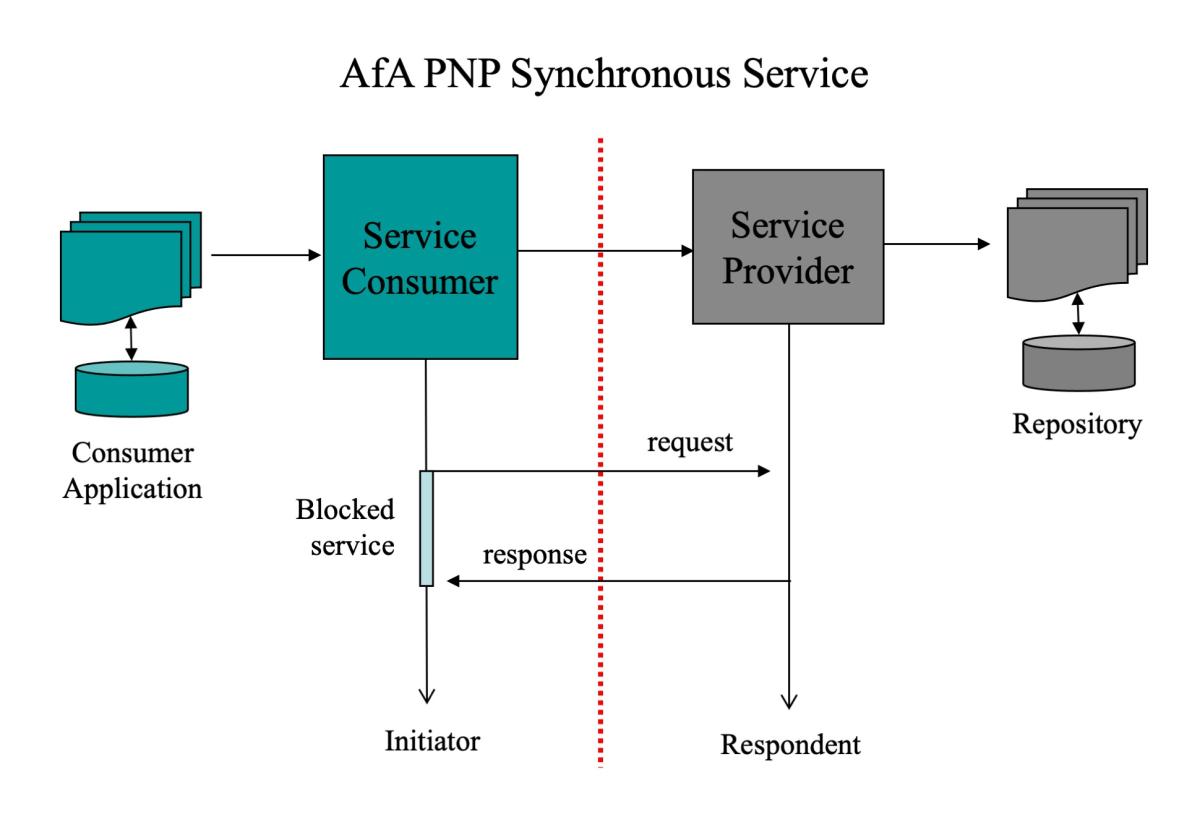
The AfA PNP Service is a synchronous service i.e. the consumer is blocked until the response from the provider is received. This means that a consumer can only have one outstanding request with a service provider. The corresponding sequence of actions is shown in Figure 3.3.
Figure 3.3 - The action sequence for the AfA PNP synchronous service.
Figure 3.3 shows the action sequence from the prespective of the consumer but it must be noted that a Service Provider will be expected to support concurrent requests from many consumers.
This Section is NORMATIVE
The model for the service representation is shown in Figure 4.1 and Table 4.1 (the syntax and semantics for this representation is described in Appendix A1.1). Following the service definition are the descriptions for the set of corresponding service operations (the syntax and semantics for these descriptions is described in Appendix A1.2).
Figure 4.1 - Service interface definitions.
| Interface | Description |
|---|---|
| AfAPNPRecordManagement | This interface enables the management of the access to the set of Access for All Personal Needs and Preferences (AFA PNP) records. The set of operations support the creation, deletion and reading of AfA PNP records. |
This interface enables the management of the access to the set of Access for All Personal Needs and Preferences (AFA PNP) records. The set of operations support the creation, deletion and reading of AfA PNP records.
The set of operations for this interface are summarized in Table 4.2.
| Operation | Description |
|---|---|
| getAllAfAPNPRecords | To read all of the AfA PNP records in the context of the system implementation i.e. for a schools, district, etc. |
| getAfAPNPRecordForUserForActivity | To read the AfA PNP record the identified user for the specified learning activity. If either the user or activity cannot be identified within the service provider then a status code of 'unknownobject' must be reported. |
| getAfAPNPRecordSetForUser | To read the set of AfA PNP records for the identified user. If the specified user cannot be identified within the service provider then a status code of 'unknownobject' must be reported. |
| deleteAfAPNPRecordSetForUser | To delete all of the AfA PNP records associated with the identified user. If the specified user cannot be identified within the service provider then a status code of 'unknownobject' must be reported. Note that the user record is NOT deleted i.e. ONLY the AFA PNP records are deleted. |
| deleteAfAPNPRecordForUserForActivity | To delete the identified AfA PNP record associated with the identified user. If the specified user and/or AFA PNP record cannot be identified within the service provider then a status code of 'unknownobject' must be reported. Note that the user record is NOT deleted i.e. ONLY the AfA PNP record is deleted. |
| createAfAPNPRecordForUserForActivity | To create an AfA PNP record for the defined user. If the user already exists then the request is rejected with a status code of 'user_already_exists'. This request results in a new user record being created to which AfA PNP records for other activities MAY be added. |
| addAfAPNPRecordForUserForActivity | To add an AfA PNP record for the specified activity for a user who already has other AfA PNP record(s). If the specified activity is already defined, that record is replaced with the AfA PNP record supplied. |
| Name: | getAllAfAPNPRecords () |
| Return Function Parameter: | imsx_StatusInfo : imsx_StatusInfo - the transaction-level status information for the request. This report has end-to-end significance and must map between the messaging technology approach and the business transaction API. For REST-based bindings this structure describes the message payload that must be returned when the request has not been successfully completed. |
| Supplied (in) Parameters: | None. |
| Returned (out) Parameters: | afapnpRecordSet : AccessForAllPNPRecordSet - the set of AfA PNP records that have been read from the service provider in the operational context for that service i.e. the school, district, etc. |
| Behavior: | To read all of the AfA PNP records in the context of the system implementation i.e. for a schools, district, etc. |
| Notes: |
Query Parameters for the REST-based binding have been defined for this operation, namely:
|
| Name: | getAfAPNPRecordForUserForActivity () |
| Return Function Parameter: | imsx_StatusInfo : imsx_StatusInfo - the transaction-level status information for the request. This report has end-to-end significance and must map between the messaging technology approach and the business transaction API. For REST-based bindings this structure describes the message payload that must be returned when the request has not been successfully completed. |
| Supplied (in) Parameters: | userSourcedId : PersonSourcedId - the unique identifier, GUID, for this user. This is the interoperability identifier for the user. activitySourcedId : ActivitySourcedId - the unique identifier, GUID, for this activity This is the interoperability identifier for the activity. |
| Returned (out) Parameters: | afapnpRecord : SingleAFAPNPRecord - the AFA PNP record for that user for that learning activity. This may be empty. |
| Behavior: | To read the AfA PNP record the identified user for the specified learning activity. If either the user or activity cannot be identified within the service provider then a status code of 'unknownobject' must be reported. |
| Notes: |
Query Parameters for the REST-based binding have been defined for this operation, namely:
|
| Name: | getAfAPNPRecordSetForUser () |
| Return Function Parameter: | imsx_StatusInfo : imsx_StatusInfo - the transaction-level status information for the request. This report has end-to-end significance and must map between the messaging technology approach and the business transaction API. For REST-based bindings this structure describes the message payload that must be returned when the request has not been successfully completed. |
| Supplied (in) Parameters: | userSourcedId : PersonSourcedId - the unique identifier, GUID, for this user. This is the interoperability identifier for the user. |
| Returned (out) Parameters: | afapnpRecordSet : AccessForAllPNPRecordSet - the set of AFA PNP records for the identified user stored by the service provider (this may be empty). |
| Behavior: | To read the set of AfA PNP records for the identified user. If the specified user cannot be identified within the service provider then a status code of 'unknownobject' must be reported. |
| Notes: |
Query Parameters for the REST-based binding have been defined for this operation, namely:
|
| Name: | deleteAfAPNPRecordSetForUser () |
| Return Function Parameter: | imsx_StatusInfo : imsx_StatusInfo - the transaction-level status information for the request. This report has end-to-end significance and must map between the messaging technology approach and the business transaction API. For REST-based bindings this structure describes the message payload that must be returned when the request has not been successfully completed. |
| Supplied (in) Parameters: | userSourcedId : PersonSourcedId - the unique identifier, GUID, for this user. This is the interoperability identifier for the user. |
| Returned (out) Parameters: | None. |
| Behavior: | To delete all of the AfA PNP records associated with the identified user. If the specified user cannot be identified within the service provider then a status code of 'unknownobject' must be reported. Note that the user record is NOT deleted i.e. ONLY the AFA PNP records are deleted. |
| Name: | deleteAfAPNPRecordForUserForActivity () |
| Return Function Parameter: | imsx_StatusInfo : imsx_StatusInfo - the transaction-level status information for the request. This report has end-to-end significance and must map between the messaging technology approach and the business transaction API. For REST-based bindings this structure describes the message payload that must be returned when the request has not been successfully completed. |
| Supplied (in) Parameters: | userSourcedId : PersonSourcedId - the unique identifier, GUID, for this user. This is the interoperability identifier for the user. activitySourcedId : ActivitySourcedId - the unique identifier, GUID, for this activity This is the interoperability identifier for the activity. |
| Returned (out) Parameters: | None. |
| Behavior: | To delete the identified AfA PNP record associated with the identified user. If the specified user and/or AFA PNP record cannot be identified within the service provider then a status code of 'unknownobject' must be reported. Note that the user record is NOT deleted i.e. ONLY the AfA PNP record is deleted. |
| Name: | createAfAPNPRecordForUserForActivity () |
| Return Function Parameter: | imsx_StatusInfo : imsx_StatusInfo - the transaction-level status information for the request. This report has end-to-end significance and must map between the messaging technology approach and the business transaction API. For REST-based bindings this structure describes the message payload that must be returned when the request has not been successfully completed. |
| Supplied (in) Parameters: | userSourcedId : PersonSourcedId - the unique identifier, GUID, for this user. This is the interoperability identifier for the user. activitySourcedId : ActivitySourcedId - the unique identifier, GUID, for this learning activity This is the interoperability identifier for the activity. afapnpUserRecord : SingleUserAFAPNPRecord - the combination of the user information for the creation of the user record and the first AfA PNP record that is to be associated with that user information. |
| Returned (out) Parameters: | None. |
| Behavior: | To create an AfA PNP record for the defined user. If the user already exists then the request is rejected with a status code of 'user_already_exists'. This request results in a new user record being created to which AfA PNP records for other activities MAY be added. |
| Name: | addAfAPNPRecordForUserForActivity () |
| Return Function Parameter: | imsx_StatusInfo : imsx_StatusInfo - the transaction-level status information for the request. This report has end-to-end significance and must map between the messaging technology approach and the business transaction API. For REST-based bindings this structure describes the message payload that must be returned when the request has not been successfully completed. |
| Supplied (in) Parameters: | userSourcedId : PersonSourcedId - the unique identifier, GUID, for this user. This is the interoperability identifier for the user. activitySourcedId : ActivitySourcedId - the unique identifier, GUID, for this learning activity This is the interoperability identifier for the activity. afapnpRecord : SingleAFAPNPRecord - tthe AfA PNP record that is to be added to the set of records for the specified user. |
| Returned (out) Parameters: | None. |
| Behavior: | To add an AfA PNP record for the specified activity for a user who already has other AfA PNP record(s). If the specified activity is already defined, that record is replaced with the AfA PNP record supplied. |
This Section is NORMATIVE
The set of operations described within the behavior model (The Behavior Model) are based upon class descriptions specific to the parameters of the operations. All parameters are mandatory. The syntax and semantics for this representation is described in Appendix A2.
The data model for the "AccessForAllPNPRecordSet" class is shown in Figure 5.1 and the accompanying definition in Table 5.1.
Figure 5.1 - AccessForAllPNPRecordSet class definitions.
| Descriptor | Definition |
|---|---|
| Class Name | AccessForAllPNPRecordSet |
| Class Type | Container [ Sequence ] |
| Parents | Service parameter data-type used in the following operations: |
| Characteristics | There are no characteristics. |
| Children | The set of children attributes are: |
| Description | This is the root container for the set AfA PNP Records. The order of the records is not significant and the payload may be empty. |
The description of the "access-for-all-pnp-record" attribute for the "AccessForAllPNPRecordSet" class is given in Table 5.1.1.
| Descriptor | Definition |
|---|---|
| Attribute Name | access-for-all-pnp-record |
| Data Type | AccessForAllPNPRecord |
| Value Space | Container [ Sequence ] |
| Scope | Local ("-") |
| Multiplicity | [0.. unbounded] |
| Privacy | Type: Container This is a CONTAINER holding information with privacy implications. |
| Description | This is used to contain the description of each of the individual AfA PNP Records. |
The data model for the "ActivitySourcedId" class is shown in Figure 5.2 and the accompanying definition in Table 5.2.
Figure 5.2 - ActivitySourcedId class definitions.
| Descriptor | Definition |
|---|---|
| Class Name | ActivitySourcedId |
| Class Type | Container [ DerivedType ] |
| Parents | Service parameter data-type used in the following operations: |
| Characteristics | There are no characteristics. |
| Children | There are no children. |
| Description | The data-type for the sourcedId of an Activity. This is used to identify the learning activity for the user. |
The data model for the "PersonSourcedId" class is shown in Figure 5.3 and the accompanying definition in Table 5.3.
Figure 5.3 - PersonSourcedId class definitions.
| Descriptor | Definition |
|---|---|
| Class Name | PersonSourcedId |
| Class Type | Container [ DerivedType ] |
| Parents | Service parameter data-type used in the following operations: |
| Characteristics | The set of characteristics are: |
| Children | There are no children. |
| Description | The data-type for the sourcedId of a Person. This is used to identify the owner of a PNP Record. There is NO predefined format for this identifier. |
The data model for the "SingleAFAPNPRecord" class is shown in Figure 5.4 and the accompanying definition in Table 5.4.
Figure 5.4 - SingleAFAPNPRecord class definitions.
| Descriptor | Definition |
|---|---|
| Class Name | SingleAFAPNPRecord |
| Class Type | Container [ Sequence ] |
| Parents | Service parameter data-type used in the following operations: |
| Characteristics | There are no characteristics. |
| Children | The set of children attributes are: |
| Description | The root container for a single AfA PNP record. |
The description of the "access-for-all-pnp-record" attribute for the "SingleAFAPNPRecord" class is given in Table 5.4.1.
| Descriptor | Definition |
|---|---|
| Attribute Name | access-for-all-pnp-record |
| Data Type | AccessForAllPNPRecord |
| Value Space | Container [ Sequence ] |
| Scope | Local ("-") |
| Multiplicity | [1] |
| Privacy | Type: Container This is a CONTAINER holding information with privacy implications. |
| Description | This is used to contain the description of a single AfA PNP Record. |
The data model for the "SingleUserAFAPNPRecord" class is shown in Figure 5.5 and the accompanying definition in Table 5.5.
Figure 5.5 - SingleUserAFAPNPRecord class definitions.
| Descriptor | Definition |
|---|---|
| Class Name | SingleUserAFAPNPRecord |
| Class Type | Container [ Sequence ] |
| Parents | Service parameter data-type used in the following operations: |
| Characteristics | There are no characteristics. |
| Children | The set of children attributes are: |
| Description | The root container for the combined user information and their first AfA PNP record. |
The description of the "access-for-all-pnp-record" attribute for the "SingleUserAFAPNPRecord" class is given in Table 5.5.1.
| Descriptor | Definition |
|---|---|
| Attribute Name | access-for-all-pnp-record |
| Data Type | UserAFAPNPRecord |
| Value Space | Container [ Sequence ] |
| Scope | Local ("-") |
| Multiplicity | [1] |
| Privacy | Type: Container This is a CONTAINER holding information with privacy implications. |
| Description | This is used to contain the combined description of the user and their first AfA PNP Record. |
The data model for the "imsx_StatusInfo" class is shown in Figure 5.6 and the accompanying definition in Table 5.6.
Figure 5.6 - imsx_StatusInfo class definitions.
| Descriptor | Definition |
|---|---|
| Class Name | imsx_StatusInfo |
| Class Type | Container [ Sequence ] |
| Parents | Service parameter data-type used in the following operations: |
| Characteristics | There are no characteristics. |
| Children | The set of children attributes are: |
| Description | This is the container for the status code and associated information returned within the HTTP messages received from the Service Provider. For the OneRoster Resources service this object will only be returned to provide information about a failed request i.e. it will NOT be in the payload for a successful request. See Appendix B for further information on the interpretation of the information contained within this class. |
The description of the "imsx_codeMajor" attribute for the "imsx_StatusInfo" class is given in Table 5.6.1.
| Descriptor | Definition |
|---|---|
| Attribute Name | imsx_codeMajor |
| Data Type | imsx_CodeMajorEnum |
| Value Space | Enumerated value set of: { success | processing | failure | unsupported } |
| Scope | Local ("-") |
| Multiplicity | [1] |
| Privacy | There are NO privacy implications. |
| Description | The code major value (from the corresponding enumerated vocabulary). See Appendix B for further information on the interpretation of this set of codes. The permitted vocabulary for the values for the CodeMajor field. |
The description of the "imsx_severity" attribute for the "imsx_StatusInfo" class is given in Table 5.6.2.
| Descriptor | Definition |
|---|---|
| Attribute Name | imsx_severity |
| Data Type | imsx_SeverityEnum |
| Value Space | Enumerated value set of: { status | warning | error } |
| Scope | Local ("-") |
| Multiplicity | [1] |
| Privacy | There are NO privacy implications. |
| Description | The severity value (from the corresponding enumerated vocabulary). See Appendix B for further information on the interpretation of this set of codes. |
The description of the "imsx_description" attribute for the "imsx_StatusInfo" class is given in Table 5.6.3.
| Descriptor | Definition |
|---|---|
| Attribute Name | imsx_description |
| Data Type | String (Primitive-type) |
| Value Space | See Appendix A3.3. |
| Scope | Local ("-") |
| Multiplicity | [0..1] |
| Privacy | There are NO privacy implications. |
| Description | A human readable description supplied by the entity creating the status code information. |
The description of the "imsx_codeMinor" attribute for the "imsx_StatusInfo" class is given in Table 5.6.4.
| Descriptor | Definition |
|---|---|
| Attribute Name | imsx_codeMinor |
| Data Type | imsx_CodeMinor |
| Value Space | Container [ Sequence ] |
| Scope | Local ("-") |
| Multiplicity | [0..1] |
| Privacy | There are NO privacy implications. |
| Description | The set of reported code minor status codes. See Appendix B for further information on the interpretation of this set of codes. |
This Section is NORMATIVE.
All of the data classes used within this Information Model are described in this Section. The syntax and semantics for this representation is described in Appendix A3.2.
The data model for the "AccessForAllPNP" class is shown in Figure 6.1.1 and the accompanying definition in Table 6.1.1.
Figure 6.1.1 - AccessForAllPNP class definitions.
The description of the "access-mode-required" attribute for the "AccessForAllPNP" class is given in Table 6.1.1.1.
| Descriptor | Definition |
|---|---|
| Attribute Name | access-mode-required |
| Data Type | AccessModeRequired |
| Value Space | Container [ Sequence ] |
| Scope | Local ("-") |
| Multiplicity | [0.. unbounded] |
| Privacy | Type: Accessibility Access mode that a user seeks either in an adaptation or an original resource as a replacement for a different access mode. |
| Description | Access mode that a user seeks either in an adaptation or an original resource as a replacement for a different access mode. This attribute relates an 'existingAccessMode' to an access mode that the user prefers, called an 'adaptationRequest'. |
The description of the "adaptation-type-required" attribute for the "AccessForAllPNP" class is given in Table 6.1.1.2.
| Descriptor | Definition |
|---|---|
| Attribute Name | adaptation-type-required |
| Data Type | AdaptationTypeRequired |
| Value Space | Container [ Sequence ] |
| Scope | Local ("-") |
| Multiplicity | [0.. unbounded] |
| Privacy | Type: Accessibility Nature or genre of the adaptation required as a replacement for a specific access mode. |
| Description | Nature or genre of the adaptation required as a replacement for a specific access mode. This attribute relates an 'existingAccessMode' to an adaptation type that the user prefers, called an 'adaptationRequest'. |
The description of the "at-interoperable" attribute for the "AccessForAllPNP" class is given in Table 6.1.1.3.
| Descriptor | Definition |
|---|---|
| Attribute Name | at-interoperable |
| Data Type | Boolean (Primitive-type) |
| Value Space | See Appendix A3.3. |
| Scope | Local ("-") |
| Multiplicity | [0..1] |
| Privacy | Type: Accessibility A preference for resources which are compatible with assistive technologies. |
| Description | A preference for resources which are compatible with assistive technologies. Resources that are interoperable with AT should be selected whenever possible. Interoperability is indicated by compliance with WCAG 2.0 checkpoints- 1.1.1, 1.3.1, 1.3.2, 2.4.4, 3.1.1, 3.1.2, 3.3.2, 4.1.1 and 4.1.2. The specific details of the AT are normally provided by a user agent or the operating system. The example of 'atInteroperable=true' expresses this statement - resources that are interoperable with AT should be selected whenever possible. |
The description of the "educational-complexity-of-adaptation" attribute for the "AccessForAllPNP" class is given in Table 6.1.1.4.
| Descriptor | Definition |
|---|---|
| Attribute Name | educational-complexity-of-adaptation |
| Data Type | EducationalComplexityValueExtEnum |
| Value Space | Container [ Union ] |
| Scope | Local ("-") |
| Multiplicity | [0..1] |
| Privacy | Type: Accessibility A preference for a resource that is simplified or enriched relative to another resource that presents the same intellectual content. |
| Description | A preference for a resource that is simplified or enriched relative to another resource that presents the same intellectual content. The example of 'educationalComplexityOfAdaptation=simplified' expresses this statement: Resources that are presented in a simplified form should be selected whenever possible. |
The description of the "hazard-avoidance" attribute for the "AccessForAllPNP" class is given in Table 6.1.1.5.
| Descriptor | Definition |
|---|---|
| Attribute Name | hazard-avoidance |
| Data Type | HazardValueExtEnum |
| Value Space | Container [ Union ] |
| Scope | Local ("-") |
| Multiplicity | [0.. unbounded] |
| Privacy | Type: Accessibility A resource having such a characteristic should not be delivered to a user with this preference. |
| Description | A resource having such a characteristic should not be delivered to a user with this preference. The example of 'hazardAvoidance=flashing' expresses this statement: Resources that include flashing visuals should never be presented. |
The description of the "input-requirements" attribute for the "AccessForAllPNP" class is given in Table 6.1.1.6.
| Descriptor | Definition |
|---|---|
| Attribute Name | input-requirements |
| Data Type | ControlFlexibilityValueExtEnum |
| Value Space | Container [ Union ] |
| Scope | Local ("-") |
| Multiplicity | [0..1] |
| Privacy | Type: Accessibility Single input system that is sufficient to control a resource. |
| Description | Single input system that is sufficient to control a resource. The example of 'inputRequirements=fullKeyboardControl' expresses this statement: Resources that are fully usable with keyboard control should be selected whenever possible. |
The description of the "language-of-adaptation" attribute for the "AccessForAllPNP" class is given in Table 6.1.1.7.
| Descriptor | Definition |
|---|---|
| Attribute Name | language-of-adaptation |
| Data Type | LanguageMode |
| Value Space | Container [ Unordered ] |
| Scope | Local ("-") |
| Multiplicity | [0.. unbounded] |
| Privacy | Type: Accessibility A preference for the language of the adaptation [RFC 4646]. |
| Description | A preference for the language of the adaptation [RFC 4646]. The example of 'languageOfAdaptation=spa' expresses this statement: Resources in Spanish should be selected whenever possible. |
The description of the "language-of-interface" attribute for the "AccessForAllPNP" class is given in Table 6.1.1.8.
| Descriptor | Definition |
|---|---|
| Attribute Name | language-of-interface |
| Data Type | LanguageMode |
| Value Space | Container [ Unordered ] |
| Scope | Local ("-") |
| Multiplicity | [0.. unbounded] |
| Privacy | Type: Accessibility A preference for the language of the user interface [RFC 4646]. |
| Description | A preference for the language of the user interface [RFC 4646]. The example of 'languageOfInterface=spa' expresses this statement: User interfaces should be presented in Spanish whenever possible. |
The description of the "adaptation-detail-required" attribute for the "AccessForAllPNP" class is given in Table 6.1.1.9.
| Descriptor | Definition |
|---|---|
| Attribute Name | adaptation-detail-required |
| Data Type | AdaptationDetailRequired |
| Value Space | Container [ Sequence ] |
| Scope | Local ("-") |
| Multiplicity | [0.. unbounded] |
| Privacy | Type: Accessibility Relates an 'existingAccessMode' to an adaptation detail that the user prefers, called an 'adaptationRequest'. |
| Description | This attribute relates an 'existingAccessMode' to an adaptation detail that the user prefers, called an 'adaptationRequest'. The example of 'adaptationDetailRequired.existingAccessMode = auditory' an 'adaptationDetailRequired.adaptationRequested = verbatim' expresses this statement: Resources that are auditory should be replaced by verbatim alternatives. |
The description of the "adaptation-media-required" attribute for the "AccessForAllPNP" class is given in Table 6.1.1.10.
| Descriptor | Definition |
|---|---|
| Attribute Name | adaptation-media-required |
| Data Type | AdaptationMediaRequired |
| Value Space | Container [ Sequence ] |
| Scope | Local ("-") |
| Multiplicity | [0.. unbounded] |
| Privacy | Type: Accessibility Relates an 'existingAccessMode' to an adaptation media that the user prefers, called an 'adaptationRequest'. |
| Description | This attribute relates an 'existingAccessMode' to an adaptation media that the user prefers, called an 'adaptationRequest'. The example of 'adaptationMediaRequired.existingAccessMode = textual' and 'adaptationMediaRequired.adaptationRequested = NIMAS' expresses this statement: Resources that are textual should be replaced by NIMAS-based alternatives. |
The description of the "educational-level-of-adaptation" attribute for the "AccessForAllPNP" class is given in Table 6.1.1.11.
| Descriptor | Definition |
|---|---|
| Attribute Name | educational-level-of-adaptation |
| Data Type | NormalizedString (Primitive-type) |
| Value Space | See Appendix A3.3. |
| Scope | Local ("-") |
| Multiplicity | [0.. unbounded] |
| Privacy | Type: Accessibility A preference for the education level of the adaptation. |
| Description | A preference for the education level of the adaptation. The example of 'educationalLevelOfAdaptation=Grade5' expresses this statement - resources that match education level Grade 5 should be selected whenever possible when used in conjunction with the ASN Educational Level Vocabulary. |
The description of the "linguistic-guidance" attribute for the "AccessForAllPNP" class is given in Table 6.1.1.12.
| Descriptor | Definition |
|---|---|
| Attribute Name | linguistic-guidance |
| Data Type | ReplacesAccessMode |
| Value Space | Container [ Unordered ] |
| Scope | Local ("-") |
| Multiplicity | [0..1] |
| Privacy | Type: Accessibility Additional definitions or explanations are associated with the content to assist users who are not fluent readers of the language in which the content is written. |
| Description | Additional definitions or explanations are associated with the content to assist users who are not fluent readers of the language in which the content is written. This indicates that the user should be presented additional linguistic-guidance content when available. |
The description of the "keyword-emphasis" attribute for the "AccessForAllPNP" class is given in Table 6.1.1.13.
| Descriptor | Definition |
|---|---|
| Attribute Name | keyword-emphasis |
| Data Type | ReplacesAccessMode |
| Value Space | Container [ Unordered ] |
| Scope | Local ("-") |
| Multiplicity | [0..1] |
| Privacy | Type: Accessibility Certain words are designated in the content as key words. Programs should designate how they are to be emphasized |
| Description | Certain words are designated in the content as key words. Programs should designate how they are to be emphasized. This value is used to define the corresponding user preference setting. |
The description of the "keyword-translation" attribute for the "AccessForAllPNP" class is given in Table 6.1.1.14.
| Descriptor | Definition |
|---|---|
| Attribute Name | keyword-translation |
| Data Type | LanguageMode |
| Value Space | Container [ Unordered ] |
| Scope | Local ("-") |
| Multiplicity | [0..1] |
| Privacy | Type: Accessibility Certain specific words would have translations available to users who need some assistance with difficult or important words in the content. |
| Description | Certain specific words would have translations available to users who need some assistance with difficult or important words in the content. The user profile should specify the language requested and the content would supply translation for the required languages. This value is used to define the corresponding user preference settings. |
The description of the "simplified-language-portions" attribute for the "AccessForAllPNP" class is given in Table 6.1.1.15.
| Descriptor | Definition |
|---|---|
| Attribute Name | simplified-language-portions |
| Data Type | ReplacesAccessMode |
| Value Space | Container [ Unordered ] |
| Scope | Local ("-") |
| Multiplicity | [0..1] |
| Privacy | Type: Accessibility An entirely different version of a question may be given to a user using simpler language |
| Description | An entirely different version of a question may be given to a user using simpler language. This value is used to define the corresponding user preference settings. |
The description of the "simplified-graphics" attribute for the "AccessForAllPNP" class is given in Table 6.1.1.16.
| Descriptor | Definition |
|---|---|
| Attribute Name | simplified-graphics |
| Data Type | ReplacesAccessMode |
| Value Space | Container [ Unordered ] |
| Scope | Local ("-") |
| Multiplicity | [0..1] |
| Privacy | Type: Accessibility An entirely different version of a question may be given to a user using simpler graphics. |
| Description | An entirely different version of a question may be given to a user using simpler graphics. This value is used to define the corresponding user preference settings. |
The description of the "item-translation" attribute for the "AccessForAllPNP" class is given in Table 6.1.1.17.
| Descriptor | Definition |
|---|---|
| Attribute Name | item-translation |
| Data Type | LanguageMode |
| Value Space | Container [ Unordered ] |
| Scope | Local ("-") |
| Multiplicity | [0..1] |
| Privacy | Type: Accessibility An alternate item is made and the user exposed to the alternate language version. |
| Description | An alternate item is made and the user exposed to the alternate language version. The Item information must contain which specific language it supports. This value is used to define the corresponding user preference settings. |
The description of the "sign-language" attribute for the "AccessForAllPNP" class is given in Table 6.1.1.18.
| Descriptor | Definition |
|---|---|
| Attribute Name | sign-language |
| Data Type | LanguageMode |
| Value Space | Container [ Unordered ] |
| Scope | Local ("-") |
| Multiplicity | [0..1] |
| Privacy | Type: Accessibility Animated or live action movie recordings can be provided to the user as either an ASL translation or Signed English version of the Item. |
| Description | Animated or live action movie recordings can be provided to the user as either an ASL translation or Signed English version of the Item. This value is used to define the corresponding user preference settings. |
The description of the "encouragement" attribute for the "AccessForAllPNP" class is given in Table 6.1.1.19.
| Descriptor | Definition |
|---|---|
| Attribute Name | encouragement |
| Data Type | ReplacesAccessMode |
| Value Space | Container [ Unordered ] |
| Scope | Local ("-") |
| Multiplicity | [0..1] |
| Privacy | Type: Accessibility Some users may benefit from receiving expressions of encouragement as they work on the content. |
| Description | Some users may benefit from receiving expressions of encouragement as they work on the Test/Item. This is the container for the user preferences specific to the provision of expressions of encouragement. |
The description of the "additional-testing-time" attribute for the "AccessForAllPNP" class is given in Table 6.1.1.20.
| Descriptor | Definition |
|---|---|
| Attribute Name | additional-testing-time |
| Data Type | AdditionalTestingTime |
| Value Space | Container [ Selection ] |
| Scope | Local ("-") |
| Multiplicity | [0..1] |
| Privacy | Type: Accessibility If a test has a time limit, the user will be allowed additional time to complete the test. |
| Description | If a test has a time limit, the user will be allowed additional time to complete the test. This is the container for the user's addition time preferences. |
The description of the "line-reader" attribute for the "AccessForAllPNP" class is given in Table 6.1.1.21.
| Descriptor | Definition |
|---|---|
| Attribute Name | line-reader |
| Data Type | LineReader |
| Value Space | Container [ Unordered ] |
| Scope | Local ("-") |
| Multiplicity | [0..1] |
| Privacy | Type: Accessibility Sets the preferences for the use of a line reader |
| Description | Describes the preferences for the use of a line reader. |
The description of the "magnification" attribute for the "AccessForAllPNP" class is given in Table 6.1.1.22.
| Descriptor | Definition |
|---|---|
| Attribute Name | magnification |
| Data Type | Magnification |
| Value Space | Container [ Selection ] |
| Scope | Local ("-") |
| Multiplicity | [0..1] |
| Privacy | Type: Accessibility Sets the use of the magnification settings for the user. |
| Description | Describes the use of the magnification settings for the user. |
The description of the "spoken" attribute for the "AccessForAllPNP" class is given in Table 6.1.1.23.
| Descriptor | Definition |
|---|---|
| Attribute Name | spoken |
| Data Type | Spoken |
| Value Space | Container [ Unordered ] |
| Scope | Local ("-") |
| Multiplicity | [0..1] |
| Privacy | Type: Accessibility Sets the settings for use of Speech devices. |
| Description | Describes the settings for use of Speech devices. |
The description of the "tactile" attribute for the "AccessForAllPNP" class is given in Table 6.1.1.24.
| Descriptor | Definition |
|---|---|
| Attribute Name | tactile |
| Data Type | ReplacesAccessMode |
| Value Space | Container [ Unordered ] |
| Scope | Local ("-") |
| Multiplicity | [0..1] |
| Privacy | Type: Accessibility Sets the settings for use of tactile devices. |
| Description | Describes the settings for use of tactile devices. |
The description of the "braille" attribute for the "AccessForAllPNP" class is given in Table 6.1.1.25.
| Descriptor | Definition |
|---|---|
| Attribute Name | braille |
| Data Type | Braille |
| Value Space | Container [ Unordered ] |
| Scope | Local ("-") |
| Multiplicity | [0..1] |
| Privacy | Type: Accessibility Sets the settings for use of Braille devices |
| Description | Describes the settings for use of Braille devices. |
The description of the "answer-masking" attribute for the "AccessForAllPNP" class is given in Table 6.1.1.26.
| Descriptor | Definition |
|---|---|
| Attribute Name | answer-masking |
| Data Type | ReplacesAccessMode |
| Value Space | Container [ Unordered ] |
| Scope | Local ("-") |
| Multiplicity | [0..1] |
| Privacy | Type: Accessibility The types of content masking available to limit the amount of content rendered when an item is first presented. |
| Description | Various types of content masking are possible to limit the amount of content rendered when an item is first presented. This is the container for the user's preferred masking settings for limiting the range of shown answers. |
The description of the "keyboard-directions" attribute for the "AccessForAllPNP" class is given in Table 6.1.1.27.
| Descriptor | Definition |
|---|---|
| Attribute Name | keyboard-directions |
| Data Type | ReplacesAccessMode |
| Value Space | Container [ Unordered ] |
| Scope | Local ("-") |
| Multiplicity | [0..1] |
| Privacy | Type: Accessibility Indicates that the user should be provided with keyboard directions when available. |
| Description | Directions that supply information about how to control an interaction using a keyboard, which may include specific keyboard shortcuts (combinations of key strokes that perform a specific function). This indicates that the user should be provided with keyboard directions when available. |
The description of the "additional-directions" attribute for the "AccessForAllPNP" class is given in Table 6.1.1.28.
| Descriptor | Definition |
|---|---|
| Attribute Name | additional-directions |
| Data Type | ReplacesAccessMode |
| Value Space | Container [ Unordered ] |
| Scope | Local ("-") |
| Multiplicity | [0..1] |
| Privacy | Type: Accessibility Provides supplemental content that contains additional directions |
| Description | Provides supplemental content that contains additional directions. Generally used as a cognitive support for some users that might benefit from some additional context, or specific guidance on how they might proceed through the content/problem/interaction. Note that this is distinct from keyboard directions, or directions for a specific support (like screen-reader). This indicates a user's preference that additional directions be provided to the user if available. |
The description of the "long-description" attribute for the "AccessForAllPNP" class is given in Table 6.1.1.29.
| Descriptor | Definition |
|---|---|
| Attribute Name | long-description |
| Data Type | LongDescription |
| Value Space | Container [ Unordered ] |
| Scope | Local ("-") |
| Multiplicity | [0..1] |
| Privacy | Type: Accessibility Indicates that the user prefers to have access to long descriptions when available. |
| Description | An alternative text that is longer than a few sentences, generally used to describe a non-text object that requires a longer description than alternative text, and/or might require text formatting (headings, tables, lists, etc.). This indicates that the user prefers to have access to long descriptions when available. |
The description of the "captions" attribute for the "AccessForAllPNP" class is given in Table 6.1.1.30.
| Descriptor | Definition |
|---|---|
| Attribute Name | captions |
| Data Type | ReplacesAccessMode |
| Value Space | Container [ Unordered ] |
| Scope | Local ("-") |
| Multiplicity | [0..1] |
| Privacy | Type: Accessibility SSynchronized visual and/or text alternative for both speech and non-speech audio information needed to understand the media content. |
| Description | Synchronized visual and/or text alternative for both speech and non-speech audio information needed to understand the media content (from WCAG2, http://www.w3.org/TR/WCAG20/#captionsdef). This indicates a user's preference that captions be provided automatically when audio-visual material is displayed. |
The description of the "environment" attribute for the "AccessForAllPNP" class is given in Table 6.1.1.31.
| Descriptor | Definition |
|---|---|
| Attribute Name | environment |
| Data Type | Environment |
| Value Space | Container [ Unordered ] |
| Scope | Local ("-") |
| Multiplicity | [0..1] |
| Privacy | Type: Accessibility In the context of an assessment, this environment information should be made available prior to the testing session to ensure it is setup correctly for the candidate. |
| Description | The term 'environment' contains information about the physical space which the candidate occupies, including the space itself, anything that should or should not be in that space, the social environment, medicines, software, hardware, machines, and whether the candidate will be taking breaks (usually referring to assessment breaks). In the context of an assessment, this environment information should be made available prior to the testing session to ensure it is setup correctly for the candidate. |
The description of the "transcript" attribute for the "AccessForAllPNP" class is given in Table 6.1.1.32.
| Descriptor | Definition |
|---|---|
| Attribute Name | transcript |
| Data Type | ReplacesAccessMode |
| Value Space | Container [ Unordered ] |
| Scope | Local ("-") |
| Multiplicity | [0..1] |
| Privacy | Type: Accessibility Indicates that the user should have access to transcript content if available. |
| Description | A non-synchronous written alternative for time-based media content, which includes dialogue (including the speaker name/role) and descriptions of sounds and/or important information that is presented visually. This indicates that the user should have access to transcript content if available. |
The description of the "alternative-text" attribute for the "AccessForAllPNP" class is given in Table 6.1.1.33.
| Descriptor | Definition |
|---|---|
| Attribute Name | alternative-text |
| Data Type | ReplacesAccessMode |
| Value Space | Container [ Unordered ] |
| Scope | Local ("-") |
| Multiplicity | [0..1] |
| Privacy | Type: Accessibility Indicates a user's preference to have access to any alternative text. |
| Description | Text that is programmatically associated with non-text content and that serves the equivalent purpose (from WCAG 2.0, http://www.w3.org/TR/WCAG20/#text-altdef). Adding alternative text to an image is commonly done by using the alt attribute on an image (img) tag. It is intended to be a short description of the object. If the description is lengthy, or requires formatting of any kind, the object may also need a long description. This feature indicates a user's preference to have access to any alternative text. |
The description of the "audio-description" attribute for the "AccessForAllPNP" class is given in Table 6.1.1.34.
| Descriptor | Definition |
|---|---|
| Attribute Name | audio-description |
| Data Type | ReplacesAccessMode |
| Value Space | Container [ Unordered ] |
| Scope | Local ("-") |
| Multiplicity | [0..1] |
| Privacy | Type: Accessibility Indicates a user's preference that they should be given audio descriptions for media containing video. |
| Description | Narration added to a soundtrack to describe important visual details that cannot be understood from the main soundtrack alone (from WCAG 2.0 http://www.w3.org/TR/WCAG20/#audiodescdef). Audio-descriptions can be useful for video-only media, or synchronized media (video and audio) content. This term indicates a user's preference that they should be given audio descriptions for media containing video. |
The description of the "high-contrast" attribute for the "AccessForAllPNP" class is given in Table 6.1.1.35.
| Descriptor | Definition |
|---|---|
| Attribute Name | high-contrast |
| Data Type | ReplacesAccessMode |
| Value Space | Container [ Unordered ] |
| Scope | Local ("-") |
| Multiplicity | [0..1] |
| Privacy | Type: Accessibility Indicates a user's preference that high-contrast alternatives (graphics, interface, or any other visually presented materials) be provided to the user if available. |
| Description | A resource offering an alternative visual version of another resource, with visual presentation of text and images of text that has a contrast ratio of at least 7:1, or, for larger text, a contrast ratio of at least 4.5:1 (WCAG2 Guideline 1.4.6): https://www.w3.org/TR/2008/WD-UNDERSTANDING-WCAG20-20081103/visual-audio-contrast7.html. This term indicates a user's preference that high-contrast alternatives (graphics, interface, or any other visually presented materials) be provided to the user if available. |
The description of the "layout-single-column" attribute for the "AccessForAllPNP" class is given in Table 6.1.1.36.
| Descriptor | Definition |
|---|---|
| Attribute Name | layout-single-column |
| Data Type | ReplacesAccessMode |
| Value Space | Container [ Unordered ] |
| Scope | Local ("-") |
| Multiplicity | [0..1] |
| Privacy | Type: Accessibility Iindicates that the user requests that the content be displayed in a single column of text when possible. |
| Description | The term 'layout-single-column' indicates that the user requests that the content be displayed in a single column of text when possible. |
The description of the "text-appearance" attribute for the "AccessForAllPNP" class is given in Table 6.1.1.37.
| Descriptor | Definition |
|---|---|
| Attribute Name | text-appearance |
| Data Type | TextAppearance |
| Value Space | Container [ Unordered ] |
| Scope | Local ("-") |
| Multiplicity | [0..1] |
| Privacy | Type: Accessibility Define the set of characteristics that describe the appearance of displayed text. |
| Description | This is used to define the set of characteristics that describe the appearance of displayed text. |
The description of the "calculator-on-screen" attribute for the "AccessForAllPNP" class is given in Table 6.1.1.38.
| Descriptor | Definition |
|---|---|
| Attribute Name | calculator-on-screen |
| Data Type | Calculator |
| Value Space | Container [ DerivedType ] |
| Scope | Local ("-") |
| Multiplicity | [0..1] |
| Privacy | Type: Accessibility Makes available, on screen, the calculator tool. |
| Description | The presence of this attribute makes available, on screen, the calculator tool. |
The description of the "dictionary-on-screen" attribute for the "AccessForAllPNP" class is given in Table 6.1.1.39.
| Descriptor | Definition |
|---|---|
| Attribute Name | dictionary-on-screen |
| Data Type | Empty (Primitive-type) |
| Value Space | See Appendix A3.3. |
| Scope | Local ("-") |
| Multiplicity | [0..1] |
| Privacy | Type: Accessibility Makes available, on screen, the dictionary tool. |
| Description | The presence of this attribute makes available, on screen, the dictionary tool. |
The description of the "glossary-on-screen" attribute for the "AccessForAllPNP" class is given in Table 6.1.1.40.
| Descriptor | Definition |
|---|---|
| Attribute Name | glossary-on-screen |
| Data Type | Empty (Primitive-type) |
| Value Space | See Appendix A3.3. |
| Scope | Local ("-") |
| Multiplicity | [0..1] |
| Privacy | Type: Accessibility Makes available, on screen, the glossary tool. |
| Description | The presence of this attribute makes available, on screen, the glossary tool. |
The description of the "thesaurus-on-screen" attribute for the "AccessForAllPNP" class is given in Table 6.1.1.41.
| Descriptor | Definition |
|---|---|
| Attribute Name | thesaurus-on-screen |
| Data Type | Empty (Primitive-type) |
| Value Space | See Appendix A3.3. |
| Scope | Local ("-") |
| Multiplicity | [0..1] |
| Privacy | Type: Accessibility Makes available, on screen, the thesaurus tool. |
| Description | The presence of this attribute makes available, on screen, the thesaurus tool. |
The description of the "homophone-checker-on-screen" attribute for the "AccessForAllPNP" class is given in Table 6.1.1.42.
| Descriptor | Definition |
|---|---|
| Attribute Name | homophone-checker-on-screen |
| Data Type | Empty (Primitive-type) |
| Value Space | See Appendix A3.3. |
| Scope | Local ("-") |
| Multiplicity | [0..1] |
| Privacy | Type: Accessibility Makes available, on screen, the homophone checker tool. |
| Description | The presence of this attribute makes available, on screen, the homophone checker tool. |
The description of the "note-taking-on-screen" attribute for the "AccessForAllPNP" class is given in Table 6.1.1.43.
| Descriptor | Definition |
|---|---|
| Attribute Name | note-taking-on-screen |
| Data Type | Empty (Primitive-type) |
| Value Space | See Appendix A3.3. |
| Scope | Local ("-") |
| Multiplicity | [0..1] |
| Privacy | Type: Accessibility Makes available, on screen, the note taking tool. |
| Description | The presence of this attribute makes available, on screen, the note taking tool. |
The description of the "visual-organizer-on-screen" attribute for the "AccessForAllPNP" class is given in Table 6.1.1.44.
| Descriptor | Definition |
|---|---|
| Attribute Name | visual-organizer-on-screen |
| Data Type | Empty (Primitive-type) |
| Value Space | See Appendix A3.3. |
| Scope | Local ("-") |
| Multiplicity | [0..1] |
| Privacy | Type: Accessibility Makes available, on screen, the visual organizer tool. |
| Description | The presence of this attribute makes available, on screen, the visual organizer tool. |
The description of the "outliner-on-screen" attribute for the "AccessForAllPNP" class is given in Table 6.1.1.45.
| Descriptor | Definition |
|---|---|
| Attribute Name | outliner-on-screen |
| Data Type | Empty (Primitive-type) |
| Value Space | See Appendix A3.3. |
| Scope | Local ("-") |
| Multiplicity | [0..1] |
| Privacy | Type: Accessibility Makes available, on screen, the outliner tool. |
| Description | The presence of this attribute makes available, on screen, the outliner tool. |
The description of the "peer-interaction-on-screen" attribute for the "AccessForAllPNP" class is given in Table 6.1.1.46.
| Descriptor | Definition |
|---|---|
| Attribute Name | peer-interaction-on-screen |
| Data Type | Empty (Primitive-type) |
| Value Space | See Appendix A3.3. |
| Scope | Local ("-") |
| Multiplicity | [0..1] |
| Privacy | Type: Accessibility Makes available, on screen, the peer interaction tool. |
| Description | The presence of this attribute makes available, on screen, the peer interaction tool. |
The description of the "spell-checker-on-screen" attribute for the "AccessForAllPNP" class is given in Table 6.1.1.47.
| Descriptor | Definition |
|---|---|
| Attribute Name | spell-checker-on-screen |
| Data Type | Empty (Primitive-type) |
| Value Space | See Appendix A3.3. |
| Scope | Local ("-") |
| Multiplicity | [0..1] |
| Privacy | Type: Accessibility Makes available, on screen, the spell checker tool. |
| Description | The presence of this attribute makes available, on screen, the spell checker tool. |
The description of the "activate-at-initialization-set" attribute for the "AccessForAllPNP" class is given in Table 6.1.1.48.
| Descriptor | Definition |
|---|---|
| Attribute Name | activate-at-initialization-set |
| Data Type | FeatureSet |
| Value Space | Container [ Unordered ] |
| Scope | Local ("-") |
| Multiplicity | [0..1] |
| Privacy | Type: Accessibility Identifies the set of features that MUST be activated during initalization of the system i.e. the default settings at the start of the learning activity. |
| Description | This attribute is used to define the set of features that MUST be activated during initalization of the system i.e. the default settings at the start of the learning activity. |
The description of the "activate-as-option-set" attribute for the "AccessForAllPNP" class is given in Table 6.1.1.49.
| Descriptor | Definition |
|---|---|
| Attribute Name | activate-as-option-set |
| Data Type | FeatureSet |
| Value Space | Container [ Unordered ] |
| Scope | Local ("-") |
| Multiplicity | [0..1] |
| Privacy | Type: Accessibility Identifies the set of features that MAY be activated during the learning activity by the user i.e. features that the user can may available. |
| Description | This attribute is used to define the set of features that MAY be activated during the learning activity by the user i.e. features that the user can may available. |
The description of the "prohibit-set" attribute for the "AccessForAllPNP" class is given in Table 6.1.1.50.
| Descriptor | Definition |
|---|---|
| Attribute Name | prohibit-set |
| Data Type | FeatureSet |
| Value Space | Container [ Unordered ] |
| Scope | Local ("-") |
| Multiplicity | [0..1] |
| Privacy | Type: Accessibility Identifies the set of features that MUST be prohibited during initalization of the system i.e. the features that will not be available during the learning activity. |
| Description | This attribute is used to define the set of features that MUST be prohibited during initalization of the system i.e. the features that will not be available during the learning activity. |
The description of the "extensions" attribute for the "AccessForAllPNP" class is given in Table 6.1.1.51.
| Descriptor | Definition |
|---|---|
| Attribute Name | extensions |
| Data Type | Namespace (Primitive-type) |
| Value Space | See Appendix A3.3. |
| Scope | Global ("+") |
| Multiplicity | [0.. unbounded] |
| Privacy | Type: Extension This extension enables the exchange of proprietary data. Therefore this is a privacy vulnerability. |
| Description | This is a placeholder. It informs bindings of this Information Model as to the valid locations for the inclusion that extend the parent class. The form of the extension is dependent on the type of binding. |
The data model for the "AccessForAllPNPRecord" class is shown in Figure 6.1.2 and the accompanying definition in Table 6.1.2.
Figure 6.1.2 - AccessForAllPNPRecord class definitions.
| Descriptor | Definition |
|---|---|
| Class Name | AccessForAllPNPRecord |
| Class Type | Container [ Sequence ] |
| Parents | The set of parent classes are: |
| Derived Classes | There are no derived classes. |
| Super Classes | This class is not derived from another class. |
| Characteristics | There are no characteristics. |
| Children |
The set of children attributes are:
|
| Link Data | The set of attributes that are used to provide links to other data objects are: |
| Description | This is the container for each of the AfA PNP Records. The related privacy definitions for the child attributes are available HERE. |
The description of the "personSourcedId" attribute for the "AccessForAllPNPRecord" class is given in Table 6.1.2.1.
| Descriptor | Definition |
|---|---|
| Attribute Name | personSourcedId |
| Data Type | PersonSourcedId |
| Value Space | Container [ DerivedType ] |
| Scope | Local ("-") |
| Multiplicity | [1] |
| Privacy | Type: SourcedId The unique identifier, sourcedId, for the user undertaking the learning activity. |
| Description | This is the unique identifier for the person who owns the PNP record. |
| Link Data | This is the 'sourcedId' of the user/learner for whom the AFA PNP record is to be used i.e. a link to another first class object in another specification e.g. OneRoster Rostering Service. See User for the details about this link. |
The description of the "activitySourcedId" attribute for the "AccessForAllPNPRecord" class is given in Table 6.1.2.2.
| Descriptor | Definition |
|---|---|
| Attribute Name | activitySourcedId |
| Data Type | ActivitySourcedId |
| Value Space | Container [ DerivedType ] |
| Scope | Local ("-") |
| Multiplicity | [1] |
| Privacy | Type: Identifier Identifier that has been assigned to the individual as part of the learning process for which the PNP record will be used. |
| Description | This is an identifier that has been assigned to the individual as part of the learning process for which the PNP record will be used. |
The description of the "access-for-all-pnp" attribute for the "AccessForAllPNPRecord" class is given in Table 6.1.2.3.
| Descriptor | Definition |
|---|---|
| Attribute Name | access-for-all-pnp |
| Data Type | AccessForAllPNP |
| Value Space | Container [ Unordered ] |
| Scope | Local ("-") |
| Multiplicity | [1] |
| Privacy | Type: Container This is a CONTAINER holding information with privacy implications. |
| Description | This is actual AfA PNP Record instance. |
The data model for the "AccessForAllPNPRecordSet" class is shown in Figure 6.1.3 and the accompanying definition in Table 6.1.3.
Figure 6.1.3 - AccessForAllPNPRecordSet class definitions.
The description of the "access-for-all-pnp-record" attribute for the "AccessForAllPNPRecordSet" class is given in Table 6.1.3.1.
| Descriptor | Definition |
|---|---|
| Attribute Name | access-for-all-pnp-record |
| Data Type | AccessForAllPNPRecord |
| Value Space | Container [ Sequence ] |
| Scope | Local ("-") |
| Multiplicity | [0.. unbounded] |
| Privacy | Type: Container This is a CONTAINER holding information with privacy implications. |
| Description | This is used to contain the description of each of the individual AfA PNP Records. |
The data model for the "AccessModeRequired" class is shown in Figure 6.1.4 and the accompanying definition in Table 6.1.4.
Figure 6.1.4 - AccessModeRequired class definitions.
The description of the "existing-access-mode" attribute for the "AccessModeRequired" class is given in Table 6.1.4.1.
| Descriptor | Definition |
|---|---|
| Attribute Name | existing-access-mode |
| Data Type | AccessModeValue |
| Value Space | Container [ Union ] |
| Scope | Local ("-") |
| Multiplicity | [1] |
| Privacy | There are NO privacy implications. |
| Description | A value, from the AccessMode vocabulary, for the existing access mode. |
The description of the "adaptation-request" attribute for the "AccessModeRequired" class is given in Table 6.1.4.2.
| Descriptor | Definition |
|---|---|
| Attribute Name | adaptation-request |
| Data Type | AccessModeValue |
| Value Space | Container [ Union ] |
| Scope | Local ("-") |
| Multiplicity | [1] |
| Privacy | There are NO privacy implications. |
| Description | A value, from the AccessMode vocabulary, for the new adaptation access mode. |
The data model for the "AdaptationDetailRequired" class is shown in Figure 6.1.5 and the accompanying definition in Table 6.1.5.
Figure 6.1.5 - AdaptationDetailRequired class definitions.
The description of the "existing-access-mode" attribute for the "AdaptationDetailRequired" class is given in Table 6.1.5.1.
| Descriptor | Definition |
|---|---|
| Attribute Name | existing-access-mode |
| Data Type | AccessModeValue |
| Value Space | Container [ Union ] |
| Scope | Local ("-") |
| Multiplicity | [1] |
| Privacy | There are NO privacy implications. |
| Description | A value, from the AdaptationDetail vocabulary, for the existing access mode. |
The description of the "adaptation-request" attribute for the "AdaptationDetailRequired" class is given in Table 6.1.5.2.
| Descriptor | Definition |
|---|---|
| Attribute Name | adaptation-request |
| Data Type | AdaptationDetailValue |
| Value Space | Container [ Union ] |
| Scope | Local ("-") |
| Multiplicity | [1] |
| Privacy | There are NO privacy implications. |
| Description | A value, from the AdaptatonDetail vocabulary, for the new adaptation detail mode. |
The data model for the "AdaptationMediaRequired" class is shown in Figure 6.1.6 and the accompanying definition in Table 6.1.6.
Figure 6.1.6 - AdaptationMediaRequired class definitions.
The description of the "existing-access-mode" attribute for the "AdaptationMediaRequired" class is given in Table 6.1.6.1.
| Descriptor | Definition |
|---|---|
| Attribute Name | existing-access-mode |
| Data Type | AccessModeValue |
| Value Space | Container [ Union ] |
| Scope | Local ("-") |
| Multiplicity | [1] |
| Privacy | There are NO privacy implications. |
| Description | A value, from the AdaptationMedia vocabulary, for the existing access mode. |
The description of the "adaptation-request" attribute for the "AdaptationMediaRequired" class is given in Table 6.1.6.2.
| Descriptor | Definition |
|---|---|
| Attribute Name | adaptation-request |
| Data Type | AdaptationMediaTypeValue |
| Value Space | Container [ Union ] |
| Scope | Local ("-") |
| Multiplicity | [1] |
| Privacy | There are NO privacy implications. |
| Description | A value, from the AdaptatonMedia vocabulary, for the new adaptation media mode. |
The data model for the "AdaptationTypeRequired" class is shown in Figure 6.1.7 and the accompanying definition in Table 6.1.7.
Figure 6.1.7 - AdaptationTypeRequired class definitions.
The description of the "existing-access-mode" attribute for the "AdaptationTypeRequired" class is given in Table 6.1.7.1.
| Descriptor | Definition |
|---|---|
| Attribute Name | existing-access-mode |
| Data Type | AccessModeValue |
| Value Space | Container [ Union ] |
| Scope | Local ("-") |
| Multiplicity | [1] |
| Privacy | There are NO privacy implications. |
| Description | A value, from the AdaptationType vocabulary, for the existing access mode. |
The description of the "adaptation-request" attribute for the "AdaptationTypeRequired" class is given in Table 6.1.7.2.
| Descriptor | Definition |
|---|---|
| Attribute Name | adaptation-request |
| Data Type | AdaptationTypeValue |
| Value Space | Container [ Union ] |
| Scope | Local ("-") |
| Multiplicity | [1] |
| Privacy | There are NO privacy implications. |
| Description | A value, from the AdaptatonType vocabulary, for the new adaptation media mode. |
The data model for the "AdditionalTestingTime" class is shown in Figure 6.1.8 and the accompanying definition in Table 6.1.8.
Figure 6.1.8 - AdditionalTestingTime class definitions.
The description of the "time-multiplier" attribute for the "AdditionalTestingTime" class is given in Table 6.1.8.1.
| Descriptor | Definition |
|---|---|
| Attribute Name | time-multiplier |
| Data Type | Float (Primitive-type) |
| Value Space | See Appendix A3.3. |
| Scope | Local ("-") |
| Multiplicity | [1] |
| Privacy | There are NO privacy implications. |
| Description | Providing the additional testing time as a multiplier of the set time. |
The description of the "fixed-minutes" attribute for the "AdditionalTestingTime" class is given in Table 6.1.8.2.
| Descriptor | Definition |
|---|---|
| Attribute Name | fixed-minutes |
| Data Type | Integer (Primitive-type) |
| Value Space | See Appendix A3.3. |
| Scope | Local ("-") |
| Multiplicity | [1] |
| Privacy | There are NO privacy implications. |
| Description | Providing the additional testing time as an additional number of minutes. |
The description of the "unlimited" attribute for the "AdditionalTestingTime" class is given in Table 6.1.8.3.
| Descriptor | Definition |
|---|---|
| Attribute Name | unlimited |
| Data Type | Empty (Primitive-type) |
| Value Space | See Appendix A3.3. |
| Scope | Local ("-") |
| Multiplicity | [1] |
| Privacy | There are NO privacy implications. |
| Description | Providing the additional testing time as an unlimited time. |
The data model for the "Braille" class is shown in Figure 6.1.9 and the accompanying definition in Table 6.1.9.
Figure 6.1.9 - Braille class definitions.
The description of the "language" characteristic for the "Braille" class is given in Table 6.1.9.1.
| Descriptor | Definition |
|---|---|
| Characteristic Name | language |
| Data Type | Language (Primitive-type) |
| Value Space | See Appendix A3.3. |
| Scope | Local ("-") |
| Multiplicity | [0..1] |
| Description | The native language, defined as per [RFC 3066], to which the Braille conversion will be applied. |
The description of the "delivery-mode" attribute for the "Braille" class is given in Table 6.1.9.2.
| Descriptor | Definition |
|---|---|
| Attribute Name | delivery-mode |
| Data Type | DeliveryModeEnum |
| Value Space | Enumerated value set of: { refreshable | embossed } Default = "refreshable". |
| Scope | Local ("-") |
| Multiplicity | [0..1] |
| Privacy | There are NO privacy implications. |
| Description | The delivery mode for the Braille device: this is defined as an enumerated vocabulary. |
The description of the "grade" attribute for the "Braille" class is given in Table 6.1.9.3.
| Descriptor | Definition |
|---|---|
| Attribute Name | grade |
| Data Type | GradeEnum |
| Value Space | Enumerated value set of: { 1 | 2 | 3 } Default = "2". |
| Scope | Local ("-") |
| Multiplicity | [0..1] |
| Privacy | There are NO privacy implications. |
| Description | The grade, for the encoding, for the Braille device: this is defined as an enumerated vocabulary. |
The description of the "braille-type" attribute for the "Braille" class is given in Table 6.1.9.4.
| Descriptor | Definition |
|---|---|
| Attribute Name | braille-type |
| Data Type | BrailleType |
| Value Space | Container [ Union ] |
| Scope | Local ("-") |
| Multiplicity | [0..1] |
| Privacy | There are NO privacy implications. |
| Description | The type of Braille to be used. |
The description of the "math-type" attribute for the "Braille" class is given in Table 6.1.9.5.
| Descriptor | Definition |
|---|---|
| Attribute Name | math-type |
| Data Type | MathType |
| Value Space | Container [ Union ] |
| Scope | Local ("-") |
| Multiplicity | [0..1] |
| Privacy | There are NO privacy implications. |
| Description | The type of Braille to be used for the rendering if Maths: this is defined as an enumerated vocabulary. |
The data model for the "Environment" class is shown in Figure 6.1.10 and the accompanying definition in Table 6.1.10.
Figure 6.1.10 - Environment class definitions.
The description of the "description" attribute for the "Environment" class is given in Table 6.1.10.1.
| Descriptor | Definition |
|---|---|
| Attribute Name | description |
| Data Type | NormalizedString (Primitive-type) |
| Value Space | See Appendix A3.3. |
| Scope | Local ("-") |
| Multiplicity | [0..1] |
| Privacy | There are NO privacy implications. |
| Description | A human-readable description of the accessibility support environment. |
The description of the "medical" attribute for the "Environment" class is given in Table 6.1.10.2.
| Descriptor | Definition |
|---|---|
| Attribute Name | medical |
| Data Type | NormalizedString (Primitive-type) |
| Value Space | See Appendix A3.3. |
| Scope | Local ("-") |
| Multiplicity | [0..1] |
| Privacy | There are NO privacy implications. |
| Description | A human-readable description of the available medical support. |
The description of the "software" attribute for the "Environment" class is given in Table 6.1.10.3.
| Descriptor | Definition |
|---|---|
| Attribute Name | software |
| Data Type | NormalizedString (Primitive-type) |
| Value Space | See Appendix A3.3. |
| Scope | Local ("-") |
| Multiplicity | [0..1] |
| Privacy | There are NO privacy implications. |
| Description | A human-readable description of the available accessibility software. |
The description of the "hardware" attribute for the "Environment" class is given in Table 6.1.10.4.
| Descriptor | Definition |
|---|---|
| Attribute Name | hardware |
| Data Type | NormalizedString (Primitive-type) |
| Value Space | See Appendix A3.3. |
| Scope | Local ("-") |
| Multiplicity | [0..1] |
| Privacy | There are NO privacy implications. |
| Description | A human-readable description of the available accessibility hardware. |
The description of the "breaks" attribute for the "Environment" class is given in Table 6.1.10.5.
| Descriptor | Definition |
|---|---|
| Attribute Name | breaks |
| Data Type | Boolean (Primitive-type) |
| Value Space | See Appendix A3.3. |
| Scope | Local ("-") |
| Multiplicity | [0..1] |
| Privacy | There are NO privacy implications. |
| Description | A human-readable description of the available breaks i.e. moments away for the activity itself. |
The data model for the "FeatureSet" class is shown in Figure 6.1.11 and the accompanying definition in Table 6.1.11.
Figure 6.1.11 - FeatureSet class definitions.
The description of the "linguistic-guidance" attribute for the "FeatureSet" class is given in Table 6.1.11.1.
| Descriptor | Definition |
|---|---|
| Attribute Name | linguistic-guidance |
| Data Type | Empty (Primitive-type) |
| Value Space | See Appendix A3.3. |
| Scope | Local ("-") |
| Multiplicity | [0..1] |
| Privacy | There are NO privacy implications. |
| Description | Used to indicate that the corresponding 'linguistic-guidance' preferences are to be established appropriately. |
The description of the "keyword-emphasis" attribute for the "FeatureSet" class is given in Table 6.1.11.2.
| Descriptor | Definition |
|---|---|
| Attribute Name | keyword-emphasis |
| Data Type | Empty (Primitive-type) |
| Value Space | See Appendix A3.3. |
| Scope | Local ("-") |
| Multiplicity | [0..1] |
| Privacy | There are NO privacy implications. |
| Description | Used to indicate that the corresponding 'keyword-emphasis' preferences are to be established appropriately. |
The description of the "keyword-translation" attribute for the "FeatureSet" class is given in Table 6.1.11.3.
| Descriptor | Definition |
|---|---|
| Attribute Name | keyword-translation |
| Data Type | Empty (Primitive-type) |
| Value Space | See Appendix A3.3. |
| Scope | Local ("-") |
| Multiplicity | [0..1] |
| Privacy | There are NO privacy implications. |
| Description | Used to indicate that the corresponding 'keyword-translation' preferences are to be established appropriately. |
The description of the "simplified-language-portions" attribute for the "FeatureSet" class is given in Table 6.1.11.4.
| Descriptor | Definition |
|---|---|
| Attribute Name | simplified-language-portions |
| Data Type | Empty (Primitive-type) |
| Value Space | See Appendix A3.3. |
| Scope | Local ("-") |
| Multiplicity | [0..1] |
| Privacy | There are NO privacy implications. |
| Description | Used to indicate that the corresponding 'simplified-language-portions' preferences are to be established appropriately. |
The description of the "simplified-graphics" attribute for the "FeatureSet" class is given in Table 6.1.11.5.
| Descriptor | Definition |
|---|---|
| Attribute Name | simplified-graphics |
| Data Type | Empty (Primitive-type) |
| Value Space | See Appendix A3.3. |
| Scope | Local ("-") |
| Multiplicity | [0..1] |
| Privacy | There are NO privacy implications. |
| Description | Used to indicate that the corresponding 'simplified-graphics' preferences are to be established appropriately. |
The description of the "item-translation" attribute for the "FeatureSet" class is given in Table 6.1.11.6.
| Descriptor | Definition |
|---|---|
| Attribute Name | item-translation |
| Data Type | Empty (Primitive-type) |
| Value Space | See Appendix A3.3. |
| Scope | Local ("-") |
| Multiplicity | [0..1] |
| Privacy | There are NO privacy implications. |
| Description | Used to indicate that the corresponding 'item-translation' preferences are to be established appropriately. |
The description of the "sign-language" attribute for the "FeatureSet" class is given in Table 6.1.11.7.
| Descriptor | Definition |
|---|---|
| Attribute Name | sign-language |
| Data Type | Empty (Primitive-type) |
| Value Space | See Appendix A3.3. |
| Scope | Local ("-") |
| Multiplicity | [0..1] |
| Privacy | There are NO privacy implications. |
| Description | Used to indicate that the corresponding 'sign-language' preferences are to be established appropriately. |
The description of the "encouragement" attribute for the "FeatureSet" class is given in Table 6.1.11.8.
| Descriptor | Definition |
|---|---|
| Attribute Name | encouragement |
| Data Type | Empty (Primitive-type) |
| Value Space | See Appendix A3.3. |
| Scope | Local ("-") |
| Multiplicity | [0..1] |
| Privacy | There are NO privacy implications. |
| Description | Used to indicate that the corresponding 'encouragement' preferences are to be established appropriately. |
The description of the "additional-testing-time" attribute for the "FeatureSet" class is given in Table 6.1.11.9.
| Descriptor | Definition |
|---|---|
| Attribute Name | additional-testing-time |
| Data Type | Empty (Primitive-type) |
| Value Space | See Appendix A3.3. |
| Scope | Local ("-") |
| Multiplicity | [0..1] |
| Privacy | There are NO privacy implications. |
| Description | Used to indicate that the corresponding 'additional-testing-time' preferences are to be established appropriately. |
The description of the "line-reader" attribute for the "FeatureSet" class is given in Table 6.1.11.10.
| Descriptor | Definition |
|---|---|
| Attribute Name | line-reader |
| Data Type | Empty (Primitive-type) |
| Value Space | See Appendix A3.3. |
| Scope | Local ("-") |
| Multiplicity | [0..1] |
| Privacy | There are NO privacy implications. |
| Description | Used to indicate that the corresponding 'line-reader' preferences are to be established appropriately. |
The description of the "magnification" attribute for the "FeatureSet" class is given in Table 6.1.11.11.
| Descriptor | Definition |
|---|---|
| Attribute Name | magnification |
| Data Type | Empty (Primitive-type) |
| Value Space | See Appendix A3.3. |
| Scope | Local ("-") |
| Multiplicity | [0..1] |
| Privacy | There are NO privacy implications. |
| Description | Used to indicate that the corresponding 'magnification' preferences are to be established appropriately. |
The description of the "spoken" attribute for the "FeatureSet" class is given in Table 6.1.11.12.
| Descriptor | Definition |
|---|---|
| Attribute Name | spoken |
| Data Type | Empty (Primitive-type) |
| Value Space | See Appendix A3.3. |
| Scope | Local ("-") |
| Multiplicity | [0..1] |
| Privacy | There are NO privacy implications. |
| Description | Used to indicate that the corresponding 'spoken' preferences are to be established appropriately. |
The description of the "tactile" attribute for the "FeatureSet" class is given in Table 6.1.11.13.
| Descriptor | Definition |
|---|---|
| Attribute Name | tactile |
| Data Type | Empty (Primitive-type) |
| Value Space | See Appendix A3.3. |
| Scope | Local ("-") |
| Multiplicity | [0..1] |
| Privacy | There are NO privacy implications. |
| Description | Used to indicate that the corresponding 'tactile' preferences are to be established appropriately. |
The description of the "braille" attribute for the "FeatureSet" class is given in Table 6.1.11.14.
| Descriptor | Definition |
|---|---|
| Attribute Name | braille |
| Data Type | Empty (Primitive-type) |
| Value Space | See Appendix A3.3. |
| Scope | Local ("-") |
| Multiplicity | [0..1] |
| Privacy | There are NO privacy implications. |
| Description | Used to indicate that the corresponding 'braille' preferences are to be established appropriately. |
The description of the "answer-masking" attribute for the "FeatureSet" class is given in Table 6.1.11.15.
| Descriptor | Definition |
|---|---|
| Attribute Name | answer-masking |
| Data Type | Empty (Primitive-type) |
| Value Space | See Appendix A3.3. |
| Scope | Local ("-") |
| Multiplicity | [0..1] |
| Privacy | There are NO privacy implications. |
| Description | Used to indicate that the corresponding 'answer-masking' preferences are to be established appropriately. |
The description of the "keyboard-directions" attribute for the "FeatureSet" class is given in Table 6.1.11.16.
| Descriptor | Definition |
|---|---|
| Attribute Name | keyboard-directions |
| Data Type | Empty (Primitive-type) |
| Value Space | See Appendix A3.3. |
| Scope | Local ("-") |
| Multiplicity | [0..1] |
| Privacy | There are NO privacy implications. |
| Description | Used to indicate that the corresponding 'keyboard-directions' preferences are to be established appropriately. |
The description of the "additional-directions" attribute for the "FeatureSet" class is given in Table 6.1.11.17.
| Descriptor | Definition |
|---|---|
| Attribute Name | additional-directions |
| Data Type | Empty (Primitive-type) |
| Value Space | See Appendix A3.3. |
| Scope | Local ("-") |
| Multiplicity | [0..1] |
| Privacy | There are NO privacy implications. |
| Description | Used to indicate that the corresponding 'additional-directions' preferences are to be established appropriately. |
The description of the "long-description" attribute for the "FeatureSet" class is given in Table 6.1.11.18.
| Descriptor | Definition |
|---|---|
| Attribute Name | long-description |
| Data Type | Empty (Primitive-type) |
| Value Space | See Appendix A3.3. |
| Scope | Local ("-") |
| Multiplicity | [0..1] |
| Privacy | There are NO privacy implications. |
| Description | Used to indicate that the corresponding 'long-description' preferences are to be established appropriately. |
The description of the "captions" attribute for the "FeatureSet" class is given in Table 6.1.11.19.
| Descriptor | Definition |
|---|---|
| Attribute Name | captions |
| Data Type | Empty (Primitive-type) |
| Value Space | See Appendix A3.3. |
| Scope | Local ("-") |
| Multiplicity | [0..1] |
| Privacy | There are NO privacy implications. |
| Description | Used to indicate that the corresponding 'captions' preferences are to be established appropriately. |
The description of the "transcript" attribute for the "FeatureSet" class is given in Table 6.1.11.20.
| Descriptor | Definition |
|---|---|
| Attribute Name | transcript |
| Data Type | Empty (Primitive-type) |
| Value Space | See Appendix A3.3. |
| Scope | Local ("-") |
| Multiplicity | [0..1] |
| Privacy | There are NO privacy implications. |
| Description | Used to indicate that the corresponding 'transcript' preferences are to be established appropriately. |
The description of the "alternative-text" attribute for the "FeatureSet" class is given in Table 6.1.11.21.
| Descriptor | Definition |
|---|---|
| Attribute Name | alternative-text |
| Data Type | Empty (Primitive-type) |
| Value Space | See Appendix A3.3. |
| Scope | Local ("-") |
| Multiplicity | [0..1] |
| Privacy | There are NO privacy implications. |
| Description | Used to indicate that the corresponding 'alternative-text' preferences are to be established appropriately. |
The description of the "audio-description" attribute for the "FeatureSet" class is given in Table 6.1.11.22.
| Descriptor | Definition |
|---|---|
| Attribute Name | audio-description |
| Data Type | Empty (Primitive-type) |
| Value Space | See Appendix A3.3. |
| Scope | Local ("-") |
| Multiplicity | [0..1] |
| Privacy | There are NO privacy implications. |
| Description | Used to indicate that the corresponding 'audio-description' preferences are to be established appropriately. |
The description of the "high-contrast" attribute for the "FeatureSet" class is given in Table 6.1.11.23.
| Descriptor | Definition |
|---|---|
| Attribute Name | high-contrast |
| Data Type | Empty (Primitive-type) |
| Value Space | See Appendix A3.3. |
| Scope | Local ("-") |
| Multiplicity | [0..1] |
| Privacy | There are NO privacy implications. |
| Description | Used to indicate that the corresponding 'high-contrast' preferences are to be established appropriately. |
The description of the "input-requirements" attribute for the "FeatureSet" class is given in Table 6.1.11.24.
| Descriptor | Definition |
|---|---|
| Attribute Name | input-requirements |
| Data Type | Empty (Primitive-type) |
| Value Space | See Appendix A3.3. |
| Scope | Local ("-") |
| Multiplicity | [0..1] |
| Privacy | There are NO privacy implications. |
| Description | Used to indicate that the corresponding 'input-requirements' preferences are to be established appropriately. |
The description of the "language-of-interface" attribute for the "FeatureSet" class is given in Table 6.1.11.25.
| Descriptor | Definition |
|---|---|
| Attribute Name | language-of-interface |
| Data Type | Empty (Primitive-type) |
| Value Space | See Appendix A3.3. |
| Scope | Local ("-") |
| Multiplicity | [0..1] |
| Privacy | There are NO privacy implications. |
| Description | Used to indicate that the corresponding 'language-of-interface' preferences are to be established appropriately. |
The description of the "layout-single-column" attribute for the "FeatureSet" class is given in Table 6.1.11.26.
| Descriptor | Definition |
|---|---|
| Attribute Name | layout-single-column |
| Data Type | Empty (Primitive-type) |
| Value Space | See Appendix A3.3. |
| Scope | Local ("-") |
| Multiplicity | [0..1] |
| Privacy | There are NO privacy implications. |
| Description | Used to indicate that the corresponding 'layout-single-column' preferences are to be established appropriately. |
The description of the "text-appearance" attribute for the "FeatureSet" class is given in Table 6.1.11.27.
| Descriptor | Definition |
|---|---|
| Attribute Name | text-appearance |
| Data Type | Empty (Primitive-type) |
| Value Space | See Appendix A3.3. |
| Scope | Local ("-") |
| Multiplicity | [0..1] |
| Privacy | There are NO privacy implications. |
| Description | Used to indicate that the corresponding 'text-appearance' preferences are to be established appropriately. |
The description of the "calculator-on-screen" attribute for the "FeatureSet" class is given in Table 6.1.11.28.
| Descriptor | Definition |
|---|---|
| Attribute Name | calculator-on-screen |
| Data Type | Empty (Primitive-type) |
| Value Space | See Appendix A3.3. |
| Scope | Local ("-") |
| Multiplicity | [0..1] |
| Privacy | There are NO privacy implications. |
| Description | Used to indicate that the corresponding 'calculator-on-screen' preferences are to be established appropriately. |
The description of the "dictionary-on-screen" attribute for the "FeatureSet" class is given in Table 6.1.11.29.
| Descriptor | Definition |
|---|---|
| Attribute Name | dictionary-on-screen |
| Data Type | Empty (Primitive-type) |
| Value Space | See Appendix A3.3. |
| Scope | Local ("-") |
| Multiplicity | [0..1] |
| Privacy | There are NO privacy implications. |
| Description | Used to indicate that the corresponding 'dictionary-on-screen' preferences are to be established appropriately. |
The description of the "glossary-on-screen" attribute for the "FeatureSet" class is given in Table 6.1.11.30.
| Descriptor | Definition |
|---|---|
| Attribute Name | glossary-on-screen |
| Data Type | Empty (Primitive-type) |
| Value Space | See Appendix A3.3. |
| Scope | Local ("-") |
| Multiplicity | [0..1] |
| Privacy | There are NO privacy implications. |
| Description | Used to indicate that the corresponding 'glossary-on-screen' preferences are to be established appropriately. |
The description of the "thesaurus-on-screen" attribute for the "FeatureSet" class is given in Table 6.1.11.31.
| Descriptor | Definition |
|---|---|
| Attribute Name | thesaurus-on-screen |
| Data Type | Empty (Primitive-type) |
| Value Space | See Appendix A3.3. |
| Scope | Local ("-") |
| Multiplicity | [0..1] |
| Privacy | There are NO privacy implications. |
| Description | Used to indicate that the corresponding 'thesaurus-on-screen' preferences are to be established appropriately. |
The description of the "homophone-checker-on-screen" attribute for the "FeatureSet" class is given in Table 6.1.11.32.
| Descriptor | Definition |
|---|---|
| Attribute Name | homophone-checker-on-screen |
| Data Type | Empty (Primitive-type) |
| Value Space | See Appendix A3.3. |
| Scope | Local ("-") |
| Multiplicity | [0..1] |
| Privacy | There are NO privacy implications. |
| Description | Used to indicate that the corresponding 'homophone-checker-on-screen' preferences are to be established appropriately. |
The description of the "note-taking-on-screen" attribute for the "FeatureSet" class is given in Table 6.1.11.33.
| Descriptor | Definition |
|---|---|
| Attribute Name | note-taking-on-screen |
| Data Type | Empty (Primitive-type) |
| Value Space | See Appendix A3.3. |
| Scope | Local ("-") |
| Multiplicity | [0..1] |
| Privacy | There are NO privacy implications. |
| Description | Used to indicate that the corresponding 'note-taking-on-screen' preferences are to be established appropriately. |
The description of the "visual-organizer-on-screen" attribute for the "FeatureSet" class is given in Table 6.1.11.34.
| Descriptor | Definition |
|---|---|
| Attribute Name | visual-organizer-on-screen |
| Data Type | Empty (Primitive-type) |
| Value Space | See Appendix A3.3. |
| Scope | Local ("-") |
| Multiplicity | [0..1] |
| Privacy | There are NO privacy implications. |
| Description | Used to indicate that the corresponding 'visual-organizer-on-screen' preferences are to be established appropriately. |
The description of the "outliner-on-screen" attribute for the "FeatureSet" class is given in Table 6.1.11.35.
| Descriptor | Definition |
|---|---|
| Attribute Name | outliner-on-screen |
| Data Type | Empty (Primitive-type) |
| Value Space | See Appendix A3.3. |
| Scope | Local ("-") |
| Multiplicity | [0..1] |
| Privacy | There are NO privacy implications. |
| Description | Used to indicate that the corresponding 'outliner-on-screen' preferences are to be established appropriately. |
The description of the "peer-interaction-on-screen" attribute for the "FeatureSet" class is given in Table 6.1.11.36.
| Descriptor | Definition |
|---|---|
| Attribute Name | peer-interaction-on-screen |
| Data Type | Empty (Primitive-type) |
| Value Space | See Appendix A3.3. |
| Scope | Local ("-") |
| Multiplicity | [0..1] |
| Privacy | There are NO privacy implications. |
| Description | Used to indicate that the corresponding 'peer-interaction-on-screen' preferences are to be established appropriately. |
The description of the "spell-checker-on-screen" attribute for the "FeatureSet" class is given in Table 6.1.11.37.
| Descriptor | Definition |
|---|---|
| Attribute Name | spell-checker-on-screen |
| Data Type | Empty (Primitive-type) |
| Value Space | See Appendix A3.3. |
| Scope | Local ("-") |
| Multiplicity | [0..1] |
| Privacy | There are NO privacy implications. |
| Description | Used to indicate that the corresponding 'spell-checker-on-screen' preferences are to be established appropriately. |
The description of the "extensions" attribute for the "FeatureSet" class is given in Table 6.1.11.38.
| Descriptor | Definition |
|---|---|
| Attribute Name | extensions |
| Data Type | Namespace (Primitive-type) |
| Value Space | See Appendix A3.3. |
| Scope | Global ("+") |
| Multiplicity | [0.. unbounded] |
| Privacy | Type: Extension This extension enables the exchange of proprietary data. Therefore this is a privacy vulnerability. |
| Description | This is a placeholder. It informs bindings of this Information Model as to the valid locations for the inclusion that extend the parent class. The form of the extension is dependent on the type of binding. |
The data model for the "FontFace" class is shown in Figure 6.1.12 and the accompanying definition in Table 6.1.12.
Figure 6.1.12 - FontFace class definitions.
The description of the "font-name" attribute for the "FontFace" class is given in Table 6.1.12.1.
| Descriptor | Definition |
|---|---|
| Attribute Name | font-name |
| Data Type | NormalizedString (Primitive-type) |
| Value Space | See Appendix A3.3. |
| Scope | Local ("-") |
| Multiplicity | [0.. unbounded] |
| Privacy | There are NO privacy implications. |
| Description | The name of the font to be used for text display. |
The description of the "generic-font-face" attribute for the "FontFace" class is given in Table 6.1.12.2.
| Descriptor | Definition |
|---|---|
| Attribute Name | generic-font-face |
| Data Type | FontFaceEnum |
| Value Space | Enumerated value set of: { serif | sans serif | monospaced | cursive | fantasy } |
| Scope | Local ("-") |
| Multiplicity | [1] |
| Privacy | There are NO privacy implications. |
| Description | The generic font face to be use for text. This is based upon an enumerated vocabulary. |
The data model for the "LanguageMode" class is shown in Figure 6.1.13 and the accompanying definition in Table 6.1.13.
Figure 6.1.13 - LanguageMode class definitions.
The description of the "language" characteristic for the "LanguageMode" class is given in Table 6.1.13.1.
| Descriptor | Definition |
|---|---|
| Characteristic Name | language |
| Data Type | Language (Primitive-type) |
| Value Space | See Appendix A3.3. |
| Scope | Local ("-") |
| Multiplicity | [1] |
| Description | Identification of the language. The permitted value is based upon [RFC 3066]. |
The data model for the "LineReader" class is shown in Figure 6.1.14 and the accompanying definition in Table 6.1.14.
Figure 6.1.14 - LineReader class definitions.
The description of the "highlight-color" characteristic for the "LineReader" class is given in Table 6.1.14.1.
| Descriptor | Definition |
|---|---|
| Characteristic Name | highlight-color |
| Data Type | Hex |
| Value Space | Container [ DerivedType ] |
| Scope | Local ("-") |
| Multiplicity | [0..1] |
| Description | The highlight color to be used by the display when identifying the position of the line reader. |
The data model for the "LongDescription" class is shown in Figure 6.1.15 and the accompanying definition in Table 6.1.15.
Figure 6.1.15 - LongDescription class definitions.
The description of the "hide-visually" characteristic for the "LongDescription" class is given in Table 6.1.15.1.
| Descriptor | Definition |
|---|---|
| Characteristic Name | hide-visually |
| Data Type | Boolean (Primitive-type) |
| Value Space | See Appendix A3.3. Default = "true". |
| Scope | Local ("-") |
| Multiplicity | [0..1] |
| Description | Defines whether or not the long description is hidden from view as a default setting. |
The data model for the "Magnification" class is shown in Figure 6.1.16 and the accompanying definition in Table 6.1.16.
Figure 6.1.16 - Magnification class definitions.
The description of the "all-content" attribute for the "Magnification" class is given in Table 6.1.16.1.
| Descriptor | Definition |
|---|---|
| Attribute Name | all-content |
| Data Type | ZoomAmount |
| Value Space | Container [ DerivedType ] |
| Scope | Local ("-") |
| Multiplicity | [0..1] |
| Privacy | There are NO privacy implications. |
| Description | This is the default zoom value for all content. |
The description of the "select-magnification" attribute for the "Magnification" class is given in Table 6.1.16.2.
| Descriptor | Definition |
|---|---|
| Attribute Name | select-magnification |
| Data Type | SelectMagnification |
| Value Space | Container [ Sequence ] |
| Scope | Local ("-") |
| Multiplicity | [0..1] |
| Privacy | There are NO privacy implications. |
| Description | This is an abstract attribute that enables the specific definition of the magnification for text and non-text content. |
The data model for the "ReplacesAccessMode" class is shown in Figure 6.1.17 and the accompanying definition in Table 6.1.17.
Figure 6.1.17 - ReplacesAccessMode class definitions.
The description of the "replace-access-mode-auditory" attribute for the "ReplacesAccessMode" class is given in Table 6.1.17.1.
| Descriptor | Definition |
|---|---|
| Attribute Name | replace-access-mode-auditory |
| Data Type | Empty (Primitive-type) |
| Value Space | See Appendix A3.3. |
| Scope | Local ("-") |
| Multiplicity | [0..1] |
| Privacy | There are NO privacy implications. |
| Description | The parent access mode preference is to be applied to auditory based tools and/or content i.e. it replaces the default mode. |
The description of the "replace-access-mode-color" attribute for the "ReplacesAccessMode" class is given in Table 6.1.17.2.
| Descriptor | Definition |
|---|---|
| Attribute Name | replace-access-mode-color |
| Data Type | Empty (Primitive-type) |
| Value Space | See Appendix A3.3. |
| Scope | Local ("-") |
| Multiplicity | [0..1] |
| Privacy | There are NO privacy implications. |
| Description | The parent access mode preference is to be applied to color based content and/or tools i.e. it replaces the default mode. |
The description of the "replace-access-mode-item-size" attribute for the "ReplacesAccessMode" class is given in Table 6.1.17.3.
| Descriptor | Definition |
|---|---|
| Attribute Name | replace-access-mode-item-size |
| Data Type | Empty (Primitive-type) |
| Value Space | See Appendix A3.3. |
| Scope | Local ("-") |
| Multiplicity | [0..1] |
| Privacy | There are NO privacy implications. |
| Description | The parent access mode preference is to be applied to item-size based content and/or tools i.e. it replaces the default mode. |
The description of the "replace-access-mode-olfactory" attribute for the "ReplacesAccessMode" class is given in Table 6.1.17.4.
| Descriptor | Definition |
|---|---|
| Attribute Name | replace-access-mode-olfactory |
| Data Type | Empty (Primitive-type) |
| Value Space | See Appendix A3.3. |
| Scope | Local ("-") |
| Multiplicity | [0..1] |
| Privacy | There are NO privacy implications. |
| Description | The parent access mode preference is to be applied to olfactory based content and/or tools i.e. it replaces the default mode. |
The description of the "replace-access-mode-orientation" attribute for the "ReplacesAccessMode" class is given in Table 6.1.17.5.
| Descriptor | Definition |
|---|---|
| Attribute Name | replace-access-mode-orientation |
| Data Type | Empty (Primitive-type) |
| Value Space | See Appendix A3.3. |
| Scope | Local ("-") |
| Multiplicity | [0..1] |
| Privacy | There are NO privacy implications. |
| Description | The parent access mode preference is to be applied to orientation based content and/or tools i.e. it replaces the default mode. |
The description of the "replace-access-mode-position" attribute for the "ReplacesAccessMode" class is given in Table 6.1.17.6.
| Descriptor | Definition |
|---|---|
| Attribute Name | replace-access-mode-position |
| Data Type | Empty (Primitive-type) |
| Value Space | See Appendix A3.3. |
| Scope | Local ("-") |
| Multiplicity | [0..1] |
| Privacy | There are NO privacy implications. |
| Description | The parent access mode preference is to be applied to position based content and/or tools i.e. it replaces the default mode. |
The description of the "replace-access-mode-tactile" attribute for the "ReplacesAccessMode" class is given in Table 6.1.17.7.
| Descriptor | Definition |
|---|---|
| Attribute Name | replace-access-mode-tactile |
| Data Type | Empty (Primitive-type) |
| Value Space | See Appendix A3.3. |
| Scope | Local ("-") |
| Multiplicity | [0..1] |
| Privacy | There are NO privacy implications. |
| Description | The parent access mode preference is to be applied to tactile based content and/or tools i.e. it replaces the default mode. |
The description of the "replace-access-mode-text-on-image" attribute for the "ReplacesAccessMode" class is given in Table 6.1.17.8.
| Descriptor | Definition |
|---|---|
| Attribute Name | replace-access-mode-text-on-image |
| Data Type | Empty (Primitive-type) |
| Value Space | See Appendix A3.3. |
| Scope | Local ("-") |
| Multiplicity | [0..1] |
| Privacy | There are NO privacy implications. |
| Description | The parent access mode preference is to be applied to text-on-image based content and/or tools i.e. it replaces the default mode. |
The description of the "replace-access-mode-textual" attribute for the "ReplacesAccessMode" class is given in Table 6.1.17.9.
| Descriptor | Definition |
|---|---|
| Attribute Name | replace-access-mode-textual |
| Data Type | Empty (Primitive-type) |
| Value Space | See Appendix A3.3. |
| Scope | Local ("-") |
| Multiplicity | [0..1] |
| Privacy | There are NO privacy implications. |
| Description | The parent access mode preference is to be applied to text based content and/or tools i.e. it replaces the default mode. |
The description of the "replace-access-mode-visual" attribute for the "ReplacesAccessMode" class is given in Table 6.1.17.10.
| Descriptor | Definition |
|---|---|
| Attribute Name | replace-access-mode-visual |
| Data Type | Empty (Primitive-type) |
| Value Space | See Appendix A3.3. |
| Scope | Local ("-") |
| Multiplicity | [0..1] |
| Privacy | There are NO privacy implications. |
| Description | The parent access mode preference is to be applied to visually based content and/or tools i.e. it replaces the default mode. |
The data model for the "SelectMagnification" class is shown in Figure 6.1.18 and the accompanying definition in Table 6.1.18.
Figure 6.1.18 - SelectMagnification class definitions.
The description of the "text" attribute for the "SelectMagnification" class is given in Table 6.1.18.1.
| Descriptor | Definition |
|---|---|
| Attribute Name | text |
| Data Type | ZoomAmount |
| Value Space | Container [ DerivedType ] |
| Scope | Local ("-") |
| Multiplicity | [0..1] |
| Privacy | There are NO privacy implications. |
| Description | The magnification value for text display. |
The description of the "non-text" attribute for the "SelectMagnification" class is given in Table 6.1.18.2.
| Descriptor | Definition |
|---|---|
| Attribute Name | non-text |
| Data Type | ZoomAmount |
| Value Space | Container [ DerivedType ] |
| Scope | Local ("-") |
| Multiplicity | [0..1] |
| Privacy | There are NO privacy implications. |
| Description | The magnification value for non-text display. |
The data model for the "SingleAFAPNPRecord" class is shown in Figure 6.1.19 and the accompanying definition in Table 6.1.19.
Figure 6.1.19 - SingleAFAPNPRecord class definitions.
The description of the "access-for-all-pnp-record" attribute for the "SingleAFAPNPRecord" class is given in Table 6.1.19.1.
| Descriptor | Definition |
|---|---|
| Attribute Name | access-for-all-pnp-record |
| Data Type | AccessForAllPNPRecord |
| Value Space | Container [ Sequence ] |
| Scope | Local ("-") |
| Multiplicity | [1] |
| Privacy | Type: Container This is a CONTAINER holding information with privacy implications. |
| Description | This is used to contain the description of a single AfA PNP Record. |
The data model for the "SingleUserAFAPNPRecord" class is shown in Figure 6.1.20 and the accompanying definition in Table 6.1.20.
Figure 6.1.20 - SingleUserAFAPNPRecord class definitions.
The description of the "access-for-all-pnp-record" attribute for the "SingleUserAFAPNPRecord" class is given in Table 6.1.20.1.
| Descriptor | Definition |
|---|---|
| Attribute Name | access-for-all-pnp-record |
| Data Type | UserAFAPNPRecord |
| Value Space | Container [ Sequence ] |
| Scope | Local ("-") |
| Multiplicity | [1] |
| Privacy | Type: Container This is a CONTAINER holding information with privacy implications. |
| Description | This is used to contain the combined description of the user and their first AfA PNP Record. |
The data model for the "Spoken" class is shown in Figure 6.1.21 and the accompanying definition in Table 6.1.21.
Figure 6.1.21 - Spoken class definitions.
The description of the "reading-type" attribute for the "Spoken" class is given in Table 6.1.21.1.
| Descriptor | Definition |
|---|---|
| Attribute Name | reading-type |
| Data Type | ReadingTypeEnum |
| Value Space | Enumerated value set of: { screen-reader | computer-read-aloud } Default = "screen-reader". |
| Scope | Local ("-") |
| Multiplicity | [1] |
| Privacy | There are NO privacy implications. |
| Description | Deines the type of reading that is to be used. This is based upon an enumerated vocabulary. |
The description of the "restriction-type" attribute for the "Spoken" class is given in Table 6.1.21.2.
| Descriptor | Definition |
|---|---|
| Attribute Name | restriction-type |
| Data Type | RestrictionType |
| Value Space | Container [ Union ] Default = "unrestricted". |
| Scope | Local ("-") |
| Multiplicity | [0.. unbounded] |
| Privacy | There are NO privacy implications. |
| Description | Defines the type of restrictions to which the reading is to be applied. This is based upon an extendable enumerated vocbulary. |
The description of the "speech-rate" attribute for the "Spoken" class is given in Table 6.1.21.3.
| Descriptor | Definition |
|---|---|
| Attribute Name | speech-rate |
| Data Type | Integer (Primitive-type) |
| Value Space | See Appendix A3.3. Default = "180". |
| Scope | Local ("-") |
| Multiplicity | [0..1] |
| Privacy | There are NO privacy implications. |
| Description | Rate of speech of a speech synthesizer. A speech synthesizer may be used by or with a number of technologies, including a screen reader, text reader/highlighter or Braille display, among others. |
The description of the "pitch" attribute for the "Spoken" class is given in Table 6.1.21.4.
| Descriptor | Definition |
|---|---|
| Attribute Name | pitch |
| Data Type | Float (Primitive-type) |
| Value Space | See Appendix A3.3. Default = "0.5". |
| Scope | Local ("-") |
| Multiplicity | [0..1] |
| Privacy | There are NO privacy implications. |
| Description | Pitch of a speech synthesizer. A speech synthesizer may be used by or with a number of technologies, including a screen reader, text reader/highlighter or Braille display, among others. Use 0.0 = 'low', 0.5 = 'medium', 1.0 = 'high'. |
The description of the "volume" attribute for the "Spoken" class is given in Table 6.1.21.5.
| Descriptor | Definition |
|---|---|
| Attribute Name | volume |
| Data Type | Volume |
| Value Space | Container [ DerivedType ] Default = "0.5". |
| Scope | Local ("-") |
| Multiplicity | [0..1] |
| Privacy | There are NO privacy implications. |
| Description | Volume of a speech synthesizer. A speech synthesizer may be used by or with a number of technologies, including a screen reader, text reader/highlighter or Braille display, among others. Use 0.0 = 'low', 0.5 = 'medium', 1.0 = 'high'. |
The description of the "link-indication" attribute for the "Spoken" class is given in Table 6.1.21.6.
| Descriptor | Definition |
|---|---|
| Attribute Name | link-indication |
| Data Type | LinkIndicationEnum |
| Value Space | Enumerated value set of: { speak-link | different-voice | sound-effect | none } |
| Scope | Local ("-") |
| Multiplicity | [1] |
| Privacy | There are NO privacy implications. |
| Description | The nature of handling embedded links. This is based upon an enumerated vocabulary. |
The description of the "typing-echo" attribute for the "Spoken" class is given in Table 6.1.21.7.
| Descriptor | Definition |
|---|---|
| Attribute Name | typing-echo |
| Data Type | TypingEchoEnum |
| Value Space | Enumerated value set of: { characters | words | characters-and-words | none } |
| Scope | Local ("-") |
| Multiplicity | [1] |
| Privacy | There are NO privacy implications. |
| Description | Unit of reading to be spoken. This is an enumerated vocabulary. |
The data model for the "TextAppearance" class is shown in Figure 6.1.22 and the accompanying definition in Table 6.1.22.
Figure 6.1.22 - TextAppearance class definitions.
The description of the "color-theme" attribute for the "TextAppearance" class is given in Table 6.1.22.1.
| Descriptor | Definition |
|---|---|
| Attribute Name | color-theme |
| Data Type | ColorThemeExtEnum |
| Value Space | Container [ Union ] Default = "default". |
| Scope | Local ("-") |
| Multiplicity | [0..1] |
| Privacy | There are NO privacy implications. |
| Description | The color theme that SHOULD be applied to the text. This is an extensible enumerated vocabulary. |
The description of the "background-color" attribute for the "TextAppearance" class is given in Table 6.1.22.2.
| Descriptor | Definition |
|---|---|
| Attribute Name | background-color |
| Data Type | Hex |
| Value Space | Container [ DerivedType ] |
| Scope | Local ("-") |
| Multiplicity | [0..1] |
| Privacy | There are NO privacy implications. |
| Description | Background color in an interface that is displaying text. |
The description of the "font-color" attribute for the "TextAppearance" class is given in Table 6.1.22.3.
| Descriptor | Definition |
|---|---|
| Attribute Name | font-color |
| Data Type | Hex |
| Value Space | Container [ DerivedType ] |
| Scope | Local ("-") |
| Multiplicity | [0..1] |
| Privacy | There are NO privacy implications. |
| Description | Font color in an interface that is displaying text. |
The description of the "font-size" attribute for the "TextAppearance" class is given in Table 6.1.22.4.
| Descriptor | Definition |
|---|---|
| Attribute Name | font-size |
| Data Type | Float (Primitive-type) |
| Value Space | See Appendix A3.3. Default = "12.0". |
| Scope | Local ("-") |
| Multiplicity | [0..1] |
| Privacy | There are NO privacy implications. |
| Description | Size of a font. This value is in points. |
The description of the "font-face" attribute for the "TextAppearance" class is given in Table 6.1.22.5.
| Descriptor | Definition |
|---|---|
| Attribute Name | font-face |
| Data Type | FontFace |
| Value Space | Container [ Unordered ] |
| Scope | Local ("-") |
| Multiplicity | [0..1] |
| Privacy | There are NO privacy implications. |
| Description | The font face. This is an enumerated vocabulary. |
The description of the "line-spacing" attribute for the "TextAppearance" class is given in Table 6.1.22.6.
| Descriptor | Definition |
|---|---|
| Attribute Name | line-spacing |
| Data Type | Float (Primitive-type) |
| Value Space | See Appendix A3.3. |
| Scope | Local ("-") |
| Multiplicity | [0..1] |
| Privacy | There are NO privacy implications. |
| Description | The line spacing. |
The description of the "line-height" attribute for the "TextAppearance" class is given in Table 6.1.22.7.
| Descriptor | Definition |
|---|---|
| Attribute Name | line-height |
| Data Type | Float (Primitive-type) |
| Value Space | See Appendix A3.3. |
| Scope | Local ("-") |
| Multiplicity | [0..1] |
| Privacy | There are NO privacy implications. |
| Description | The line height. |
The description of the "letter-spacing" attribute for the "TextAppearance" class is given in Table 6.1.22.8.
| Descriptor | Definition |
|---|---|
| Attribute Name | letter-spacing |
| Data Type | Float (Primitive-type) |
| Value Space | See Appendix A3.3. |
| Scope | Local ("-") |
| Multiplicity | [0..1] |
| Privacy | There are NO privacy implications. |
| Description | The spacing between letters. This value is in points. |
The description of the "uniform-font-sizing" attribute for the "TextAppearance" class is given in Table 6.1.22.9.
| Descriptor | Definition |
|---|---|
| Attribute Name | uniform-font-sizing |
| Data Type | Empty (Primitive-type) |
| Value Space | See Appendix A3.3. |
| Scope | Local ("-") |
| Multiplicity | [0..1] |
| Privacy | There are NO privacy implications. |
| Description | Defines if uniform font sizing is to be used. If present then uniform spacing is to be used. |
The description of the "word-spacing" attribute for the "TextAppearance" class is given in Table 6.1.22.10.
| Descriptor | Definition |
|---|---|
| Attribute Name | word-spacing |
| Data Type | Float (Primitive-type) |
| Value Space | See Appendix A3.3. |
| Scope | Local ("-") |
| Multiplicity | [0..1] |
| Privacy | There are NO privacy implications. |
| Description | The spacing between words. This value is in points. |
The description of the "word-wrapping" attribute for the "TextAppearance" class is given in Table 6.1.22.11.
| Descriptor | Definition |
|---|---|
| Attribute Name | word-wrapping |
| Data Type | Empty (Primitive-type) |
| Value Space | See Appendix A3.3. |
| Scope | Local ("-") |
| Multiplicity | [0..1] |
| Privacy | There are NO privacy implications. |
| Description | Defines if word wrapping is to be used. If present then word wrapping is to be used. |
The description of the "extensions" attribute for the "TextAppearance" class is given in Table 6.1.22.12.
| Descriptor | Definition |
|---|---|
| Attribute Name | extensions |
| Data Type | Namespace (Primitive-type) |
| Value Space | See Appendix A3.3. |
| Scope | Global ("+") |
| Multiplicity | [0.. unbounded] |
| Privacy | Type: Extension This extension enables the exchange of proprietary data. Therefore this is a privacy vulnerability. |
| Description | This is a placeholder. It informs bindings of this Information Model as to the valid locations for the inclusion that extend the TextAppearance class. The form of the extension is dependent on the type of binding. |
The data model for the "UserAFAPNPRecord" class is shown in Figure 6.1.23 and the accompanying definition in Table 6.1.23.
Figure 6.1.23 - UserAFAPNPRecord class definitions.
| Descriptor | Definition |
|---|---|
| Class Name | UserAFAPNPRecord |
| Class Type | Container [ Sequence ] |
| Parents | The set of parent classes are: |
| Derived Classes | There are no derived classes. |
| Super Classes | This class is not derived from another class. |
| Characteristics | There are no characteristics. |
| Children |
The set of children attributes are:
|
| Description | This is the container for each of the combined user information and AfA PNP record. The related privacy definitions for the child attributes are available HERE. |
The description of the "personSourcedId" attribute for the "UserAFAPNPRecord" class is given in Table 6.1.23.1.
| Descriptor | Definition |
|---|---|
| Attribute Name | personSourcedId |
| Data Type | PersonSourcedId |
| Value Space | Container [ DerivedType ] |
| Scope | Local ("-") |
| Multiplicity | [1] |
| Privacy | Type: SourcedId No description supplied. |
| Description | This is the unique identifier for the person who owns the PNP record(s) |
The description of the "activitySourcedId" attribute for the "UserAFAPNPRecord" class is given in Table 6.1.23.2.
| Descriptor | Definition |
|---|---|
| Attribute Name | activitySourcedId |
| Data Type | ActivitySourcedId |
| Value Space | Container [ DerivedType ] |
| Scope | Local ("-") |
| Multiplicity | [1] |
| Privacy | There are NO privacy implications. |
| Description | This is an identifier that has been assigned to the individual as part of the learning process for which the PNP record will be used. |
The description of the "user" attribute for the "UserAFAPNPRecord" class is given in Table 6.1.23.3.
| Descriptor | Definition |
|---|---|
| Attribute Name | user |
| Data Type | UserRecord |
| Value Space | Container [ Unordered ] |
| Scope | Local ("-") |
| Multiplicity | [1] |
| Privacy | Type: Container This is a CONTAINER holding information with privacy implications. |
| Description | The user record. This contains the minimum information required to identify, uniquely (excluding the use of the 'sourcedid'), an individual in the AfA PNP Server. |
The description of the "access-for-all-pnp" attribute for the "UserAFAPNPRecord" class is given in Table 6.1.23.4.
| Descriptor | Definition |
|---|---|
| Attribute Name | access-for-all-pnp |
| Data Type | AccessForAllPNP |
| Value Space | Container [ Unordered ] |
| Scope | Local ("-") |
| Multiplicity | [1] |
| Privacy | Type: Container This is a CONTAINER holding information with privacy implications. |
| Description | This is actual AfA PNP Record instance. |
The data model for the "UserId" class is shown in Figure 6.1.24 and the accompanying definition in Table 6.1.24.
Figure 6.1.24 - UserId class definitions.
| Descriptor | Definition |
|---|---|
| Class Name | UserId |
| Class Type | Container [ Unordered ] |
| Parents | The set of parent classes are: |
| Derived Classes | There are no derived classes. |
| Super Classes | This class is not derived from another class. |
| Characteristics | There are no characteristics. |
| Children |
The set of children attributes are:
|
| Description | This is the container for an external user identifier that should be used for this user in the cntext of the AFA PNP Server. This might be an active directory id, an LTI id, or some other machine-readable identifier that is used for this person. The related privacy definitions for the child attributes are available HERE. |
The description of the "type" attribute for the "UserId" class is given in Table 6.1.24.1.
| Descriptor | Definition |
|---|---|
| Attribute Name | type |
| Data Type | NormalizedString (Primitive-type) |
| Value Space | See Appendix A3.3. |
| Scope | Local ("-") |
| Multiplicity | [1] |
| Privacy | Type: Identifier No description supplied. |
| Description | The type of identifier. This is no predefined vocabuary. |
The description of the "identifier" attribute for the "UserId" class is given in Table 6.1.24.2.
| Descriptor | Definition |
|---|---|
| Attribute Name | identifier |
| Data Type | Identifier |
| Value Space | Container [ DerivedType ] |
| Scope | Local ("-") |
| Multiplicity | [1] |
| Privacy | Type: Identifier No description supplied. |
| Description | The identifier, of the defined type, for the user. |
The data model for the "UserRecord" class is shown in Figure 6.1.25 and the accompanying definition in Table 6.1.25.
Figure 6.1.25 - UserRecord class definitions.
| Descriptor | Definition |
|---|---|
| Class Name | UserRecord |
| Class Type | Container [ Unordered ] |
| Parents | The set of parent classes are: |
| Derived Classes | There are no derived classes. |
| Super Classes | This class is not derived from another class. |
| Characteristics | There are no characteristics. |
| Children |
The set of children attributes are:
|
| Description | The container for the user information. This is a minimal set of information that can identify, uniquely, a user in the AfA PNP Server. It MUST not contain Personally Identifiable Information. The related privacy definitions for the child attributes are available HERE. |
The description of the "userIds" attribute for the "UserRecord" class is given in Table 6.1.25.1.
| Descriptor | Definition |
|---|---|
| Attribute Name | userIds |
| Data Type | UserId |
| Value Space | Container [ Unordered ] |
| Scope | Local ("-") |
| Multiplicity | [1.. unbounded] |
| Privacy | Type: Container This is a CONTAINER holding information with privacy implications. |
| Description | This is the set of external user identifiers that should be used for this user in the context of the AFA PNP Server. This might be an active directory id, an LTI id, or some other machine-readable identifier that is used for this person. |
The description of the "extensions" attribute for the "UserRecord" class is given in Table 6.1.25.2.
| Descriptor | Definition |
|---|---|
| Attribute Name | extensions |
| Data Type | Namespace (Primitive-type) |
| Value Space | See Appendix A3.3. |
| Scope | Global ("+") |
| Multiplicity | [0.. unbounded] |
| Privacy | Type: Extension This extension enables the exchange of proprietary data. Therefore this is a privacy vulnerability. |
| Description | The form of the extension is dependent on the binding technology being used. This specification is silent on what implementers may consider to be appropriate extensions. |
The data model for the "imsx_CodeMinor" class is shown in Figure 6.1.26 and the accompanying definition in Table 6.1.26.
Figure 6.1.26 - imsx_CodeMinor class definitions.
The description of the "imsx_codeMinorField" attribute for the "imsx_CodeMinor" class is given in Table 6.1.26.1.
| Descriptor | Definition |
|---|---|
| Attribute Name | imsx_codeMinorField |
| Data Type | imsx_CodeMinorField |
| Value Space | Container [ Sequence ] |
| Scope | Local ("-") |
| Multiplicity | [1.. unbounded] |
| Privacy | There are NO privacy implications. |
| Description | Each reported code minor status code. |
The data model for the "imsx_CodeMinorField" class is shown in Figure 6.1.27 and the accompanying definition in Table 6.1.27.
Figure 6.1.27 - imsx_CodeMinorField class definitions.
The description of the "imsx_codeMinorFieldName" attribute for the "imsx_CodeMinorField" class is given in Table 6.1.27.1.
| Descriptor | Definition |
|---|---|
| Attribute Name | imsx_codeMinorFieldName |
| Data Type | NormalizedString (Primitive-type) |
| Value Space | See Appendix A3.3. Default = "TargetEndSystem". |
| Scope | Local ("-") |
| Multiplicity | [1] |
| Privacy | There are NO privacy implications. |
| Description | This should contain the identity of the system that has produced the code minor status code report. In most cases this will be the target service provider denoted as 'TargetEndSystem'. |
The description of the "imsx_codeMinorFieldValue" attribute for the "imsx_CodeMinorField" class is given in Table 6.1.27.2.
| Descriptor | Definition |
|---|---|
| Attribute Name | imsx_codeMinorFieldValue |
| Data Type | imsx_CodeMinorValueEnum |
| Value Space | Enumerated value set of: { fullsuccess | forbidden | internal_server_error | invalid_filter_field | invalid_selection_field | invalid_sort_field | invaliddata | server_busy | unauthorisedrequest | unknownobject | unsupported | user_already_exists } |
| Scope | Local ("-") |
| Multiplicity | [1] |
| Privacy | There are NO privacy implications. |
| Description | The code minor status code (this is a value from the corresponding enumerated vocabulary). |
The data model for the "imsx_StatusInfo" class is shown in Figure 6.1.28 and the accompanying definition in Table 6.1.28.
Figure 6.1.28 - imsx_StatusInfo class definitions.
The description of the "imsx_codeMajor" attribute for the "imsx_StatusInfo" class is given in Table 6.1.28.1.
| Descriptor | Definition |
|---|---|
| Attribute Name | imsx_codeMajor |
| Data Type | imsx_CodeMajorEnum |
| Value Space | Enumerated value set of: { success | processing | failure | unsupported } |
| Scope | Local ("-") |
| Multiplicity | [1] |
| Privacy | There are NO privacy implications. |
| Description | The code major value (from the corresponding enumerated vocabulary). See Appendix B for further information on the interpretation of this set of codes. The permitted vocabulary for the values for the CodeMajor field. |
The description of the "imsx_severity" attribute for the "imsx_StatusInfo" class is given in Table 6.1.28.2.
| Descriptor | Definition |
|---|---|
| Attribute Name | imsx_severity |
| Data Type | imsx_SeverityEnum |
| Value Space | Enumerated value set of: { status | warning | error } |
| Scope | Local ("-") |
| Multiplicity | [1] |
| Privacy | There are NO privacy implications. |
| Description | The severity value (from the corresponding enumerated vocabulary). See Appendix B for further information on the interpretation of this set of codes. |
The description of the "imsx_description" attribute for the "imsx_StatusInfo" class is given in Table 6.1.28.3.
| Descriptor | Definition |
|---|---|
| Attribute Name | imsx_description |
| Data Type | String (Primitive-type) |
| Value Space | See Appendix A3.3. |
| Scope | Local ("-") |
| Multiplicity | [0..1] |
| Privacy | There are NO privacy implications. |
| Description | A human readable description supplied by the entity creating the status code information. |
The description of the "imsx_codeMinor" attribute for the "imsx_StatusInfo" class is given in Table 6.1.28.4.
| Descriptor | Definition |
|---|---|
| Attribute Name | imsx_codeMinor |
| Data Type | imsx_CodeMinor |
| Value Space | Container [ Sequence ] |
| Scope | Local ("-") |
| Multiplicity | [0..1] |
| Privacy | There are NO privacy implications. |
| Description | The set of reported code minor status codes. See Appendix B for further information on the interpretation of this set of codes. |
This Section is NORMATIVE.
All of the derived data classes used within this Information Model are described in this Section. The syntax and semantics for this representation is described in Appendix A3.2.
The data model for the "ActivitySourcedId" class is shown in Figure 6.2.1 and the accompanying definition in Table 6.2.1.
Figure 6.2.1 - ActivitySourcedId class definitions.
The data model for the "Calculator" class is shown in Figure 6.2.2 and the accompanying definition in Table 6.2.2.
Figure 6.2.2 - Calculator class definitions.
The description of the "calculator-type" characteristic for the "Calculator" class is given in Table 6.2.2.1.
| Descriptor | Definition |
|---|---|
| Characteristic Name | calculator-type |
| Data Type | CalculatorType |
| Value Space | The union consists of values of data-type(s): CalculatorTypeEnum (Enumeration), ExtensionString (Derived-type) |
| Scope | Local ("-") |
| Multiplicity | [0..1] |
| Description | The type of calculator that can be used. This consists of an extensible predefined set of types of permitted calculator. |
The data model for the "ExtensionString" class is shown in Figure 6.2.3 and the accompanying definition in Table 6.2.3.
Figure 6.2.3 - ExtensionString class definitions.
The description of the "pattern" attribute for the "ExtensionString" class is given in Table 6.2.3.
| Descriptor | Definition |
|---|---|
| Attribute Name | pattern |
| Data Type | String (Primitive-type) |
| Value Space | See Appendix A3.3. Default = "(ext:)[a-z|A-Z|.|_]+". |
| Scope | Local ("-") |
| Multiplicity | [1] |
| Privacy | There are NO privacy implications. |
| Description | The regular expression that constrains the extension value to start with the sub-string of 'ext:'. |
The data model for the "Hex" class is shown in Figure 6.2.4 and the accompanying definition in Table 6.2.4.
Figure 6.2.4 - Hex class definitions.
The description of the "pattern" attribute for the "Hex" class is given in Table 6.2.4.
| Descriptor | Definition |
|---|---|
| Attribute Name | pattern |
| Data Type | String (Primitive-type) |
| Value Space | See Appendix A3.3. Default = "(#)([A-Fa-f0-9]{6}|[A-Fa-f0-9]{3})". |
| Scope | Local ("-") |
| Multiplicity | [1] |
| Privacy | There are NO privacy implications. |
| Description | The regular expression to establish the constrain for creating a hex value. |
The data model for the "Identifier" class is shown in Figure 6.2.5 and the accompanying definition in Table 6.2.5.
Figure 6.2.5 - Identifier class definitions.
The data model for the "PersonSourcedId" class is shown in Figure 6.2.6 and the accompanying definition in Table 6.2.6.
Figure 6.2.6 - PersonSourcedId class definitions.
The description of the "source-system" characteristic for the "PersonSourcedId" class is given in Table 6.2.6.1.
| Descriptor | Definition |
|---|---|
| Characteristic Name | source-system |
| Data Type | NormalizedString (Primitive-type) |
| Value Space | See Appendix A3.3. |
| Scope | Local ("-") |
| Multiplicity | [1] |
| Description | The source system that was responsible for the allocation of the 'sourcedId' for the Person. |
The data model for the "Volume" class is shown in Figure 6.2.7 and the accompanying definition in Table 6.2.7.
Figure 6.2.7 - Volume class definitions.
The description of the "maxInclusive" attribute for the "Volume" class is given in Table 6.2.7.
| Descriptor | Definition |
|---|---|
| Attribute Name | maxInclusive |
| Data Type | String (Primitive-type) |
| Value Space | See Appendix A3.3. Default = "1.0". |
| Scope | Local ("-") |
| Multiplicity | [1] |
| Privacy | There are NO privacy implications. |
| Description | The maximum permitted value for the volume. |
The data model for the "ZoomAmount" class is shown in Figure 6.2.8 and the accompanying definition in Table 6.2.8.
Figure 6.2.8 - ZoomAmount class definitions.
The description of the "zoom-amount" characteristic for the "ZoomAmount" class is given in Table 6.2.8.1.
| Descriptor | Definition |
|---|---|
| Characteristic Name | zoom-amount |
| Data Type | Float (Primitive-type) |
| Value Space | See Appendix A3.3. |
| Scope | Local ("-") |
| Multiplicity | [0..1] |
| Description | The value for the zoom amount as a float number. |
This Section is NORMATIVE.
All of the enumerated vocabularies used within this Information Model are described in this Section. The syntax and semantics for this representation is described in Appendix A3.4.
The AccessMode vocabulary defines the set of permitted values for the access mode. Access mode defines what a user seeks either in an adaptation or an original resource as a replacement for a different access mode. The data model for the "AccessModeEnum" enumerated class is shown in Figure 6.3.1 and the accompanying vocabulary definition in Table 6.3.1.
Figure 6.3.1 - AccessModeEnum class definitions.
The AdaptationDetail vocabulary defines the set of permitted values for the adaptation detail. The data model for the "AdaptationDetailEnum" enumerated class is shown in Figure 6.3.2 and the accompanying vocabulary definition in Table 6.3.2.
Figure 6.3.2 - AdaptationDetailEnum class definitions.
The AdaptationMediaType vocabulary defines the set of permitted values for the adaptation media type. The data model for the "AdaptationMediaTypeEnum" enumerated class is shown in Figure 6.3.3 and the accompanying vocabulary definition in Table 6.3.3.
Figure 6.3.3 - AdaptationMediaTypeEnum class definitions.
The AdaptationType vocabulary defines the set of permitted values for the adaptation type. The adaptation type is the nature or genre of the adaptation required as a replacement for a specific access mode. The data model for the "AdaptationTypeEnum" enumerated class is shown in Figure 6.3.4 and the accompanying vocabulary definition in Table 6.3.4.
Figure 6.3.4 - AdaptationTypeEnum class definitions.
The BrailleType vocabulary defines the set of permitted values for the type of Braille. The data model for the "BrailleTypeEnum" enumerated class is shown in Figure 6.3.5 and the accompanying vocabulary definition in Table 6.3.5.
Figure 6.3.5 - BrailleTypeEnum class definitions.
| Term | Definition |
|---|---|
| ebae | Use of English Braille American Edition. |
| ueb | Use of Unified English Braille. |
The CalculatorType vocabulary defines the set of permitted values for the type of calculator to made available to the user. The data model for the "CalculatorTypeEnum" enumerated class is shown in Figure 6.3.6 and the accompanying vocabulary definition in Table 6.3.6.
Figure 6.3.6 - CalculatorTypeEnum class definitions.
The data model for the "ColorThemeEnum" enumerated class is shown in Figure 6.3.7 and the accompanying vocabulary definition in Table 6.3.7.
Figure 6.3.7 - ColorThemeEnum class definitions.
The ControlFlexibility vocabulary defines the set of permitted values for the type of control over a resource. The data model for the "ControlFexibilityEnum" enumerated class is shown in Figure 6.3.8 and the accompanying vocabulary definition in Table 6.3.8.
Figure 6.3.8 - ControlFexibilityEnum class definitions.
The DeliveryMode vocabulary defines the set of permitted values for the mode of delivery for the Braille device. The data model for the "DeliveryModeEnum" enumerated class is shown in Figure 6.3.9 and the accompanying vocabulary definition in Table 6.3.9.
Figure 6.3.9 - DeliveryModeEnum class definitions.
The EducationalComplexity vocabulary defines the set of permitted values for the educational complexity. This identifies a resource that is simplified or enriched relative to another resource that presents the same intellectual content. The data model for the "EducationalComplexityEnum" enumerated class is shown in Figure 6.3.10 and the accompanying vocabulary definition in Table 6.3.10.
Figure 6.3.10 - EducationalComplexityEnum class definitions.
The FontFace vocabulary defines the set of permitted values for the nature of the font used to render textual information. The data model for the "FontFaceEnum" enumerated class is shown in Figure 6.3.11 and the accompanying vocabulary definition in Table 6.3.11.
Figure 6.3.11 - FontFaceEnum class definitions.
The Grade vocabulary defines the set of permitted values for the form of encoding for the Braille device. The data model for the "GradeEnum" enumerated class is shown in Figure 6.3.12 and the accompanying vocabulary definition in Table 6.3.12.
Figure 6.3.12 - GradeEnum class definitions.
| Term | Definition |
|---|---|
| 1 | A Braille grade 1. |
| 2 | A Braille grade 2. |
| 3 | A Braille grade 3. |
The HazardVocabulary vocabulary defines the set of permitted values for a hazard. This is used to annotate a resource as having a characteristic taht should not be delivered to a user. The data model for the "HazardVocabularyEnum" enumerated class is shown in Figure 6.3.13 and the accompanying vocabulary definition in Table 6.3.13.
Figure 6.3.13 - HazardVocabularyEnum class definitions.
| Term | Definition |
|---|---|
| flashing | A resource whose visual pattern flashes more than three times in any one second; this level of flashing can cause seizures in some users (WCAG2 Guideline 2.3.2): http://www.w3.org/TR/WCAG20/#seizure]. |
| motion-simulation | A resource that simulates motion; this may result in a feeling of nausea to the user. |
| olfactory-hazard | A resource generating a smell that may generate an allergic reaction [ISO 29138]. |
| sound | A resource generating audio pattern that can cause the user to have seizures [ISO 29138]. |
The LinkIndication vocabulary defines the set of permitted values for the indicating presence of a linking object e.g. URL. The data model for the "LinkIndicationEnum" enumerated class is shown in Figure 6.3.14 and the accompanying vocabulary definition in Table 6.3.14.
Figure 6.3.14 - LinkIndicationEnum class definitions.
The MathType vocabulary defines the set of permitted values for the type of Braille code for Mathematics. The data model for the "MathTypeEnum" enumerated class is shown in Figure 6.3.15 and the accompanying vocabulary definition in Table 6.3.15.
Figure 6.3.15 - MathTypeEnum class definitions.
The ReadingType vocabulary defines the set of permitted values for the type of reading aloud. The data model for the "ReadingTypeEnum" enumerated class is shown in Figure 6.3.16 and the accompanying vocabulary definition in Table 6.3.16.
Figure 6.3.16 - ReadingTypeEnum class definitions.
The RestrictionType vocabulary defines the set of permitted values for the type of restrictions to which the reading is applied. The data model for the "RestrictionTypeEnum" enumerated class is shown in Figure 6.3.17 and the accompanying vocabulary definition in Table 6.3.17.
Figure 6.3.17 - RestrictionTypeEnum class definitions.
The TypingEcho vocabulary defines the set of permitted values for the resolution of the typing activity. The data model for the "TypingEchoEnum" enumerated class is shown in Figure 6.3.18 and the accompanying vocabulary definition in Table 6.3.18.
Figure 6.3.18 - TypingEchoEnum class definitions.
The data model for the "imsx_CodeMajorEnum" enumerated class is shown in Figure 6.3.19 and the accompanying vocabulary definition in Table 6.3.19.
Figure 6.3.19 - imsx_CodeMajorEnum class definitions.
The data model for the "imsx_CodeMinorValueEnum" enumerated class is shown in Figure 6.3.20 and the accompanying vocabulary definition in Table 6.3.20.
Figure 6.3.20 - imsx_CodeMinorValueEnum class definitions.
The data model for the "imsx_SeverityEnum" enumerated class is shown in Figure 6.3.21 and the accompanying vocabulary definition in Table 6.3.21.
Figure 6.3.21 - imsx_SeverityEnum class definitions.
The set of union classes used within this Information Model are described in this Section. The syntax and semantics for this representation is described in Appendix A3.2.
The data model for the "AccessModeValue" class is shown in Figure 6.4.1 and the accompanying definition in Table 6.4.1.
Figure 6.4.1 - AccessModeValue class definitions.
The data model for the "AdaptationDetailValue" class is shown in Figure 6.4.2 and the accompanying definition in Table 6.4.2.
Figure 6.4.2 - AdaptationDetailValue class definitions.
The data model for the "AdaptationMediaTypeValue" class is shown in Figure 6.4.3 and the accompanying definition in Table 6.4.3.
Figure 6.4.3 - AdaptationMediaTypeValue class definitions.
The data model for the "AdaptationTypeValue" class is shown in Figure 6.4.4 and the accompanying definition in Table 6.4.4.
Figure 6.4.4 - AdaptationTypeValue class definitions.
The data model for the "BrailleType" class is shown in Figure 6.4.5 and the accompanying definition in Table 6.4.5.
Figure 6.4.5 - BrailleType class definitions.
The data model for the "CalculatorType" class is shown in Figure 6.4.6 and the accompanying definition in Table 6.4.6.
Figure 6.4.6 - CalculatorType class definitions.
The data model for the "ColorThemeExtEnum" class is shown in Figure 6.4.7 and the accompanying definition in Table 6.4.7.
Figure 6.4.7 - ColorThemeExtEnum class definitions.
The data model for the "ControlFlexibilityValueExtEnum" class is shown in Figure 6.4.8 and the accompanying definition in Table 6.4.8.
Figure 6.4.8 - ControlFlexibilityValueExtEnum class definitions.
The data model for the "EducationalComplexityValueExtEnum" class is shown in Figure 6.4.9 and the accompanying definition in Table 6.4.9.
Figure 6.4.9 - EducationalComplexityValueExtEnum class definitions.
The data model for the "HazardValueExtEnum" class is shown in Figure 6.4.10 and the accompanying definition in Table 6.4.10.
Figure 6.4.10 - HazardValueExtEnum class definitions.
The data model for the "MathType" class is shown in Figure 6.4.11 and the accompanying definition in Table 6.4.11.
Figure 6.4.11 - MathType class definitions.
The data model for the "RestrictionType" class is shown in Figure 6.4.12 and the accompanying definition in Table 6.4.12.
Figure 6.4.12 - RestrictionType class definitions.
This Section is NORMATIVE.
All of the privacy implications contained within this Information Model are described in this Section. The syntax and semantics for this representation is described in Appendix A3.8. All of the corresponding concepts and methods for these privacy annotations are defined in the 1EdTech Privacy Framework [Privacy, 23].
The privacy implications for the "AccessForAllPNP" class are listed in Table 7.1.
The privacy implications for the "AccessForAllPNPRecord" class are listed in Table 7.2.
The privacy implications for the "UserAFAPNPRecord" class are listed in Table 7.3.
| Attribute | Multiplicity | Data-type | Privacy Implication | Description |
|---|---|---|---|---|
| personSourcedId | [ 1..1 ] | DT: PersonSourcedId (PT: NormalizedString) | SourcedId | ERROR: MISSING DESCRIPTION |
| activitySourcedId | [ 1..1 ] | DT: ActivitySourcedId (PT: NormalizedString) | N/A | N/A |
| user | [ 1..1 ] | Container: UserRecord | Container | See the privacy definition for the UserRecord class. |
| access-for-all-pnp | [ 1..1 ] | Container: AccessForAllPNP | Container | See the privacy definition for the AccessForAllPNP class. |
The privacy implications for the "UserId" class are listed in Table 7.4.
The privacy implications for the "UserRecord" class are listed in Table 7.5.
| Attribute | Multiplicity | Data-type | Privacy Implication | Description |
|---|---|---|---|---|
| userIds | [ 1..* ] | Container: UserId | Container | See the privacy definition for the UserId class. |
| extensions | [ 0..* ] | PT: Namespace | Extension | This proprietary extension MAY contain privacy or privacy-related information. |
This Section is NORMATIVE.
All of the link data for the relationships used within this Information Model are described in this Section. The syntax and semantics for this representation is described in Appendix A3.7.
The description for the "User" link data class is shown in Figure 8.1 and defined in Table 8.1.
Figure 8.1 - User link data definition.
The definition of new operations should follow the same format as adopted herein. The new operations should be defined using a new interface type. Every operation must result in the return of a status code that describes the final state of the request on the target end system
It is recognized that implementers may wish to extend the specification. The preferred mechanism for doing this is for implementers to use an extension space within the AfA PNP data model, and then set their parsers to read those extension attributes. Extensions are only permitted in the following classes:
In this service some of the enumerated vocabularies can be extended. The vocabularies that can be extended are:
Each proprietary term MUST start with the characters 'ext:'.
This specification may be profiled. A profile must be a formal subset of the base specification. This ensures that, with the exception of namespace/schema location changes, any instance which is compliant to the profile MUST also be compliant to the base specification. This means that a profile must only increase the constraints on the properties of the data model. For example, an element with a multiplicity of [0..1] can have this changed to [1..1] but NOT [0..*]. Proprietary extensions are ONLY permitted as defined by the base specification.
It is strongly recommended that a profile of this specification is undertaken either by, or with the close support, of 1EdTech. However, no matter who is responsible for creating the profile artefacts (documents, XSDs, etc.), it is strongly recommended that the 1EdTech specification tools are used. This will ensure that the artifacts are consistent with the base specifications and that useful support documentation is automatically produced e.g. creation of a document that summarises the differences between the base specification and the profile. Organizations wishing to produce a profile of this specification should contact the 1EdTech VP of Operations at: operations@1edtech.org.
| [AFADRD-DM-30] | 1EdTech Access For All Digital Resource v3.0 Description Information Model v1.0 Public Candidate Final v2.0, M.Rothberg, T.Hoffman and C.Smythe, 1EdTech Consortium Inc., January 2021, https://www.imsglobal.org/afa/afav3p0/imsafadrdv3p0_infomodelpdv2p0.html. |
| [AFAPNP-IMPL-10] | 1EdTech Access for All Personal Needs and Preferences (AfA PNP) Service 1.0 Best Practices, C.Smythe and T.Hoffmann, 1EdTech Consortium Inc., November 2023, https://www.imsglobal.org/afa/afav1p0/imsafapnpservicev1p0_bpigcfv1p0.html. |
| [AFAPNP-IMPL-30] | 1EdTech Access For All v3.0 Best Practices Guide v1.0, M.Rothberg, T.Hoffman and C.Smythe, 1EdTech Consortium Inc., January 2021, https://www.imsglobal.org/afa/afav3p0/imsafapnpv3p0_bpigpdv2p0.html. |
| [AFAPNP-OVW-30] | 1EdTech Access For All Specification Overview v1.0, M.Rothberg, T.Hoffman and C.Smythe, 1EdTech Consortium Inc., January 2021, https://www.imsglobal.org/afa/afav3p0/imsafapnpv3p0_overviewpdv2p0.html. |
| [AFAPNP-RJ-10] | 1EdTech Access for All Personal Needs and Preferences (AfA PNP) Service REST/JSON Binding 1.0, C.Smythe and T.Hoffmann, 1EdTech Consortium Inc., November 2023, https://www.imsglobal.org/afa/afav1p0/imsafapnpservicev1p0_restjsoncfv1p0.html. |
| [AFAPNP-SM-10] | 1EdTech Access for All Personal Needs and Preferences (AfA PNP) Service Model 1.0, C.Smythe and T.Hoffmann, 1EdTech Consortium Inc., November 2023, https://www.imsglobal.org/afa/afav1p0/imsafapnpservicev1p0_infocfv1p0.html. |
| [I-BAT, 06] | 1EdTech Binding Auto-generation Toolkit (I-BAT), C.Smythe, 1EdTech Consortium Inc., July 2006. |
| [ISO 29138] | ISO/IEC 29138-1:2018 - Information technology - User interface accessibility - Part 1: User accessibility needs, ISO, International Standards Organization (ISO), November 2018, https://www.iso.org/standard/71953.html. |
| [ISO 8601] | ISO8601:2004 Data elements and interchange formats - Information interchange - Representation of dates and times, ISO, International Standards Organization (ISO), 2000. |
| [Privacy, 23] | 1EdTech Privacy Framework 1.0 Candidate Final 1.0, C.Smythe and J.McGhee, 1EdTech Consortium Inc., November 2023, https://www.imsglobal.org/spec/privacy/v1p0/. |
| [RFC 2119] | Key words for use in RFCs to Indicate Requirement Levels, S. Bradner, IETF (RFC 2119), March 1997, https://tools.ietf.org/pdf/rfc2119.pdf. |
| [RFC 3066] | Tags for the Identification of Languages, H.Alvestrand, IETF (RFC 3066), January 2001, https://www.ietf.org/rfc/rfc3066.txt. |
| [RFC 4646] | RFC 4646: Tags for identifying Languages, A.Phillips and M.Davis, The Internet Society, September 2006, https://www.ietf.org/rfc/rfc4646.txt. |
| [UNICODE, 16] | UNICODE Collation Algorithm Version 9.0, M.Davis, K.Whistler and M.Scheer, Unicode Technical Standard #10, May 2016. |
| [VDEX, 04] | 1EdTech Vocabulary Definition Exchange (VDEX) 1.0, A.Cooper, 1EdTech Consortium Inc., February 2004, https://www.imsglobal.org/vdex/vdexv1p0/imsvdex_infov1p0.html. |
| [WCAG2, 98] | W3C/WAI Web Content Accessibility Guidelines 2.0 [W3C/WAI WCAG], Ben Caldwell, Michael Cooper, Loretta Guarino Reid and Gregg Vanderheiden, World Wide Web Consortium, 1998, http://www.w3.org/TR/2008/REC-WCAG20-20081211/. |
This section is NOT NORMATIVE.
Table A1.1 provides the key to the descriptions of service model diagrams.
| Feature | Definition and Usage |
|---|---|
| Service Model Package | Each synchronous or asynchronous service model description is enclosed in a UML Package that has the stereotype of « serviceModel » under which is the name of the service being described. A service must have at least one Interface (the breakdown of the service into the component transactions is a design decision). |
| Interface Class | Each interface description is enclosed in a UML Package that has the stereotype of « Interface » under which is the name of the interface being described. An interface is a collection of operations that support a common set of transaction objectives. An interface must have at least one operation. An Interface class has no attributes. |
| Operation Description | The behaviors provided by an interface are defined by the set of operations. Each operation must have a unique name and is accompanied by the set of parameters that are sent to the service (in) and those returned by the service (out). An operation can also have a formal return parameter whose form and usage depends upon the actual binding realisation. The description may also include a stereotype for the identification of the nature operation e.g. read, create, etc. |
Table A1.2 provides the key to the descriptions of the operation tables.
| Descriptor | Definition |
|---|---|
| Name | The name given to the operation being described. In the case of an interface, by definition, every operation has the scope value of global denoted by the "+" symbol before the name. |
| Stereotype | Before the name of the operation there may be a stereotype classifier. This is used to provide information about the nature of the behavior of the operation. The permitted set of stereotype values and their meaning are:
|
| Return Function Parameter | The formal return parameter for the operation/method returned for the transaction request (the form in which this information is provided depends on the realisation of the binding). The description includes the name of the parameter and the data-type in the form "name:data-type" pair. The name/data-type provides a link to the associated interface data-type description in The Interface Model. In situations where there is no return function this entry will be set to "void" |
| Supplied (in) Parameters | The list of parameters that are sent from the client to the end-service in the service request message. Each parameter description includes the name of the parameter and the data-type in the form "name:data-type" pair. The name/data-type provides a link to the associated interface data-type description in The Interface Model. |
| Supplied (out) Parameters | The list of parameters that are returned from the end-service in the service response message. Each parameter description includes the name of the parameter and the data-type in the form "name:data-type" pair. The name/data-type provides a link to the associated interface data-type description in The Interface Model. |
| Behavior | A description of the behavior of the operation. |
| Notes | Further information on the behavior particularly in the context of the use of other operations and the relationship to the behaviors of those operations. |
This section is NOT NORMATIVE.
Table A2.1 provides the key to the descriptions of parameter data model diagrams.
| Feature | Definition and Usage |
|---|---|
| Data Model Package | Each parameter data model description is enclosed in a UML Package that has the stereotype of « dataModel » under which is the name of the class being described. |
| DerivedType Class | This is a class that is identified by the stereotype « DerivedType » under which is the name of the data-type. A derived class is one that is derived either from another derived class or a PrimitiveType class. |
| Enumeration Class | This is a class that is identified by the stereotype « Enumeration » under which is the name of the enumeration data-type. The enumeration class consists of the list of tokens that are the permitted values of the assigned attribute. |
| Selection Class | This is a class that is identified by the stereotype « Selection » under which is the name of the data-type. The selection means that only one of the listed attributes make occur in an instance. If this is an abstract class then multiple iterations of the instance may occur and the multiplicity of the attribute defines the constraints on the number of times the attribute can occur in the full instance. |
| Sequence Class | This is a class that is identified by the stereotype « Sequence » under which is the name of the data-type. The sequence means that the listed attributes must occur only in the order of the attributes listed on the class. The associated multiplicity defines the number of times the attribute may occur consecutively in the instance. |
| Unordered Class | This is a class that is identified by the stereotype « Unordered » under which is the name of the data-type. The unordering means that the listed attributes may occur in any order but the associated multiplicity for the attribute must be followed (when binding to XML this requires the use of Schematron rules to enforce the multiplicity). |
| Attribute Description | Each class contains a set of attributes. Each attribute description consists of the scope, name, data-type and multiplicity (see Appendix A2.3 for a more complete description). |
| Composition Arrow | This is an arrow with a filled diamond head to indicate that the child class is a composite structure of the parent class i.e. the child class only exists within the context of the parent class. This association allows complex structures to be constructed with common subcomponents. |
Table A2.2 provides the key to the descriptions of the parameter data class tables.
| Descriptor | Definition |
|---|---|
| Class Name | The name given to the class being described. |
| Class Type | The nature of the class (for a parameter data-type this must not be an abstract class). This is described as a "Container [...]" with the value of "..." being (see Appendix A2.1 for the meaning of these values):
|
| Parents | This is the list of operations for which this class is a data-type for one or more of the parameters. Each entry is linked to the corresponding operation description. |
| Children | Lists the set of attributes for this class (the only other permitted associations are generalizations). The list of children includes those that are grouped under a corresponding stereotyped attribute class. Each child is linked to the corresponding attribute description table. The nature of the relationship between the children is defined by the stereotype of the parent class i.e. the class type. The marking of [P] is used to denote that the attribute has privacy implications that will be described in the corresponding description of the attribute. |
| Description | Contains descriptions relating to the class and its properties and relationships. |
Table A2.3 provides the key to the descriptions of the data attributes for the data classes for the operation parameters.
| Descriptor | Definition |
|---|---|
| Attribute Name | The name given to the attribute being described. |
| Data Type | This is the data-type of the attribute. It can take many forms:
|
| Value Space | The range of valid values for this class (including any default value). If the value space is unspecified, it is not known or is not important. This value space must be defined in terms of the associated data-type. |
| Scope | This is the scope of the attribute with permitted values of:
|
| Multiplicity | A property of an attribute indicating the number of times it may be used or appear in a given class instance. The values of this property are expressed as a range or shorthand for a range using the notation:
|
| Privacy | Identifies the nature, if any, of the privacy sensitivity. If there are no privacy implications the phrase "There are NO privacy implications is presented". When there are privacy implications the category of the privacy is present (the available terms are defined in Privacy Data Description Appendix Subsection) along with a description of the privacy implications. |
| Description | Contains descriptions relating to the attribute and its values space. |
This section is NOT NORMATIVE.
Table A3.1 provides the key to the descriptions of data model diagrams.
| Feature | Definition and Usage |
|---|---|
| Data Model Package | Each data model description is enclosed in a UML Package that has the stereotype of « dataModel » under which is the name of the data model diagram being described. Only one logical data model can be described. |
| DerivedType Class | This is a class that is identified by the stereotype « DerivedType » under which is the name of the data-type. A derived class is one that is derived either from another derived class or a PrimitiveType class. |
| Enumeration Class | This is a class that is identified by the stereotype « Enumeration » under which is the name of the enumeration data-type. The enumeration class consists of the list of tokens that are the permitted values of the assigned attribute. |
| Enumerated List Class | This is a class that is identified by the stereotype « EnumeratedList » under which is the name of the enumerated list data-type. The enumeration list class consists of the list of tokens that are the permitted values of the assigned attribute. A list of tokens is permitted using comma separation. |
| PrimitiveType Class | This is a class that is identified by the stereotype « PrimitiveType » under which is the name of the primitive data-type. A PrimitiveType is one of the many base data-types on which a data model can be built (see Appendix A3.3 for the set of primitive types that are available). |
| Selection Class | This is a class that is identified by the stereotype « Selection » under which is the name of the data-type. The selection means that only one of the listed attributes make occur in an instance. If this is an abstract class then multiple iterations of the instance may occur and the multiplicity of the attribute defines the constraints on the number of times the attribute can occur in the full instance. If the stereotype and associated name of the class are in italics this denotes the class is abstract. |
| Sequence Class | This is a class that is identified by the stereotype « Sequence » under which is the name of the data-type. The sequence means that the listed attributes must occur only in the order of the attributes listed on the class. The associated multiplicity defines the number of times the attribute may occur consecutively in the instance. If the stereotype and associated name of the class are in italics this denotes the class is abstract. |
| Unordered Class | This is a class that is identified by the stereotype « Unordered » under which is the name of the data-type. The unordering means that the listed attributes may occur in any order but the associated multiplicity for the attribute must be followed (when binding to XML this requires the use of Schematron rules to enforce the multiplicity). If the stereotype and associated name of the class are in italics this denotes the class is abstract. |
| List Class | This is a class that is identified by the stereotype « List » under which is the name of the data-type. A list class is one in which the associated instance will consist of a list of objects that conform to the permitted data-types of the list (the superclasses for the list class). The terms in the list are separated by a space. |
| Union Class | This is a class that is identified by the stereotype « Union » under which is the name of the data-type. A union class is one in which the associated instance will consist of objects that conform to any of the permitted data-types of the union (the superclasses for the union class). |
| Characteristic Description | Many classes contain a set of characteristics (the set of characteristics are listed under the stereotype « Characteristics »). Each characteristic description consists of the scope, name, data-type and multiplicity (see Appendix A3.3 for a more complete description). Note that when bound to XSD/XML, a characteristic is mapped to an XML attribute. |
| Attribute Description | Many classes contain a set of attributes (the set of attributes are listed under the stereotype « Attributes »). Each attribute description consists of the scope, name, data-type and multiplicity (see Appendix A3.3 for a more complete description). Note when bound to XSD/XML, an attribute is mapped to an XML element. |
| Aggregation Arrow | This is an arrow with a white diamond head to indicate that the child class is an aggregate structure to the parent class i.e. the child class may exist without the context of the parent class. This association allows complex structures to be constructed with common subcomponents. |
| Composition Arrow | This is an arrow with a filled diamond head to indicate that the child class is a composite structure of the parent class i.e. the child class only exists within the context of the parent class. This association allows complex structures to be constructed with common subcomponents. |
| Generalization Arrow | This is an arrow with a white arrow head to indicate the class/superclass relationship. The arrow points in the direction of generality i.e. from the class to the super class. |
Table A3.2 provides the key to the descriptions of the data class tables.
| Category | Definition |
|---|---|
| Class Name | The name given to the class being described. |
| Class Type | The nature of the class. This is described as a "Container [...]" or "Abstract Container [...]". The value of "..." being (see Appendix A3.1 for the meaning of these values):
|
| Parents | This is the list of classes that contain the class being described as either the type of a child characteristic or attribute. In the case of a Root Class the entry is also labeled as "Root Class". |
| Derived Classes | The set of classes that are derived from this class (there may be none). The entries are linked to the corresponding class descriptions. |
| Super Classes | The set of super classes from which the class being described is derived (there may be none). The entries are linked to the corresponding class descriptions. |
| Characteristics | Lists the set of characteristics for this class. The list of characteristics includes those that are inherited. Each characteristic is linked to the corresponding characteristic description table. |
| Children | Lists the set of attributes for this class (the only other permitted associations are generalizations). The list of children includes those attributes that are inherited. Each child entry is linked to the corresponding attribute description table. The nature of the relationship between the children is defined by the stereotype of the parent class i.e. the class type. If the child is in italics this denotes a reference to an abstract class and that an instance would NOT contain a child of that name but would be replaced by a complex set of children as defined by the associated abstract class. The marking of [P] is used to denote that the attribute has privacy implications that will be described in the corresponding description of the attribute. |
| Link Data | Lists the set of attributes for this class that are used to provide links to other data objects in the data model. Many types of link references are available. This row is ONLY shown when the class contains at least one link data definition. |
| Description | Contains descriptions relating to the class and its properties and relationships. |
Table A3.3 provides the key to the descriptions of the data attributes/characteristics for the data classes.
| Category | Definition |
|---|---|
| Attribute Name or Characteristic Name | The name given to the attribute or characteristic being described. If the name is in italics this denotes an abstract attribute or characteristic. |
| Data Type | This is the data-type of the attribute or characteristic (if this is in italics it denotes an abstract class). The data-type can take many forms:
|
| Value Space | The range of valid values for this attribute/characteristic (including any default value). If the value space is unspecified, it is not known or is not important. This value space must be defined in terms of the associated data-type. |
| Scope | This is the scope of the attribute/characteristic with permitted values of:
|
| Multiplicity | A property of an attribute/characteristic indicating the number of times it may be used or appear in a given class instance. The values of this property are expressed as a range or shorthand for a range using the notation:
|
| Privacy | Identifies the nature, if any, of the privacy sensitivity. If there are no privacy implications the phrase "There are NO privacy implications is presented". When there are privacy implications the category of the privacy is present (the available terms are defined in Privacy Data Description Appendix Subsection) along with a description of the privacy implications. |
| Description | Contains descriptions relating to the attribute/characteristic and its values space. |
| Link Data | Contains the description of the link data definition. A link to the corresponding detailed link data description is supplied. This row is ONLY shown when the attribute/characteristic is a link data definition. |
Table A3.4 provides the key to the descriptions of the enumerated vocabulary classes. These are vocabularies that will be contained within the binding form itself. They are contained within a class that has a stereotype of either « Enumeration » or « EnumeratedList ».
| Category | Definition |
|---|---|
| Term | The vocabulary token itself i.e. the vocabulary entry. |
| Definition | The meaning of the term and how it should be used. |
Table A3.5 provides the key to the descriptions of the external vocabulary classes. These are vocabularies that will be contained in some independent format e.g. using the 1EdTech VDEX [VDEX, 04].
| Category | Definition |
|---|---|
| Term | The vocabulary token itself i.e. the vocabulary entry. |
| Definition | The meaning of the term and how it should be used. This consists of the "Caption" and "Description" of the vocabulary term. The caption is used to provide a human readable label for the term. |
Table A3.6 provides the key to the descriptions of the import classes.
| Category | Definition |
|---|---|
| Import Class Name | The name of the class. |
| Parent Classes | The list of parent classes, and the associated children, that use this imported class. Each class and attribute name has a link to its corresponding tabular description in the information model. |
| Description | The description of how the class is used within the data model. |
Table A3.7 provides the key to the descriptions of the link data definitions.
| Category | Definition |
|---|---|
| Target Class Name | This is the name of the target class i.e. the destination point of the link reference. |
| Link Type | This is the type of link that is being used. The types of link available are:
|
| Link Sources | This is the set of classes that contain attributes/characteristics which use the link data defined by this entry. A link to the attribute/characteristic is provided. |
| Source Attribute | This is the attribute/characteristic in the source object that contains the identifier of the target object (a characteristic name MUST start with an "@"). This will only be supplied if the pointer is contained within a substructure within the source object. If there is no source the statement "Not Applicable" will be displayed. |
| Target Attribute | This is the attribute/characteristic in the target class which is the container for the identifier of the object being identified (a characteristic name MUST start with an "@"). It is the value for this identifier which MUST be supplied in the source object. For "CPResourceId" link types the fixed value of "@identifier" will be given. If there is no target the statement "Not Applicable" will be displayed. |
| Parent Class Name | This is the name of the class that contains both the source and target attributes/characteristics. This value will only be supplied for the "IntraParentClassId" link types. If there is no parent class name the statement "Not Applicable" will be displayed. |
| Description | The description of how the link data is used within the data model. |
Table A3.8 provides the key to the descriptions of the privacy data definitions.
| Category | Definition |
|---|---|
| Attribute | The name of the attribute. This is the list of ALL of the attributes in the class and NOT just those which have privacy implications. |
| Multiplicity | A property of an attribute/characteristic indicating the number of times it may be used or appear in a given class instance. This information identifies which attributes MAY/MUST NOT be excluded from the data being exchanged. The values of this property are expressed as a range or shorthand for a range using the notation:
|
| Data-type | The data-type of the attribute (the permitted set of values is listed in the Attribute and Characteristics Descriptions subsection in this Appendix). This information identifies those attributes which MAY be obfuscated and/or encrypted without violating the data-type. |
| Privacy Implication | The set of categories that can be applied to an attribute/characteristic:
|
| Description | Details of the nature of the privacy implications. |
Table A3.9 provides the key to the descriptions of the common data model persistent identifier definitions.
| Category | Definition |
|---|---|
| Name | This is the name of the data model component which has been assigned a common data model persistent identifier. |
| Type | This is the type of link that is being used. The types of link available are:
|
| Persistent Identifier | The common data model persistent identifier that has been assigned to this data model component. By definition, this is a unique (within the context of the 1EdTech Common Data Model) and very long-lived identifier |
This Section is NORMATIVE
When a behavior-based 1EdTech service model is developed each operation is required to return status information. This status information provides contextual information about the completed success or otherwise of the operation. There are two types of status information that are available to the end-systems:
The status information for the business transactions is carried in a single status information object that contains the following sub-structures:
The interpretation of the "CodeMajor/Severity" behavior matrix is summarized in Table B1.1.
| Severity | CodeMajor | |||
|---|---|---|---|---|
| "Success" | "Processing" | "Failure" | "Unsupported" | |
| "Status" | The transaction request has been completed successfully. | The transaction request is being processed at the destination i.e. the request has been received and acknowledged. This combination is used in asynchronous services. | The transaction request has failed. The detailed reason will be reported in the accompanying "codeMinor" fields. | The destination service handler does not support the requested operation. This is the required default response for an unsupported operation by an implementation. |
| "Warning" | Some of the request has been completed successfully e.g. partial data storage, etc. | The request has been transmitted but acknowledgement of receipt at the destination has not been received. This combination is used in asynchronous services. | Not permitted. | Not permitted. |
| "Error" | Not permitted. | An error has been detected in the immediate transmission communications handler i.e. the message has not left the local end-system. | There has been a failure in the end-to-end system communications mechanism and so the request has not been delivered. | The destination service handler does not recognise the requested operation i.e. it is an unknown service extension. |
The set of codes used for the "codeMajor" status code field are defined in Table B1.2.
| Status Code | Description |
|---|---|
| success | Denotes that the request has been successfully completed. If the associated 'severity' value is 'warning' then the request has been partially successful i.e. best effort by the service provider. Other parts of the status information may provide more insight into a partial success response. |
| processing | Denotes that the request is being processed at the destination or there has been a local transmission failure. This value is used in asynchronous services. |
| failure | Denotes that the transaction request has failed. The detailed reason will be reported in the accompanying 'codeMinor' fields. |
| unsupported | Denotes that the service provider does not support the requested operation. This is the required default response for an unsupported operation by an implementation. |
The set of codes used for the "severity" status code field are defined in Table B1.3.
| Status Code | Description |
|---|---|
| status | The request has been completed and a response was received from the Service Provider. |
| warning | The request has only been partially completed. For an asynchronous service a further response should be expected. |
| error | A significant error has occurred in processing the request and so the request was not completed (the Service Provider may not even have received the request). |
The set of codes used for the "codeMinor" status code field are defined in Table B1.4.
| Status Code | Description |
|---|---|
| createsuccess | The request has been fully and successfully implemented by the Service Provider. For a REST binding this will have an HTTP code of '201' for a successful 'PUT' request. |
| deletesuccess | The request has been fully and successfully implemented by the Service Provider. For a REST binding this will have an HTTP code of '204' for a successful 'DELETE' request. |
| forbidden | This is used to indicate that the server can be reached and process the request but refuses to take any further action. This would be accompanied by the 'codeMajor/severity' values of 'failure/error' and for a REST binding a HTTP code of '403'. |
| fullsuccess | The request has been fully and successfully implemented by the Service Provider. For a REST binding this will have an HTTP code of '200' for a successful 'GET' request; '201' for a successful 'PUT' request; '204' for a successful 'DELETE' request. |
| internal_server_error | This should be used only if there is catastrophic error and there is not a more appropriate code. This would be accompanied by the 'codeMajor/severity' values of 'failure/error' and for a REST binding a HTTP code of '500'. |
| invaliddata | This error condition may occur if a JSON request/response body contains well-formed (i.e. syntactically correct), but semantically erroneous, JSON instructions. This would be accompanied by the 'codeMajor/severity' values of 'failure/error' and a HTTP code of '422'. |
| invalid_filter_field | An invalid filter field was supplied and so the filtering was not possible. No data has been returned. This would be accompanied by the 'codeMajor/severity' values of 'failure/error' and for a REST binding a HTTP code of '400'. |
| invalid_selection_field | An invalid selection field was supplied and data filtering on the selection criteria was not possible. This would be accompanied by the 'codeMajor/severity' values of 'failure/error' and for a REST binding a HTTP code of '400'. |
| invalid_sort_field | An invalid sort field was supplied and sorting was not possible. This would be accompanied by the 'codeMajor/severity' values of 'failure/error' and for a REST binding a HTTP code of '400'. |
| invalid_uuid | An invalid UUID was supplied. This would be accompanied by the 'codeMajor/severity' values of 'failure/error' and for a REST binding a HTTP code of '404'. |
| readsuccess | The request has been fully and successfully implemented by the Service Provider. For a REST binding this will have an HTTP code of '200' for a successful 'GET' request. |
| replacesuccess | The request has been fully and successfully implemented by the Service Provider. For a REST binding this will have an HTTP code of '201' for a successful 'PUT' request. |
| server_busy | The server is receiving too many requests. Retry at a later time. This would be accompanied by the 'codeMajor/severity' values of 'failure/error' and for a REST binding a HTTP code of '429'. |
| unauthorised_request | The request was not correctly authorised. This would be accompanied by the 'codeMajor/severity' values of 'failure/error' and for a REST binding a HTTP code of '401'. |
| unknownobject | The supplied identifier is unknown in the Service Provider and so the object could not be changed. This would be accompanied by the 'codeMajor/severity' values of 'failure/error' and for a REST binding a HTTP code of '404'. |
| unsupported | Denotes that the service provider does not support the requested operation. This is the required default response for an unsupported operation by an implementation. This would be accompanied by the 'codeMajor/severity' values of 'failure/error' and for a REST binding a HTTP code of '405'. |
| Title: | 1EdTech Access for All (AfA) Personal Needs and Preferences (PNP) Service Model v1.0 |
| Editors: | Colin Smythe, 1EdTech (UK) Tom Hoffman, 1EdTech (USA) |
| Co-chairs: | Padraig O'hiceadha, WGBH (Houghton Mifflin Harcourt) Mark Hakkinen (ETS) Mike Powell (Pearson) |
| Version: | 1.0 |
| Version Date: | 1st May 2024 |
| Status: | 1EdTech Candidate Final |
| Summary: | This document contains the 1EdTech Access For All Personal Needs and Preferences Service Specification 1.0. This part of the Access For All specification provides a description of a learner's functional abilities and the assistive technology or other non-standard technology in use as well as other user preferences. This includes defining the exchange of a set of AfA PNP records. This is the service model definition i.e. the data formats and the exchange mechanism. |
| Revision Information: | This is the first version of the 1EdTech Access for All (AfA) Personal Needs and Preferences Service 1.0 specification. |
| Purpose: | For early adoption by the 1EdTech Members. This version is not available to non-1EdTech Members. |
| Document Location: | https://www.1edtech.org/accessibility/afav3p0pd/AfA3p0_PNPServiceModel_v1p0cf.html |
The following individuals contributed to the development of this document:
| Paul Grudnitski | amp.io (USA) |
| Mark Hakkinen | ETS (USA) |
| Susan Haught | 1EdTech (USA) |
| Tom Hoffmann | 1EdTech (USA) |
| Mark Molenaar | Apenutmize (Netherlands) |
| Pariag O'hiceadha | HMH (UK) |
| Mike Powell | Pearson (USA) |
| Julien Sebire | O.A.T. (Luxemburgh) |
| Colin Smythe | 1EdTech (USA) |
| Version No. | Release Date | Comments |
|---|---|---|
| Candidate Final 1.0 | 1st May, 2024 | The first release of the Access For All Personal Needs and Preferences Service specification. This is for early adoption by 1EdTech Members and to provide feedback to inform the completion of the Final Release. |
1EdTech Consortium, Inc. ("1EdTech") is publishing the information contained in this document ("Specification") for purposes of scientific, experimental, and scholarly collaboration only.
1EdTech makes no warranty or representation regarding the accuracy or completeness of the Specification.
This material is provided on an "As Is" and "As Available" basis.
The Specification is at all times subject to change and revision without notice.
It is your sole responsibility to evaluate the usefulness, accuracy, and completeness of the Specification as it relates to you.
1EdTech would appreciate receiving your comments and suggestions.
Please contact 1EdTech through our website at https://www.1edtech.org.
Please refer to Document Name: 1EdTech Access for All (AfA) Personal Needs and Preferences (PNP) Service Model v1.0
Date: 1st May 2024