
 |
1EdTech Learning Design Information Model Version 1.0 Final Specification |
Copyright © 2003 1EdTech Consortium, Inc. All Rights Reserved.
The 1EdTech Logo is a trademark of 1EdTech Consortium, Inc.
Document Name: 1EdTech Learning Design Information Model
Revision: 20 January 2003
IPR and Distribution Notices
Recipients of this document are requested to submit, with their comments, notification of any relevant patent claims or other intellectual property rights of which they may be aware that might be infringed by any implementation of the specification set forth in this document, and to provide supporting documentation.
1EdTech takes no position regarding the validity or scope of any intellectual property or other rights that might be claimed to pertain to the implementation or use of the technology described in this document or the extent to which any license under such rights might or might not be available; neither does it represent that it has made any effort to identify any such rights. Information on 1EdTech's procedures with respect to rights in 1EdTech specifications can be found at the 1EdTech Intellectual Property Rights web page: http://www.imsglobal.org/ipr/imsipr_policyFinal.pdf.
Copyright © 2003 1EdTech Consortium. All Rights Reserved.
Permission is granted to all parties to use excerpts from this document as needed in producing requests for proposals.
Use of this specification to develop products or services is governed by the license with 1EdTech found on the 1EdTech website: http://www.imsglobal.org/license.html.
The limited permissions granted above are perpetual and will not be revoked by 1EdTech or its successors or assigns.
THIS SPECIFICATION IS BEING OFFERED WITHOUT ANY WARRANTY WHATSOEVER, AND IN PARTICULAR, ANY WARRANTY OF NONINFRINGEMENT IS EXPRESSLY DISCLAIMED. ANY USE OF THIS SPECIFICATION SHALL BE MADE ENTIRELY AT THE IMPLEMENTER'S OWN RISK, AND NEITHER THE CONSORTIUM, NOR ANY OF ITS MEMBERS OR SUBMITTERS, SHALL HAVE ANY LIABILITY WHATSOEVER TO ANY IMPLEMENTER OR THIRD PARTY FOR ANY DAMAGES OF ANY NATURE WHATSOEVER, DIRECTLY OR INDIRECTLY, ARISING FROM THE USE OF THIS SPECIFICATION.
Table of Contents
1. Introduction
1.1 Overview
1.2 Three Levels of Implementation and Compliance
1.3 Learning Design and Other Specifications
1.4 Scope and Context
1.5 Nomenclature
1.6 References
2. Conceptual Model
2.1 Objective of Learning Design Specification
2.2 Conceptual Model
2.2.1 Semantic Aggregation Levels in Learning Design
2.2.2 Conceptual Structure of the Learning Design
2.2.3 Unit of Learning = 1EdTech Content Package + 1EdTech Learning Design
2.3 Conceptual Vocabulary of Learning Design
3. Information model
3.1 Level A Information Model
3.1.1 Conceptual Model
3.1.2 Information Table 'learning-design'
3.1.3 Information Table 'item model'
3.1.4 Information Table 'components'
3.1.5 Information Table 'roles'
3.1.6 Information Table 'activities'
3.1.7 Information Table 'learning-activity'
3.1.8 Information Table 'support-activity'
3.1.9 Information Table 'activity-structure'
3.1.10 Information Table 'environments'
3.1.11 Information Table 'service'
3.1.12 Information Table 'method'
3.1.13 Information Table 'play'
3.1.14 Information Table 'act'
3.1.15 Standard Name for the Unit of Learning Manifest File
3.1.16 Standard Namespace for 1EdTech Learning Design Elements
3.2 Level B Information Model
3.2.1 Conceptual Model
3.2.2 Information Table 'properties'
3.2.3 Information Table 'when-property-value-is-set'
3.2.4 Information Table 'change-property-value'
3.2.5 Information Table 'monitor'
3.2.6 Extension of 'email-data'
3.2.7 Extension of 'time-limit'
3.2.8 Information Table 'conditions'
3.2.9 Information Table '{thenmodel}'
3.2.10 Information Table 'if'
3.2.11 Information Table '{expression}'
3.2.12 Information Table '{calculate}'
3.2.13 Information Table '{operand}'
3.2.14 Information Table 'when-condition-true'
3.2.15 Information Table 'show & hide'
3.2.16 Information Table 'global elements'
3.2.17 Global Attribute 'class'
3.2.18 Datatypes
3.2.19 Restriction Types
3.3 Level C Information Model
3.3.1 Conceptual Model
3.3.2 Information Table 'notification'
3.3.3 Extension of 'on-completion'
3.3.4 Extension of 'then'
3.3.5 Extension of 'global elements'
4. Behavioral Model
4.1 Behavioral Model Overview
4.1.1 Instantiation
4.1.2 Runtime
4.1.3 Hierarchy of Control
4.2 Instantiating a Unit of Learning
4.3 Setting Up by Instantiating Roles and Services
4.4 Activation Process
4.5 Completion Rules
4.6 On Completion
4.7 Recording Outcomes and their Mapping to 1EdTech LIP
5. Extensibility
Appendix A - Glossary
Appendix B - User Agent Compliance
B.1 - Level A Compliance
B.2 - Level B Compliance
B.3 - Level C Compliance
About This Document
List of Contributors
Revision History
Index
1. Introduction
1.1 Overview
This document contains the Learning Design Information Model. It represents an integration of the Educational Modelling Language (EML) work, submitted to the Learning Design working group (LDWG) by the Open University of the Netherlands [LD1], and existing 1EdTech Specifications, notably Content Packaging [LD2] that this specification extends and builds on, but also Meta-Data [LD3] and Simple Sequencing [LD4].
A key task of the LDWG was "the development of a framework that supports pedagogical diversity and innovation, while promoting the exchange and interoperability of e-learning materials".
The OU Netherlands carried out extensive examination and analysis of a wide range of pedagogical approaches prior to developing EML as a relatively concise 'meta-language' that could capture this diversity. Regardless of the pedagogy involved, in practice every learning design came down to: a Method prescribing various Activities for learner and staff Roles in a certain order. Each activity refers to a collection of specific objects and services (called the 'Environment') needed to perform the activity. In order to support the description of individualized learning designs, learner Properties, Conditions, and Notifications are needed. The designs which can be described by this meta-language might involve a single user or multiple users; the learning and instructional designers and providers might take a behaviorist, cognitivist, constructivist, or some other approach; they might require learners to work separately or collaboratively, but the OUNL studies found these could all be captured in terms of a Method containing Roles, Activity-structures, and Environments and a number of other concepts elaborated around these [LD5].
This meta-language approach has the great advantage that, rather than trying to capture the terminology of each approach, which could lead to an indefinitely large vocabulary or set of vocabularies, a single relatively small vocabulary can be used to express what, in concrete terms, each of these approaches asks of the learners and support staff involved. It also allows different pedagogical approaches to be integrated into a single 'learning design' where different approaches may be appropriate for different types of learners.
The language also supports mixed mode delivery ('blended learning'), enabling traditional approaches such as face-to-face teaching, the use of books and journals, lab work, and field trips to be also specified as learning activities and combined with ICT supported learning. What it brings to mixed mode teaching is the ability to specify both kinds of learning in a unit of learning that is itself in digital form.
By being expressive of pedagogical approaches, rather than prescriptive, the language facilitates the development of new pedagogical approaches. To the developer of learning technologies, the meta-language enables pedagogical diversity to be supported through the implementation of a single engine, rather than either having to implement multiple engines for each approach, or remaining 'pedagogically agnostic' by providing no specific support for any.
The remainder of this document sets out the vocabulary of this language, its syntax expressed in terms of its information structures, and its semantics, taken to mean how designs specified in this language should be interpreted in order to give rise to learning activities when instantiated and engaged with users.
1.2 Three Levels of Implementation and Compliance
Learning Design specifies three levels of implementation and compliance. This document is therefore partitioned to reflect this. However, each level is mapped to separate XML Schemas.
Learning Design Level A includes everything described so far. It thus contains all the core vocabulary needed to support pedagogical diversity. Levels B and C add three additional concepts and their associated capabilities in order to support more sophisticated behaviors.
Learning Design Level B adds Properties and Conditions to level A, which enable personalization and more elaborate sequencing and interactions based on learner portfolios. It can be used to direct the learning activities as well as record outcomes. The separation of Properties and Conditions into a separate Schema also enable it to be used independently of the rest of the Learning Design Specification, typically as an enhancement to 1EdTech Simple Sequencing.
Learning Design Level C adds Notification to level B, which, although a fairly small addition to the specification, adds significantly to the capability, but potentially also to the implementation task where something similar is not already in place.
The approach taken in this specification is therefore not to define a single large schema with a core of mandatory elements and numerous optional elements, but rather to define a complete core that is yet as simple as possible, and then to define two levels of extension that capture more sophisticated features and behaviors.
We expect compliance to be both more rigorous and yet flexible, with Level A being relatively easy to achieve. The option lies with whether and when to implement the higher levels.
Complete compliance will then be expected of implementing systems for any given level. With respect to Learning Design, instance documents implemented in compliance with this specification, do not need to implement every element, so a distinction is made between compliance of content and compliance of supporting systems. Optional elements apply to document instances; systems must implement all the specification at a stated level and thus should be able to run all instances of that level whatever options these choose to make use of. Learning design instances that comply with this specification must be validated by a parser using the supplied XML schemas. However they should specify which Learning Design Level they expect a compliant runtime system to support, so that systems which do not specify all three levels can determine whether they are capable of running any particular learning design instance.
1.3 Learning Design and Other Specifications
Learning Design can be considered as an integrative layer to many existing specifications. The 1EdTech Learning Design Specification makes use of, includes, or is extendable with the following specifications:
- 1EdTech Content Packaging. The 1EdTech Learning Design is preferably integrated into an 1EdTech Content Package to create a so called 'Unit of Learning'. This is explained later in the text [LD2].
- 1EdTech Simple Sequencing. The 1EdTech Simple Sequencing Specification can be used to (a) sequence the resources within a learning-object and (b) sequence the different learning-objects and services within an environment. This works in a similar way as the integration of Simple Sequencing in the organization of items in an 1EdTech Content Package. The Simple Sequencing elements can be namespaced into the 'any' place holders of the elements learning-object and environment. These place holders are specified in the binding of 1EdTech LD [LD4].
- 1EdTech/LOM Meta-Data. Placeholders for meta-data are on various structures within the 1EdTech Learning Design. 1EdTech/LOM Meta-Data can be included at these places [LD3].
- 1EdTech Question and Test Interoperability. The 1EdTech QTI can be integrated in two ways. The first way is to integrate QTI elements into the element context environment/learning-object as a separate schema. This is semantically seen as the correct place for tests. Test can than be connected to learning-activities which provide the instruction to complete the test that is present in the environment. Also, the currently used methods, integrating them into 1EdTech Content Packaging as specific Resource types or as separate files are still supported [LD6].
- 1EdTech Reusable Definition of Competency or Educational Objective (RDCEO). Learning Objectives and Prerequisites can refer to resources that are defined according to this specification. This is seen as a further refinement when needed. Also supported are simple resources (e.g., textual descriptions) of the learning objectives through the standard 'item' mechanism as can be found in 1EdTech Content Packaging [LD7].
- 1EdTech Learner Information Package. The structure of 1EdTech Learning Design properties can be mapped fully to the 1EdTech LIP [LD8].
- 1EdTech Enterprise can be used for mapping learners and support staff to roles when instantiating a learning design [LD9].
- With the 1EdTech Learning Design Specification it is possible to include SCORM content within a learning design. It would be necessary to have its type set and the runtime system would have to be able to deliver and manage SCORM content [LD10].
The standard way to include specifications is through the mechanisms of XML Namespaces. All 1EdTech specifications have their own namespace.
1.4 Scope and Context
This document is the 1EdTech Learning Design Specification. As such it will be used as the basis for the production of the following documents:
- 1EdTech Learning Design XML Bindings for level A, B, and C.
- 1EdTech Learning Design Best Practice and Implementation Guide.
Taken together, the three documents constitute the 1EdTech Learning Design Specification.
This information model describes a model for learning design that contains three primary components:
- A conceptual model that presents the vocabulary, the functional relationships between the concepts, and the relationship with 1EdTech Content Packaging. The conceptual model is described from an overall (level C) perspective.
- An information model that describes the 1EdTech Learning Design elements for respectively the levels A, B, and C. Also the restricted conceptual model for the different levels is presented.
- A behavioral model which describes a set of runtime behaviors that delivery systems must implement.
1.5 Nomenclature
1.6 References
| [LD1] | EML reference manual (http://eml.ou.nl) |
| [LD2] | 1EdTech Content Packaging Specification (http://www.imsglobal.org) |
| [LD3] | 1EdTech Learning Resource Meta-Data Specification (http://www.imsglobal.org). See also IEEE LTSC (http://ltsc.ieee.org) LOM (Learning Object Metadata) |
| [LD4] | 1EdTech Simple Sequencing Specification (http://www.imsglobal.org) |
| [LD5] | Modelling units of study from a pedagogical perspective: the pedagogical metamodel behind EML, Koper E.J.R., 2001: (http://eml.ou.nl/introduction/docs/ped-metamodel.pdf) |
| [LD6] | 1EdTech Question and Test Interoperability Specification (http://www.imsglobal.org) |
| [LD7] | 1EdTech Reusable Definition of Competency or Educational Objective (RDCEO) Specification (http://www.imsglobal.org) |
| [LD8] | 1EdTech Learner Information Package Specification (http://www.imsglobal.org) |
| [LD9] | 1EdTech Enterprise Specification (http://www.imsglobal.org) |
| [LD10] | ADL SCORM (http://www.adlnet.org) |
| [LD11] | CLEO, content aggregation (http://www.lsal.cmu.edu/lsal/expertise/projects/ cleo/report20010701/working/aggregation.html) |
| [LD12] | OASIS DOCBOOK (http://www.oasis-open.org/docbook/documentation/reference/html/docbook.html) |
| [LD13] | Unified Modeling Language (http://www.omg.org/technology/documents/formal/uml.htm) |
| [LD14] | W3C HTML 4.0 specification (http://www.w3.org/TR/REC-html40/struct/global.html#h-7.5.2) (for the definition of the 'class' attribute) |
| [LD15] | IETF (http://www.ietf.org), relevant specifications: URI, ftp, news, smtp, http |
| [LD16] | W3C (http://www.w3c.org) consortium for Web-related interoperability specifications: HTML, XHTML, XML 1.0, XML schema, XML namespaces, XSLT |
| [LD17] | Vogten, H., Verhooren, M., & Koper, E. UML diagrams (http://eml.ou.nl/introduction/docs/uml.pdf) |
2. Conceptual Model
2.1 Objective of Learning Design Specification
Note: The objective of the Learning Design Specification is to provide a containment framework of elements that can describe any design of a teaching-learning process in a formal way. More specifically, the Learning Design Specification meets the following requirements:
R1. Completeness: The specification must be able to fully describe the teaching-learning process in a unit of learning, including references to the digital and non-digital learning objects and services needed during the process. This includes:
- Integration of the activities of both learners and staff members.
- Integration of resources and services used during learning.
- Support for a wide variety of approaches to learning.
- Support for both single and multiple user models of learning.
- Support mixed mode (blended learning) as well as pure online learning.
R2. Pedagogical Flexibility: The specification must be able to express the pedagogical meaning and functionality of the different data elements within the context of a unit of learning. It must be flexible in the description of all different kinds of pedagogies and not prescribe any specific pedagogical approach.
R3. Personalization: The specification must be able to describe personalization aspects within a learning design, so that the content and activities within a unit of learning can be adapted based on the preferences, portfolio, pre-knowledge, educational needs, and situational circumstances of users. In addition, the control over the adaptation process must be given, as desired, to the student, a staff member, the computer, and/or the designer.
R4. Formalization: The specification must describe a learning design in the context of a unit of learning in a formal way, so that automatic processing is possible.
R5. Reproducibility: The specification must describe the learning design abstracted in such a way that repeated execution in different settings with different persons is possible.
R6. Interoperability: The specification must support interoperability of learning designs.
R7. Compatibility: The specification uses available standards and specifications where possible, mainly 1EdTech Content Packaging, 1EdTech Question and Test Interoperability, 1EdTech/LOM Meta-Data and 1EdTech Simple Sequencing.
R8. Reusability: The specification must make it possible to identify, isolate, de-contextualize and exchange useful learning artefacts, and to re-use these in other contexts.
2.2 Conceptual Model
The conceptual model is expressed as a set of UML class models and a definition of the vocabulary used. It represents the overall conceptual model; it is not yet divided into levels A, B, or C, and it contains some elements that are not expressed in the information model but are needed for the better conceptual understanding. There are three basic models: an aggregation model, a structure model and a model representing the integration of the learning design within 1EdTech Content Package to obtain a so-called 'unit of learning'. The models are all provided before the vocabulary is defined.
2.2.1 Semantic Aggregation Levels in Learning Design
The first figure represents the conceptual model of the semantic aggregations levels in the Learning Design Specification [see also LD11]. The diagrammatic notation conforms to UML version 1.4 [LD13], and represents only aggregation relationships (including compositions) and the specializations of abstract classes ('types').
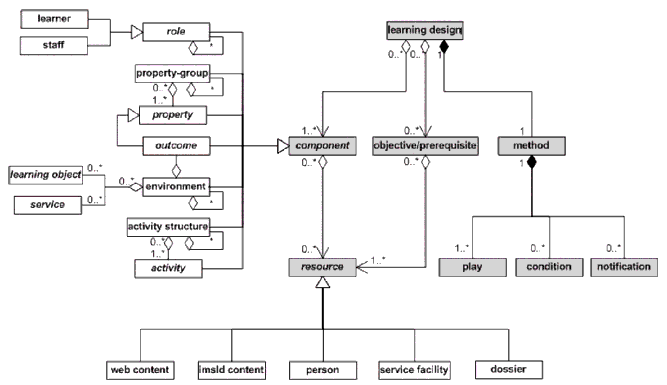
(grey coloring is only used to increase the readability).
The model shows that learning design provides a semantic view of a collection of resources on one hand, and on the other hand it integrates a method, specifying the dynamic aspects of the learning design.
The model shows three levels of semantic aggregation (the three horizontal layers of grey colored classes). The semantically highest level is the learning design, it aggregates a collection of components, objectives/prerequisites (short for: learning objectives & prerequisites), and a method. The lowest level of aggregation are the resource, play, condition, and notification. The resources are aggregated into components and objectives/prerequisites. The plays, conditions, and notifications are aggregated into the method.
A component can be one of seven different types: role, property group, property, activity structure, activity, environment, or outcome. With the exception of outcome, these are all elements in the LD Information Model. Role can be one of two types: learner or staff.
A resource can be one of five different types: web content, imsld content, person, service facility, or dossier. These resources can be referenced from a Learning Design but are not explicitly part of the Information Model.
Specific types of components are bound to specific types of resources. The moment in time when the resource is bound in the learning design differs:
Example: The textual description of a learning objective for instance, can be written during the design and delivered as a fixed resource with the learning design. However also an absolute URL can be provided to a location where the file can be edited at any time.
The resources that are not bound during design time are not part of this specification. This applies to concrete persons and to the actual dossiers of persons. However, the roles that persons can take into the learning design and the properties that have to be present in the dossiers are part of the learning design.
The model also shows that the components, objectives/prerequisites, and resources are independent of the learning design. They can be referenced and used in many other learning designs. However the method has a composite relationship with the learning design meaning that it is an integral part of it and cannot stand on its own and cannot (easily) be re-used in other learning designs.
2.2.2 Conceptual Structure of the Learning Design
Another conceptual view of the learning design is provided in Figure 2.2. In this model, the emphasis is on the functional relationships between the classes.
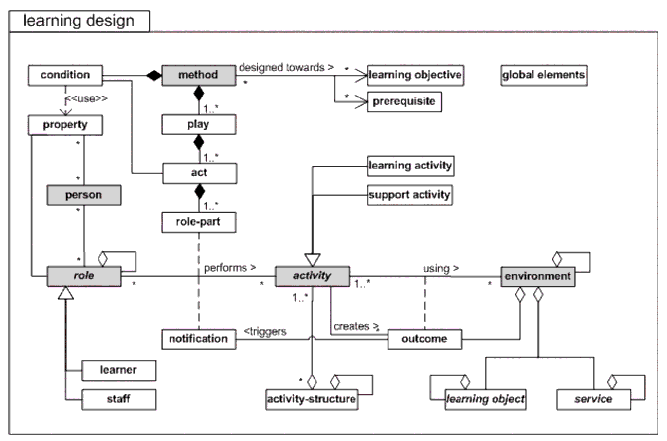
(gray coloring is only used to increase the readability).
The core concept of the Learning Design Specification, as expressed in Figure 2.s, is that regardless of pedagogical approach, a person gets a role in the teaching-learning process, typically a learner or a staff role. In this role he or she works toward certain outcomes by performing more or less structured learning and/or support activities within an environment. The environment consists of the appropriate learning objects and services to be used during the performance of the activities. Which role gets which activities at what moment in the process, is determined by the method or by a notification. Note: most of the concepts mentioned above are reflected in the information model, but some only exist at the conceptual level (person, outcome).
The method is designed to meet learning objectives (specification of the outcomes for learners), and presupposes certain prerequisites (specification of the entry level for learners). The method consists of one or more concurrent play(s); a play consists of one or more sequential act(s) and an act is related to one or more concurrent role-part(s), each role-part associates exactly one role with one activity or activity-structure. The teaching-learning process is modelled in the method on the notion of a theatrical play. A play has acts, and in each act has one or more role-parts. The acts in a play follow each other in a sequence (although more complex sequencing behavior can take place within an act). The role-parts within an act associate each role with an activity. The activity in turn describes what that role is to do and what environment is available to it within the act. In the analogy, the assigned activity is the equivalent of the script for the part that the role plays in the act, although less prescriptive. Where there is more than one role-part within an act, these are run in parallel.
A method may, at level B, contain conditions (i.e., If-Then-Else rules that further refine the visibility of activities and environment entities for persons and roles), by defining Boolean expressions on their properties. A property can be grouped into property-groups. Properties can be of different types, representing respectively global versus local properties and personal versus role properties. This is explained later.
In order to enable users to set and view the level B properties from content that is presented to them, so-called global elements are present in the model. These global elements are designed to be included in any content schema through namespaces. Content that includes these global elements is called 'imsldcontent'.
A notification is triggered by an outcome and can make a new activity available for a role to perform. The person getting the notification is not necessarily the same person who creates the outcome. For instance, when one student completes an activity (= an outcome), then another student or the teacher may be notified and set another activity as a consequence. This mechanism can also be used for learning designs where the supply of a consequent activity may be dependent on the kind of outcome of previous activities (adaptive task setting designs).
The explicit roles specified in this language are those of learner and staff roles. Each of these can be specialized into sub-roles, but no vocabulary is put forward for this. It is left open to the learning designer to name the (sub)-roles and specify their activities. For example, in simulations and games different learners can play different roles, each performing different activities in different environments.
Activities can be assembled into activity-structures. An activity-structure aggregates a set of related activities into a single structure, which can be associated to a role in a role-part. A structure can model a sequence or a selection of activities. In a sequence, a role has to complete the different activities in the structure in the order provided. In a selection, a role may select a given number of activities from the set provided in the activity-structure. This can, for instance, be used to model situations where students have to complete two activities, which they may freely select from a collection of e.g., five activities contained in the activity-structure.
Activity-structures can also reference other Activity-structures and reference external Units of Learning, enabling elaborate structures to be defined if required.
Environments can contain two basic types:
- Located learning objects, typically specified by a URL with optional metadata. A user may further classify these learning objects by means of the vocabulary provided in the 1EdTech LOM Meta-Data (5.2 Learning Resource Type) or the generic 'class' attribute that is available on all elements. In EML [LD1], the learning objects are classified in the following types: knowledge-objects, tool-objects, and test-objects.
- Generic services. A service relates to a concrete service facility available at runtime. During design a service has no URL assigned to it, but must be given a URL when the Learning Design is instantiated at runtime. Examples of a Service include a discussion forum, chat rooms, monitoring tools, search facilities, etcetera. In Learning Design the conditions for setting up a service at runtime are specified at an abstract level. For example, for discussion groups it specifies which learning design roles have what type of access (participant, observer, moderator, etc.).
Note: if a discussion forum is to be used within a learning design, were it given a predefined URL, then all instances of the Unit of Learning that includes the learning design, wherever and whenever instantiated, would have the same one specific discussion forum. While this may lead to serendipitous learning, it is probably not what was intended by the learning designer! (However, should this be desirable, then a normal Resource element with a fixed URL can be provided.)
For this version of the specification, the types of services specified are limiting these to those that are now found in typical LMS systems. It is possible to inherit from a generic service and thus specify new types as extensions to the vocabulary. As many services are targeted for use in a specific instance of a learning design, the actual members will need to have been assigned to roles before the service is instantiated. As different roles may have different permissions within a service, there is the facility to specify these within the particular service definition.
EML included a complete content vocabulary based on the OASIS DOCBOOK specification [LD12]. For Learning Design it was decided not to include any content specification, but let the users of the Learning Design Specification decide which one to use. In order to allow for runtime interactions with the end users, specific global learning design elements are provided separately at level B which can be namespaced into any XML-based content schema. A suggestion is to use XHTML for content and to namespace the global elements of learning design into XHTML.
2.2.3 Unit of Learning = 1EdTech Content Package + 1EdTech Learning Design
The primary use of 1EdTech Learning Design is to model units of learning by including an 1EdTech Learning Design in a content package, preferably - but not necessarily - an 1EdTech Content Package. It this specification it is assumed that 1EdTech Learning Design is being used with 1EdTech Content Packages to model units of learning. How this is done is explained in this section.
1EdTech Content Packages describe their contents in an XML document called the 'package manifest'. The Manifest may include structured 'views' into the resources contained in that package; each 'view' is described as a hierarchy of items called an 'organization'. Each item refers to a Resource that, in turn, can refer to a physical file within the package. It can however also refer to an external resource. Figure 2.3 depicts the entire 1EdTech Content Packaging conceptual model.

The Manifest is the information structure defined in the Content Packaging Specification. It is contained within a package as an XML file with a fixed, pre-defined name (imsmanifest.xml). This enables it to be found amongst the many other content files that may be contained in a package.
The integration of a Learning Design into the Content Packaging Structure is set out in the Figure 2.4.
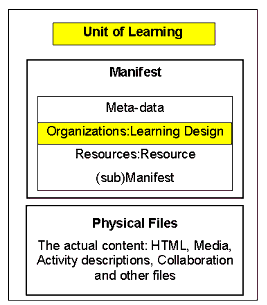
within the Organizations part of 1EdTech Content Packaging
To create a unit of learning, 1EdTech Learning Design is integrated with an 1EdTech Content Package by including the learning design element as another kind of organization within the <organizations> element, using the standard namespace for Learning Design. When the standard namespace is "[standard-namespace-for-learning-design]", then learning design elements are included as follows (ignoring irrelevant elements and attributes):
<manifest>
   <metadata/>
   <organizations>
      <learning-design xmlns="[standard-namespace-for-learning-design]">
         [add learning design elements here]
      </learning-design>
   </organizations>
   <resources/>
</manifest>
The italics have to be filled in with the appropriate namespace and elements respectively.
In a package that includes a learning design element, the optional organization element within organizations is ignored. This mechanism is in conformance with the extensibility mechanisms 1EdTech Content Packages provide. If an organizations element contains a learning design element, any 'organization' element in the same organizations element is ignored and only the learning design element is read by the runtime system. Where other content organization elements are desired, they can be included in sub manifests, as sub packages may be aggregated in the same way as in normal content packages.
2.3 Conceptual Vocabulary of Learning Design
In this section an overview will be given of the basic conceptual terms of the Learning Design Specification.
Unit of Learning
A learning design is an integral part of any unit of learning. A 'unit of learning' is an abstract term used to refer to any delimited piece of education or training, such as a course, a module, a lesson, etc. It is noted that a 'unit of learning' represents more than just a collection of ordered resources to learn, it includes a variety of prescribed activities (problem solving activities, search activities, discussion activities, peer assessment activities, etcetera), assessments, services and support facilities provided by teachers, trainers and other staff members. Which activities, which resources, which roles and which workflow is dependent on the learning design in the unit of learning. A unit of learning can be modelled as an 1EdTech Content Package by including an 1EdTech Learning Design in the package.
An 1EdTech content package is called a 'Unit of learning' if and only if it includes a valid 1EdTech learning-design element in the organizations part of the package's manifest. A Unit of Learning includes a manifest, a learning design, resources, possible (sub-) manifests and physical files.
Learning Design
A learning design is a description of a method enabling learners to attain certain learning objectives by performing certain learning activities in a certain order in the context of a certain learning environment. A learning design is based on the pedagogical principles of the designer and on specific domain and contexts variables (e.g., designs for mathematics teaching can differ from designs for language teaching; designs for distance education can differ from designs which integrate face-to-face settings). Several hundreds of designs are described in literature, each based on different assumptions about the teaching and learning process [LD5]. In daily practice, most teachers and trainers apply their own principles of learning. This leads to a countless number of possible design solutions for the same content domain. In order to allow all these different designs to be effectively included into e-learning modules, the approach of a meta-language is taken, enabling the description of all kinds of learning designs without forcing a specific solution on the designers.
The Learning Design element is the root element for the Learning Design Specification. It includes the core set of elements added by the Learning Design Specification to the existing Content Packaging Specification. It provides a semantically structured view on the resources along with learning process information. The following terms are the key additions.
Learning Objectives
The learning objectives are the overall learning objectives to be attained by learners who complete the unit of learning. Learning objectives can be specified on several levels of detail. In 1EdTech Learning Design, designers can choose to specify learning objectives at two levels, each with advantages and disadvantages. First, it is possible to define the learning objectives at the global level of the unit of learning. Second, it is possible to specify learning objectives for every single activity in the learning design. Designers can follow several approaches:
- define the learning objectives only at the level of the unit of learning as a whole, not indicating the sub-objectives of the individual learning activities or what they add to the overall objectives.
- define the learning objectives only per learning-activity and not globally for the unit of learning. The learning objective for the unit of learning is nothing more or less than the list of all the learning objectives specified in the different learning activities.
- define the learning objectives on both levels: the learning objectives at the unit of learning level can be described more abstractly than those at the activity level.
Prerequisites
The prerequisites specify the overall entry requirements for learners for doing the unit of learning. As with learning objectives, the prerequisites can be provided at the level of the unit of learning and/or for individual learning activities.
Learning objectives and prerequisites can be described using the 1EdTech Reusable Definition of Competency or Educational Objective (RDCEO) format, but can also refer to simple resources (e.g., a text) with a description of the learning objective.
Components
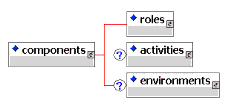
These are the declarations of the different components that provide the 'building blocks' for the method section of the learning design. In Learning Design Level A these are: roles, activities, and environments In Learning Design Levels B and C these are: roles, properties, activities, and environments. The components are declared separately from the method to avoid duplication in the method when using the same component more than once. The component and the method sections can be compared to a cooking recipe: the components are the list of ingredients and the method is the preparation instructions.
Roles
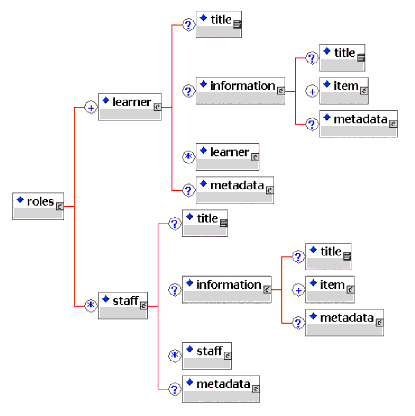
Roles allow the type of participant in a unit of learning to be specified. There are two basic Role types: Learner and Staff. These however can be sub-typed to allow learners to play different roles in certain types of learning activity such as task-based, role-play and simulations. Similarly support staff can be sub-typed and given more specialized roles, such as Tutor, Teaching Assistant, Mentor, etc. Roles thus lay the basis for multi-user models of learning.
The name a role is given depends on the pedagogy and setting used. In some instances a learner is called a 'student' in others a 'participants'. The names of staff roles are even more variant, e.g., teacher, trainer, tutor, facilitator, mentor, assessor. Every role can have its own 'title' which provides the name for it.
At runtime more than one user can be assigned to the same role, however restrictions can be set on the maximum and minimum number for each role. In this sense roles can be used for grouping purposes.
Properties
Properties are only available in level B and C of the Learning Design Specification. They form the basis on which to build user and role dossiers and portfolios. Properties are an essential part of monitoring, personalization, assessment and for user-interaction. Learning Design supports five types of properties: local properties, local-personal properties, local-role properties, global-personal properties and global properties. Furthermore, properties can be grouped to e.g. create forms. The local properties are declared in the learning design. The global properties are expected to be declared externally, but a mechanism is included to declare new global properties when they are not present.
Global Elements
In Levels B and C, in order for users to be able to set and view properties during the teaching and learning process, global elements are provided as a separate part of the 1EdTech Learning Design Specification. There are four global elements: set-property, view-property, set-property-group, and view-property-group. The set-property element enables a user control in a Web (or other) interface to change the current value of a specific property. The view-property element shows the property value of a selected property to the user as part of the learning content. The set-property-group and view-property-group elements do the same for a set of properties. Global elements are not a part of the learning-design tree, but are provided separately. They are designed to be included in any XML content schema by use of XML namespaces (e.g., for inclusion in XHTML). Without these elements it is not possible to access or set the properties. Content that uses global elements must be given a specific resource type (referring to the type attribute of the resource element of 1EdTech Content Packaging), namely 'imsldcontent' instead of 'webcontent'. In the future, the set of global elements available for inclusion in content schemas can be extended.
Activities
Activities are one of the core structural elements of the 'learning workflow' model for learning design. They form the link between the roles and the learning objects and services in the learning environment. They describe the activities a role has to undertake within a specified environment composed of learning objects and services. They also specify their termination conditions and the actions to be taken on termination. There are two basic types of activities: learning activities and support activities. A learning activity is directed at attaining a learning objective per individual user. Any user performs a learning activity only once (until completion). A support activity is meant to facilitate a role performing one or more learning activities. More than one person can be assigned to a role in runtime. In practice this means that a support activity has to be performed as many times as there are users in the supported role.
Activities can be aggregated into an activity-structure which provides the mechanisms to structure activities and referenced units of learning into a sequence or a user-selection.
An activity references the environment in which the activity must be executed. For the execution of any activity, a user needs, at a minimum, an activity description and, optionally, an environment with the learning objects and services needed to perform the activity.
Learning Activity
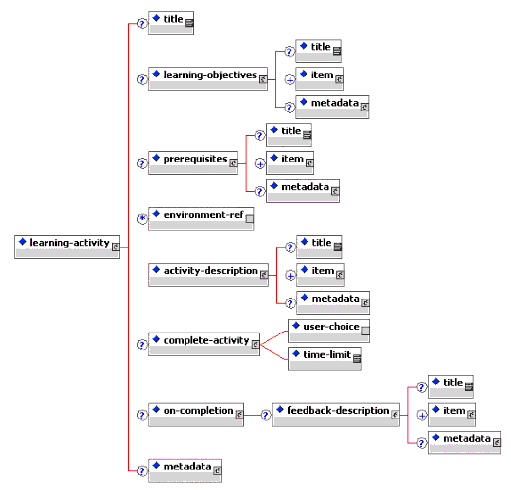
A Learning Activity consists of a single activity-description and several optional elements. The activity-description is the actual cue given to the user (rendered in the user-interface) to describe the activity to be performed by the user. In most cases the activity-description is a text (of type webcontent). In other cases it can be an audio-file (webcontent), a video file or any other cue to the user. Whatever forms it takes, the activity-description is referenced via an <item> element, derived from Content Packaging, referencing a resource element in the content package.
In addition to Environment reference(s), the other optional elements include:
title, 1EdTech metadata, learning-objectives, prerequisites (see above), and the new elements: complete-activity (which specifies when an activity is completed, in Level A either by user-choice, or on reaching a time-limit, and extended by Level B with when-property-value-is-set), and on-completion (which specifies actions that are to be executed on completion of the activity).
In level A, on-completion contains only one element, feedback-description, which references content to be displayed to the user when they finish.
on-completion is further extended at level B by the change-property-value element, and at Level C by the notification element).
Support Activity
A Support Activity consists mostly of the same elements as a Learning Activity, but without the learning-objectives, prerequisites, and with a role-ref element added. The role-ref element indicates who will be supported by this activity. The supported role can have more than one person in the role. This means in practice that the support activity has to be repeated for every user in the supported role before it is completed. This is a key difference from learning activities, which is only performed once. Example: a staff role has the support activity to grade reports made by persons in the learner role named 'student'. Every person being a student creates his/her own report. The tutor grades every report (repeating the 'grade report' support activity).
Activity-Structure
An Activity-structure in turn consists of references to one or more of:
- A Learning Activity
- A Support Activity
- An (sub) Activity-structure
- Another (separate) Unit of Learning
In the case of the Unit of Learning, the reference is an HREF to the Unique Resource Identifier (URI) of the unit of learning. This URI can be any worldwide unique identifier, including a URL (as it is used in the W3C namespace specification to identify unique namespaces). When using 1EdTech Content Packaging, this means that it refers to the 'identifier' attribute of the manifest, which must be a worldwide unique identifier of some format.
Like the single Activities, an Activity-structure may reference one or more environments. This allows for learning design models where a series of different activities are performed within the same environment. When an activity-structure references one or more environments, then these will overrule the environments specified within the referenced activities.
The environments will not be inherited between hierarchical levels of the Activity-structure, allowing environments to be omitted as well. As a consequence, for each hierarchical level of the Activity-structure the appropriate reference to an environment has to be made and possibly repeated.
A structure may contain information. This provides a CP Organization/Item structure which provides links to resources which contain further information about the activity-structure.
Environment
Activities take place in a so-called 'environment', which is a structured collection of learning objects, services, and sub-environments. The relationship between an activity and an environment can be derived from the linguistic description of the activities. Most nouns in the activity imply the availability of learning objects in the environment; references to other persons imply the availability of communication services; some verbs imply the availability of supportive services or tools. For instance the activity: 'read the problem and discuss solutions with your peers' refers to environment components: 'the problem' which must be available for reading; and 'peers' which must be available to communicate with (including communication means).
Learning Object
Learning objects are defined here, as any reproducible and addressable digital or non-digital resource used to perform learning activities or support activities. In 1EdTech Content Packaging they are represented with the element 'Resources'. Examples are: web pages, text books, productivity tools (text processors, editors, calculators, ...), instruments (microscope, etc.), test items. A classification of different types of learning objects can be found in the LOM specification (element 5.2 Learning Resource Type makes a distinction between: exercise, simulation, questionnaire, diagram, figure, graph, index, slide, table, narrative text, exam, experiment, problem statement, self assessment, and lecture). A Learning Object may reference any of these types. However this assumes a runtime system that will be able to handle them.
Service
Besides resources which can be defined at design time, there are numerous so-called 'service facilities' used during the teaching and learning, for instance, a discussion forum or some other communication facility. Service facilities are resources that cannot be given a URL at design time. They have to be instantiated by a local runtime service. This is because, if a service facility is bound at design time, then that specific service would have to be used by all users of all instances of the learning design. When what is needed is an instance of the service that is unique to the runtime instance of the learning design and its assigned users, (e.g., if a chat forum is to be dedicated to the use of a specific group of learners and support staff associated with an particular instance of a learning design), then this has to be created and the local URL assigned after the instance of the design has been set up and the group of learners and staff associated with it. For this to work, it requires a well defined set of service types, which are known to the runtime service, such as chat, discussion forum, announcement channel etc. These are now commonly found in learning management systems. In a learning design, the use and setup of such a service is declared at an abstract level, so that a runtime facility (or a human) can setup the necessary facility according to the requirements. In the learning design specification, the abstract declaration of a service facility is called a 'service'. The instantiation of a service is called a 'service facility'.
Current service types are: send-mail, conference, monitor (level B), and index search. The selection of services to be included needs to be driven by the community. We therefore decided to start with the most widely implemented and used services in online learning environments.
Send-Mail Service
One of the services in any online learning facility is the ability to send and receive mail. This is done with an e-mail client. However, in learning situations it is often needed to know all the e-mail addresses of your fellow students and teachers when sending to groups. This information is available in the runtime system. In order to help users to send e-mail to other users in the same run of the unit-of-learning, the declaration of a send-mail facility is included in the services part. When a send mail service is included as part of a user's environment, the runtime system must provide a facility to edit a message and attachments and to send them to a selected list of e-mail addresses of users in the run of the unit-of-learning. This can either be to all the users in a specific role or to individuals selected from a role. The users receive the messages in their regular inbox in the e-mail client.
Conference Service
A typical communications service is a conference. The conference service, in addition to a title and metadata, specifies four conference system roles: participant, observer, conference-manager, and moderator. These contain references to roles in the learning design. When the learning design roles have been assigned players, this information can be used to automatically set up the dedicated conference space. It is not defined in this Learning Design Specification what permissions the conference roles should have, so this is left up to the implementer. However, these conference roles have commonly understood meanings and learning designers would have the expectation that implementers would stay within this range.
The conference service can be divided into three subtypes: synchronous conferences (like chats and audio/video conferences), asynchronous conferences (like newsgroups, forums), and announcements (one to many asynchronous conferences).
Monitor Service
The monitor service provides a facility for users to look at their own properties or that of others in a structured way. The idea is that the author defines IMSLD content (e.g. XHTML tables with global view-property elements) to view the properties. This IMSLD content is referred to with the 'item' element. When creating a monitor object, the author has to choose between allowing the user to see the properties of their own dossier ( 'self' ), or those of all the users in the specified role. With a monitor object, one can look at the properties in the dossier of 'self' or in the dossiers of all users in a certain role. When 'self' is selected, every property has exactly one value. When a role is selected, the properties in the dossiers of all the users in the specified role may be viewed. In this case the learning designer has to be careful, because only one view-property is specified, but the effect is recurrent for every user in the role. This means that the list in the user interface must be extended automatically when parsing the content:
- when the view-property is in a text line without other view-properties on the same line (all outside tables), then a list of values is created, each separated with a linefeed and carriage return.
- when there is more than one view-property in a text line (outside tables), then a list of values is created, each separated with a linefeed and carriage return and grouped per line in conformance with the grouping of the view-properties.
- when the view-property is in a table, than for each user in the role a new row in the table is created.
Index-Search Service
The Index-Search service enables a unit-of-learning to be indexed, and searches to be then made across it. In addition to title and metadata elements, it includes an index element and a search element.
The index element is a wrapper for indexing aspects, used to set up a search service.
The index is made in the background (not visible to users). The visibility is determined with the search element.
The functionality of the index is dependent on the search element:
- when search is free-text-search, then the index is made on the resource pointed at in the index (i.e., the underlying html texts).
- when search is index-with/without-reference, then an index is only made of the elements which share the same class, including underlying items. This has the form of a table of contents.
The search element specifies how a user can access the indexed entities. There are three possibilities:
- the user gets a free text search dialog, where he can search the index in a free text format (this also means that the index has to be build for free text retrieval). The syntax for free text retrieval is implementation dependent (e.g., the format found in search engines like Google or Altavista).
- the user is presented a text index (table of content) with (hyper-)linked (or on other media e.g., page numbers) references to the source.
- the user is presented a text index (table of content) without (hyper-)linked references. This provides e.g., information about the structure of the unit of learning.
Method
The method contains two core parts of the Learning Design Specification: the play and conditions, along with some completion and on-completion statements.
Play
The core part of the learning design is represented in the 'play'. A play specifies the actual learning design, the teaching-learning process, referring to the components declared earlier. In the play, it is specified which roles perform what activities in what order. When reading a learning design one basically reads the play. This is true for human readers as well as machines. Components not referenced in the play are not shown in the runtime system. A play is modelled according to a theatrical play with acts and role-parts. In general: a play consists of a sequence of acts. In each act, different activities are set for different roles and are preformed in parallel. When an act is completed, the next act starts until the completion requirements for the learning design are met.
Conditions
Conditions are only available in Levels B and C of the 1EdTech Learning Design. They are used in conjunction with properties to further refinement and to add personalization facilities in the learning design.
Conditions have the basic format: IF [expression] THEN [show, hide, or change something or notify someone].
The expressions are mostly defined on the properties of the dossier of a learner (e.g., IF pre-knowledge-english="4"). The effects of a condition are mostly different for individual users, although they can be assigned to the same role. Conditions work in the context of the current active act. In practice, conditions are mostly useful within activity-structures of the type 'selection'.
Notification
Notifications are only available at Level C of the Learning Design Specification. With notifications it is possible to send a message to a role or to assign new learning or support activities to roles based on certain events. These events are:
- the completion of a certain activity.
- the completion of a certain act.
- the completion of a play.
- the completion of the unit of learning.
- when an expression in a certain condition is true.
- when a certain property-value has been changed.
Item
When a component, a learning objective, or a prerequisite needs a resource, an 'item' element is used in the similar way as in the organization part of 1EdTech Content Packaging. The learning design provides a semantic context for these items, so that runtime systems can know what to do with the resource. For example in the following case:
<learning-objectives><item identifierref="o123"/></learning-objectives> it is clear that the resource with identifier 'o123' is a learning objective description. In the case of:
<activity-description><item identifierref="o345"/></activity-description> the item is an activity description. A runtime system can position the learning objectives in a certain place in the user-interface, different from the activity-description, and activity-descriptions can be handled differently from other learning content (this can vary from implementation to implementation, within the boundaries of the behavior descriptions provided in this information model).
3. Information Model
The information model for the level A, B, and C will be presented in the following format:
- The conceptual UML model, derived from Figure 2.2, showing only the elements that are appropriate for this level. The items not used are deleted.
- Tree diagrams representing successive parts of the learning-design and global-elements tree.
- Information tables of parts of the information structure. The diagrams and tables are successively unpacked.
Note: Due to the table format, the same elements are often described more than once in different tables. The description of the elements in the different tables is kept exactly the same, as they are generated from UML diagrams [LD17]. When the same element occurs more than once in a table, the information is not repeated, but referred to with 'see above'.
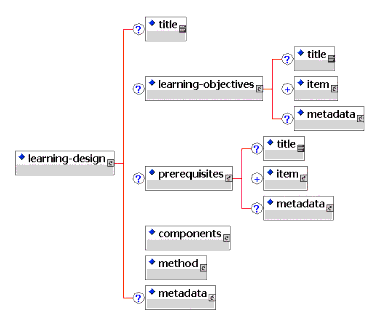
The diagrams use the following format:
- Only elements are shown (no attributes).
- The diagrams are tree structures, to be read from left to right. An element to the left contains the elements at the right hand. The element most to the left is the top of the tree.
- Only two trees are represented in this whole document: a tree with top level 'learning-design' and a small tree with top level 'global-elements'. The tree 'learning-design' is successively unpacked for presentation purposes. This is done in the order from left to right and from top to bottom of the tree. Elements that are completely unpacked are not further expanded in subsequent diagrams.
- An OR relationship in the diagrams is represented with <
- An AND relationship in the diagrams is represented with [
- * means that the element occurs zero or more times in the container
- + means that the element occurs one or more times in the container
- ? means that the element is optional
- When not one of the symbols (*, +, ?) is placed before the element name, the element occurs exactly one time.
The tables describe the elements and attributes of the diagram under which they are positioned. Tables have the following format:
3.1 Level A Information Model
3.1.1 Conceptual Model
The conceptual UML model for Level A is in Figure 3.1.
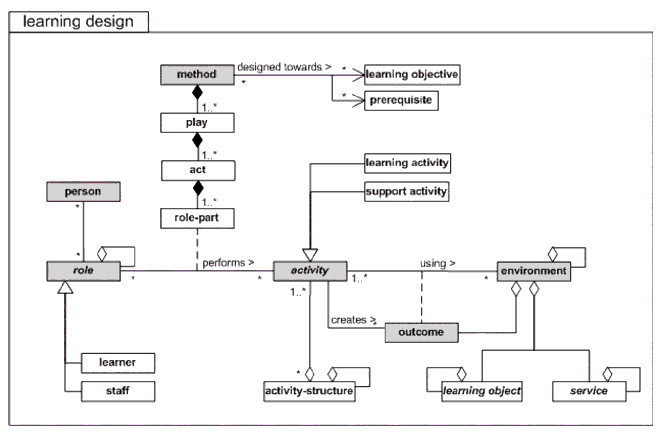
3.1.2 Information Table 'learning-design'
3.1.3 Information Table 'item model'
See previous diagram. This information table comes from 1EdTech Content Packaging.
3.1.4 Information Table 'components'
3.1.5 Information Table 'roles'
3.1.6 Information Table 'activities'

3.1.7 Information Table 'learning-activity'
3.1.8 Information Table 'support-activity'
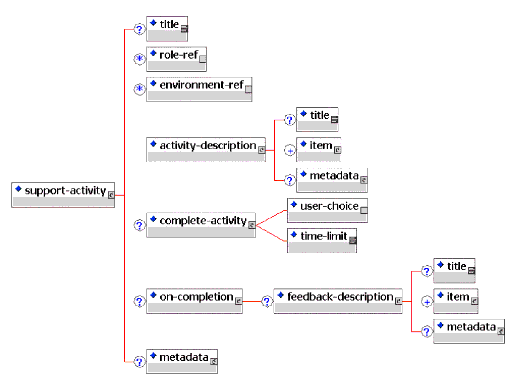
3.1.9 Information Table 'activity-structure'
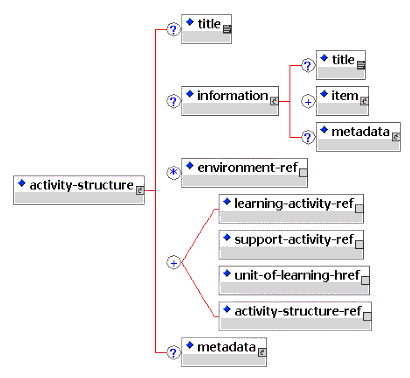
3.1.10 Information Table 'environments'
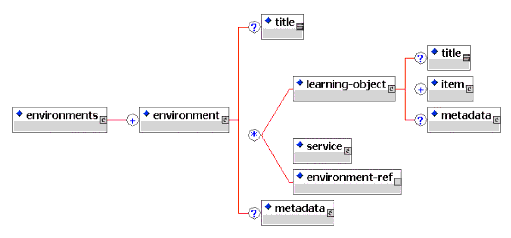
| environments | |||||
|---|---|---|---|---|---|
| No. | Name | Explanation | Reqd | Mult | Type |
| 0 | environments | Container for the environment elements. | - | - | container |
| 0.1 | environment | Contains a sequence of elements to model an environment. 1EdTech Simple Sequencing elements can be namespaced into the environment, to support the further sequencing of the environment elements. When there is no sequencing information provided, all elements that are specified in the environment will be shown to the user in the order and hierarchy provided, given that there are no further conditions defined that influences the visibility of the environment or the elements it contains. | M | 1..* | sequence |
| 0.1.1 | identifier | An identifier that is unique within the learning design file (ID). | M | 1 | ID |
| 0.1.2 | title | A short name given to the resource, suitable for rendering in user-agents. | O | 0..1 | string |
| 0.1.3 | |
Choice | O | 0..* | choice |
| 0.1.3.1 | learning-object | Learning objects are incorporated either by using an included schema (e.g. 1EdTech QTI) or by referencing resources through the item elements. 1EdTech Simple Sequencing elements can be namespaced into the learning-object, to support the further sequencing of the item elements. When there is no sequencing information provided, all items that are specified in the learning-object will be shown to the user in the order and hierarchy provided, given that there are no further conditions defined that influences the visibility of the items or the learning-object. | M | 1 | choice |
| 0.1.3.1.1 | class | The class attribute refers to the value of class attributes available in learning-design or content elements. Contains a CDATA string. Just as in HTML more than one class may be specified in one CDATA string, each separated with a blank space. The priority order for classes is the same as specified in the CSS specification (see http://www.w3.org/style/css ). Any element can in principle have the class attribute. 'Class' is a global defined W3C attribute for HTML 4.0 and XHTML [LD14]. This attribute assigns a class name or set of class names to an element. Any number of elements may be assigned the same class name or names. Multiple class names must be separated by white space characters. The class element can be used for semantic grouping of elements and be manipulated by IMSLD conditions and stylesheets. When sending a learning object to a web client, include the class attribute and value(s). | O | 1 | string |
| 0.1.3.1.2 | identifier | See above | M | 1 | ID |
| 0.1.3.1.3 | isvisible | Initial visibility attribute; possible values: true (default) or false. Possible values:true, false Default value:true |
O | 1 | boolean |
| 0.1.3.1.4 | parameters | Parameters to be passed during runtime. | O | 1 | string |
| 0.1.3.1.5 | type | The type of learning object (e.g. knowledge-object, tool-object test-object). Vocabulary used can be the one of 'learning resource type' element from the IEEE LTSC LOM. | O | 1 | string |
| 0.1.3.1.6 | |
Sequence | M | 1 | sequence |
| 0.1.3.1.6.1 | title | See above | O | 0..1 | string |
| 0.1.3.1.6.2 | item | A node in a structure, referring to a resource. | M | 1..* | sequence |
| 0.1.3.1.6.2.1 | identifier | See above | O | 1 | ID |
| 0.1.3.1.6.2.2 | identifierref | Refers to an identifier of a resource in the content package (outside the learning design). | O | 1 | IDREF |
| 0.1.3.1.6.2.3 | isvisible | See above | O | 1 | boolean |
| 0.1.3.1.6.2.4 | parameters | See above | O | 1 | string |
| 0.1.3.1.6.2.5 | title | See above | O | 0..1 | string |
| 0.1.3.1.6.2.6 | item | See above | O | 0..* | sequence |
| 0.1.3.1.6.2.7 | metadata | Placeholder for metadata. Include 1EdTech Meta-Data here, using its namespace. | O | 0..1 | sequence |
| 0.1.3.1.6.3 | metadata | Placeholder for metadata. Include 1EdTech Meta-Data here, using its namespace. | O | 0..1 | sequence |
| 0.1.3.1.7 | |
Sequence | M | 1 | sequence |
| 0.1.3.1.7.1 | schema | Indicate the schema to be used. | O | 0..1 | string |
| 0.1.3.1.7.2 | schemaversion | Indicate the version of the schema to be used. | O | 0..1 | string |
| 0.1.3.1.8 | {itemmodel} | A schema group. | M | 1 | group |
| 0.1.3.2 | service | A service is a declaration of a service facility which has to be bound during instantiation of a run of a unit of learning. To automate the set up process of a service facility from a service declaration, the runtime data from the instantiated learning design would be translated into a configuration format used by the conference system if the conference is to be automatically set up. This is an implementation issue. It is also possible that a system manager could read this information and set up the required conference space manually, but the intent is to alleviate the manager of this task by enabling it to be automated. The service specification is extensible by namespacing in additional services. When instantiating a service, the runtime systems needs to maintain a handle on the 'context' to which the service is to be bound and determine the users to whom the service is being made available. A service will be referenced by an item element's identifierref attribute. The item will be within an environment. The environment in turn will be associated with an activity, or possibly directly with a role-part, associating it with a role. The activity or role-part forms the context for the use of the service. The users playing the role are those that have access to the service. | M | 1 | choice |
| 0.1.3.2.1 | class | See above | O | 1 | string |
| 0.1.3.2.2 | identifier | See above | M | 1 | ID |
| 0.1.3.2.3 | isvisible | See above | O | 1 | boolean |
| 0.1.3.2.4 | parameters | See above | O | 1 | string |
| 0.1.3.3 | environment-ref | Refers to an environment in this package. | M | 1 | empty |
| 0.1.3.3.1 | ref | Refers to an identifier within the learning design. | M | 1 | IDREF |
| 0.1.4 | metadata | Placeholder for metadata. Include 1EdTech Meta-Data here, using its namespace. | O | 0..1 | sequence |
3.1.11 Information Table 'service'
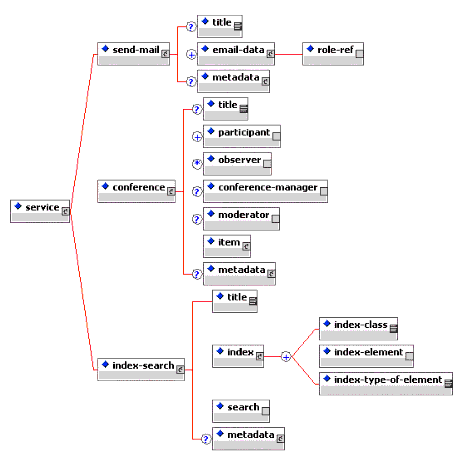
| service | |||||
|---|---|---|---|---|---|
| No. | Name | Explanation | Reqd | Mult | Type |
| 0 | service | A service is a declaration of a service facility which has to be bound during instantiation of a run of a unit of learning. To automate the set up process of a service facility from a service declaration, the runtime data from the instantiated learning design would be translated into a configuration format used by the conference system if the conference is to be automatically set up. This is an implementation issue. It is also possible that a system manager could read this information and set up the required conference space manually, but the intent is to alleviate the manager of this task by enabling it to be automated. The service specification is extensible by namespacing in additional services. When instantiating a service, the runtime systems needs to maintain a handle on the 'context' to which the service is to be bound and determine the users to whom the service is being made available. A service will be referenced by an item element's identifierref attribute. The item will be within an environment. The environment in turn will be associated with an activity, or possibly directly with a role-part, associating it with a role. The activity or role-part forms the context for the use of the service. The users playing the role are those that have access to the service. | - | - | choice |
| 0.1 | class | The class attribute refers to the value of class attributes available in learning-design or content elements. Contains a CDATA string. Just as in HTML more than one class may be specified in one CDATA string, each separated with a blank space. The priority order for classes is the same as specified in the CSS specification (see http://www.w3.org/style/css ). Any element can in principle have the class attribute. 'Class' is a global defined W3C attribute for HTML 4.0 and XHTML [LD14]. This attribute assigns a class name or set of class names to an element. Any number of elements may be assigned the same class name or names. Multiple class names must be separated by white space characters. The class element can be used for semantic grouping of elements and be manipulated by IMSLD conditions and stylesheets. When sending a learning object to a web client, include the class attribute and value(s). | O | 1 | string |
| 0.2 | identifier | An identifier that is unique within the learning design file (ID). | M | 1 | ID |
| 0.3 | isvisible | Initial visibility attribute; possible values: true (default) or false. Possible values:true, false Default value:true |
O | 1 | boolean |
| 0.4 | parameters | Parameters to be passed during runtime. | O | 1 | string |
| 0.5 | send-mail | This service is used to send mail to users in roles (with mail address in property for level b/c). | M | 1 | sequence |
| 0.5.1 | select | Fixed choice: 'all-persons-in-role' or 'persons-in-role'. With the first choice, the user agent only allows messages to be sent to the role, indicating that all persons in the role get the message. With the second choice, the user agent allows a user to select one or more individuals within the specified role to send the message to. Possible values:all-persons-in-role, persons-in-role |
M | 1 | token |
| 0.5.2 | title | A short name given to the resource, suitable for rendering in user-agents. | O | 0..1 | string |
| 0.5.3 | email-data | This is used for send-mail purposes (as a service in the environment, or in notifications). In level B, the properties on this element refer to the property resources where the relevant e-mail data can be found for the connected role. In level A, the source is not specified explicitly and is left to implementers to decide how to address the data needed. Both properties (email, username) should be available for all persons assigned to the role and also for the sending party. | M | 1..* | container |
| 0.5.3.1 | role-ref | Refers to the identifier of the resource of the role. The element can be used as an operand in an expression. | M | 1 | empty |
| 0.5.3.1.1 | ref | Refers to an identifier within the learning design. | M | 1 | IDREF |
| 0.5.4 | metadata | Placeholder for metadata. Include 1EdTech Meta-Data here, using its namespace. | O | 0..1 | sequence |
| 0.6 | conference | The elements participant, observer, conference-manager, moderator facilitate the setting of the user rights in the conferences. They each contain a role-ref which associates them with a role in the learning design. If more than one role is to be assigned to a conference role (e.g. several LD roles are to be participants) then several instances of the conference role are needed, one for each LD role. It depends on the implementation how a conference is set up and managed: 1. When the conference system is an integral part of the runtime system, it is expected to be set up automatically; 2. When the conference is external, the user-rights can be set manually by the conference manager. The conference manager must be able to get a list from the runtime agent about which conferences of what type, for what users, with what rights, need to be set up. 3. Using the data in this conference element, the conferences can also be set up by a generating scripts, configuration files or a legacy interface to the rights management system of the conferencing system. In all instances the runtime system must be able to provide this information in a structured way. The item element refers to the resource where the conferencing system is to be found or identified. External conferencing systems can be of any kind accessible through the internet (resource type is webcontent). Examples: netmeeting, placeware (synchronous), first-class, lotus notes, news groups (asynchronous). An announcement object sets the rights: creator of announcement = participant. Reader of announcements = observer. | M | 1 | sequence |
| 0.6.1 | conference-type | Fixed choice to specify the type of conference facility that is expected to be present at runtime: synchronous, asynchronous or announcement. Possible values:synchronous, asynchronous, announcement |
M | 1 | token |
| 0.6.2 | title | See above | O | 0..1 | string |
| 0.6.3 | participant | Specifies who the participants are in the conference. Participants can read (listen/see) the information, and can contribute to the conference. This element has an effect on setting the user rights in the conference. At least one role must be specified to identify the participants in the conference. | M | 1..* | empty |
| 0.6.3.1 | role-ref | Refers to a role identifier. | M | 1 | IDREF |
| 0.6.4 | observer | Specifies who the observers are in the conference. Observers have only reading rights; they may not contribute. This element has an effect on setting the user rights in the conference. | O | 0..* | empty |
| 0.6.4.1 | role-ref | See above | M | 1 | IDREF |
| 0.6.5 | conference-manager | The conference manager is allowed to create new sub conferences and delete conferences he/she created. The new conferences are children of the existing base conference. The conference manager may not delete the base conference. It is deleted by system management when deleting the information of the (completed) run of the unit of learning. The conference manager has all the rights of observer, participant. | O | 0..1 | empty |
| 0.6.5.1 | role-ref | See above | M | 1 | IDREF |
| 0.6.6 | moderator | Specifies who the moderators are in the conference. Moderators are persons who have the right to control and change the contributions of participants before they are made visible to other participants or observers. When a moderator is specified it means that participants may not contribute directly to the conference, but via the moderator. The moderator can reject, adapt or accept a proposed contribution of a participant. In all cases the contributor is notified of the judgment of the moderator. When there are more users in the role connected to the moderator, all have the same rights, but always the first one who did the job decides. This element has an effect on the setting of the user rights in the conference. | O | 0..1 | empty |
| 0.6.6.1 | role-ref | See above | M | 1 | IDREF |
| 0.6.7 | item | A node in a structure, referring to a resource. | M | 1 | sequence |
| 0.6.7.1 | identifier | See above | O | 1 | ID |
| 0.6.7.2 | identifierref | Refers to an identifier of a resource in the content package (outside the learning design). | O | 1 | IDREF |
| 0.6.7.3 | isvisible | See above | O | 1 | boolean |
| 0.6.7.4 | parameters | See above | O | 1 | string |
| 0.6.7.5 | title | See above | O | 0..1 | string |
| 0.6.7.6 | item | See above | O | 0..* | sequence |
| 0.6.7.7 | metadata | Placeholder for metadata. Include 1EdTech Meta-Data here, using its namespace. | O | 0..1 | sequence |
| 0.6.8 | metadata | Placeholder for metadata. Include 1EdTech Meta-Data here, using its namespace. | O | 0..1 | sequence |
| 0.7 | index-search | Contains a sequence of elements that declare an index and/or search service facility. | M | 1 | sequence |
| 0.7.1 | title | See above | O | 0..1 | string |
| 0.7.2 | index | A choice of elements to specify indexing aspects, used to set up a search service. The index is made in the background (not visible to users). The visibility is determined with the search element. The functionality of the index is dependent on the search element: - When search is free-text-search, then the index is made on the resource pointed at in the index (i.e. the underlying html texts). - When search is index-with/without-reference, than only an index is made of the elements which share the same class, including underlying items. This has the form of a table of content. | M | 1 | choice |
| 0.7.2.1 | index-class | This element selects the class to make the index on. Only one class item per element may be provided. Example: <index-class index-class="problemdescription"/> makes an index on all objects in the design which have one of the strings in the class attribute assigned to "problemdescription". | M | 1 | string |
| 0.7.2.2 | index-element | This element selects the element to make the index on. The index attribute specifies the element to index-on (only one reference per index-element). This indexing only makes sense when there is a structure to index on, or underlying text to index for free-text-search. | M | 1 | empty |
| 0.7.2.2.1 | index | Refers to the element to make the index of. | M | 1 | IDREF |
| 0.7.2.3 | index-type-of-element | In this element the type of element to index on is entered. Only one element name per index-type-element occurrence. The element names much match the element names uses in the IMSLD schema. E.g.: <index-type-of-element>learning-activity</index-type-of-element> | M | 1 | string |
| 0.7.3 | search | This element specifies how a user can access the indexed entities. There are three possibilities: 1. The user gets a free text search dialog, where he can search the index in a free text format (this also means that the index has to be build for free text retrieval). The syntax for free text retrieval is implementation dependent, e.g. the format found in search engines like Google or Yahoo. 2. The user is presented a text index (table of content) with (hyper-) linked (or on other media e.g. page numbers) references to the source. 3. The user is presented a text index (table of content) without (hyper-) linked references. This provides e.g. information about the structure of the unit of learning. | M | 1 | empty |
| 0.7.3.1 | search-type | Fixed choice to indicate the type of search facility that is expected at runtime: free-text-search, index-with-reference, index-without-reference. A free text search uses a free text search index. An index without reference is a list of terms without page-numbers or hyperlinks. An index with references use page-numbers or hyperlinks (depending on the publication medium used). Possible values:free-text-search, index-with-reference, index-without-reference |
M | 1 | token |
| 0.7.4 | metadata | Placeholder for metadata. Include 1EdTech Meta-Data here, using its namespace. | O | 0..1 | sequence |
3.1.12 Information Table 'method'

3.1.13 Information Table 'play'
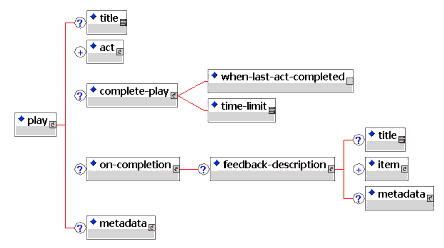
3.1.14 Information Table 'act'
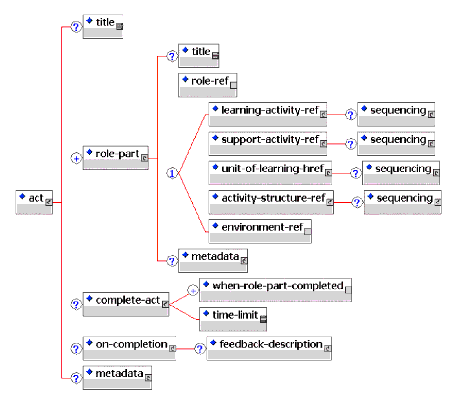
3.1.15 Standard Name for the Unit of Learning Manifest File
Like any 1EdTech Content Package, the manifest file of a unit of learning has a pre-defined name and location. The file (named 'imsmanifest.xml') is placed in the root of the package interchange file or any other packaging image like a CD-ROM. It is required that the name is kept in all lowercase letters. It would be desirable for a runtime system to know what specifications can be expected to be present in the content package (QTI, LD, SS, etc.). At the moment, no profiling mechanism is present to inform the parser or runtime before reading the file what facilities have to be present. This is a possible future specification to be provided by 1EdTech.
3.1.16 Standard Namespace for 1EdTech Learning Design Elements
The namespace to use for the learning design schema elements is: http://www.imsglobal.org/xsd/imsld_v1_p0
3.2 Level B Information Model
Level B provides additional elements, which significantly extend the ability of a learning designer to control the learning flow within a Unit of Learning. The main elements added are:
The addition of properties and conditions affect different models:
- The model of components is extended with the element properties, this is the place where the properties are declared.
- The model of complete-activity, complete-act, complete-play and complete-unit-of-learning are extended to include the element when-property-value-is-set.
- The model of on-completion is extended to include the element change-property-value.
- The model of service is extended to include the element monitor.
- The model of email-data is extended with two attributes (email-property-ref and username-property-ref) referring to global properties with data.
- The model of time-limit is extended with one attribute (property-ref) referring to a property with data.
- The element method is extended to include the element conditions.
- The model of complete-act is extended to include the element when-condition-true.
- A separate group of global-elements are included to read and set properties from all sorts of XML-based content schemas (e.g. XHTML).
- Use is made of the W3C global attribute class to enable show and hide conditions on content elements in all sorts of XML-based content schemas (e.g. XHTML).
3.2.1 Conceptual Model
The conceptual UML model for Level B is in Figure 3.2. The grey marked classes are added to the model of Level A.

The runtime system, or 'user-agent' is expected to keep record of property-values and property-definitions for users and roles in a so-called 'dossier'.
Properties are defined and or declared (for already defined global properties) under learning-design/components/properties and operated upon with property-operation elements (view-property, set-property, conditions, change-property-value, etc.).
There are several types of properties.
- Local properties (element name: loc-property) are stored with a scope local to the run of a unit of learning. They are defined and used in the unit-of-learning. The value of this property is the same for every user in the run of the unit-of-learning, but can differ in different runs.
- Global properties (element name: glob-property) are accessible outside the context of a unit of learning (e.g., by more than one unit of learning). They can be defined in one unit of learning and used in another one. In IMSLD global properties can be defined. Runtimes are expected to control whether a defined global property URI already exists or not. Global properties - once defined - may never change definition. So when the property already exists the definition is ignored.
- Personal properties (element name: locpers-property and globpers-property) are owned by a person (local or global). These properties are used for personalization. For example, a portfolio that works across units of learning can be modeled with globpers (global personal) properties. The personal properties can be stored in a personal, portable 'dossier'.
- Role properties (element name: locrole-property) are owned by a role and are always local. Every user in a specific role can access this property and has the same value in the same run of the unit of learning.
User-agents are expected to operate on properties in a secure way and with a maximum performance (to be detailed by the implementer).
3.2.1.1 The Scope of Global Properties
Global properties have to be maintained in a persistent storage. The organization or institution that controls the persistent storage effectively determines the scope of global properties by allowing or denying access to the storage.
Typically, a runtime system will have access to the persistent storage. However, there may be a number of different runtime systems accessing the same storage. The scope of the global properties is therefore extended to all these runtime systems.
A distinction can be made between global personal properties and the generic global properties.
The generic global properties are typically under the control of the organization or institution that provides the learning, so the learning provider determines their scope.
If at some point in the future, there is worldwide access to learner's progress files, and these are used to maintain the data generated during learning activities, then the scope of global personal properties (globpers-property) is potentially actually global, assuming the runtime systems that a learner is concurrently using all have access to the same persistent data. An example might be a person who, as an employee, is taking training courses at work, but on his/her own personal time is registered as a part-time distance learner in a university across the globe.
However, the issues of architectures, security, ownership, and control all need to be worked out and agreed on before this can happen and this is part of a larger problem that faces the uptake and use of the 1EdTech LIP Specification for lifelong learning.
So, for the near- and perhaps medium-term future, personal learner information is likely to be maintained separately by each organization or institution that provides the learning (despite the problems this creates for lifelong learners). So for the time being, the learning provider will be likely to also determine the scope of global personal properties.
The other large issue is that of gaining widespread agreement as to the names, type, and vocabulary of global learner properties that will allow them to be used across systems.
3.2.2 Information Table 'properties'
The element properties is added to the content model of the element components.
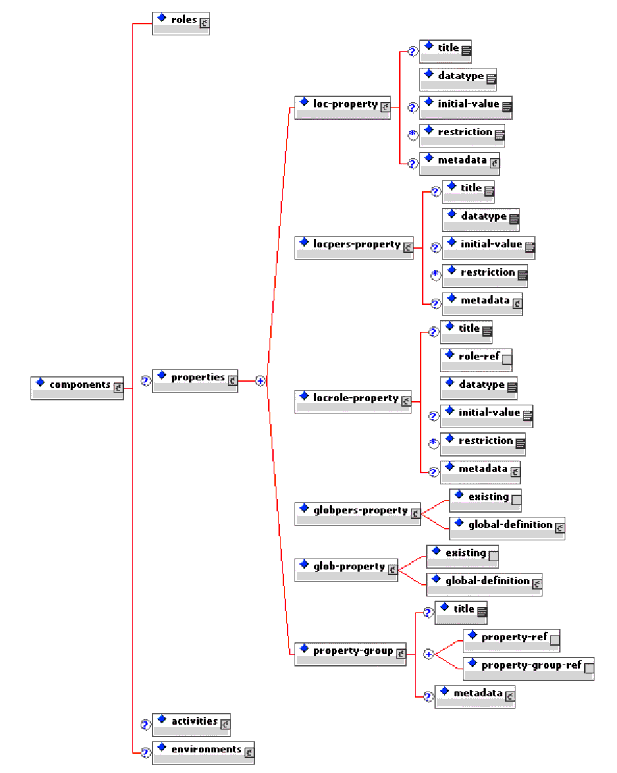
3.2.3 Information Table 'when-property-value-is-set'
The element when-property-value-is-set is added to the content models of the following Level A elements:
In all four it is added as the last element in the group.
Example for complete-activity:
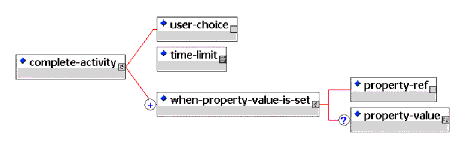
The model for when-property-value-is-set is:

3.2.4 Information Table 'change-property-value'
The element change-property-value is added to the content model of the element of Level A element on-completion. It also occurs in the Level B element then.
The extension of Level A on-completion:

The model of change-property-value is:
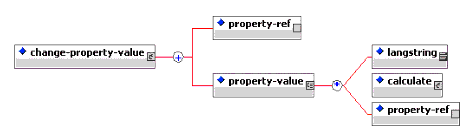
3.2.5 Information Table 'monitor'
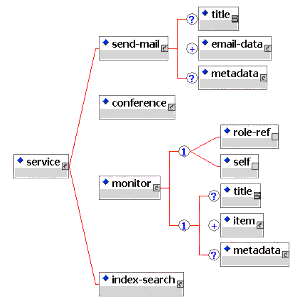
3.2.6 Extension of 'email-data'
The element email-data has two additional attributes in Level B. In Level A, the element does not have attributes.
3.2.7 Extension of 'time-limit'
The element time-limit has one additional attribute in Level B. In Level A, the element does not have attributes.
3.2.8 Information Table 'conditions'
The element conditions is added to the content model of the Level A element method.
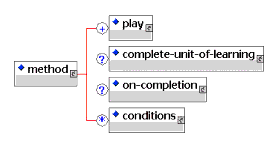
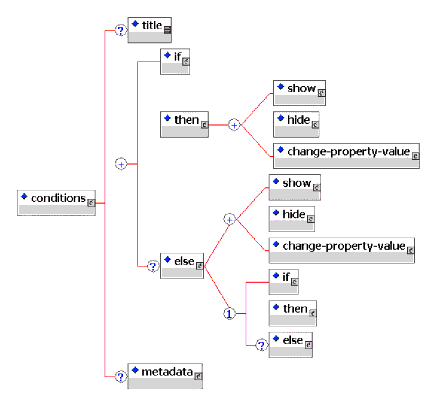
3.2.9 Information Table '{thenmodel}'
See previous diagram, {thenmodel} is a schema group.
3.2.10 Information Table 'if'
The model for if contains two grouping entities named expression and calculate. The entity expression is also available as an element with the same content in the model of elements when-condition-true (see later) and users-in-role. The entity calculate exists as an element with the identical structure within the content model of the element property-value (see: change-property-value). To avoid repeating the same information several times, the models are only expressed here.
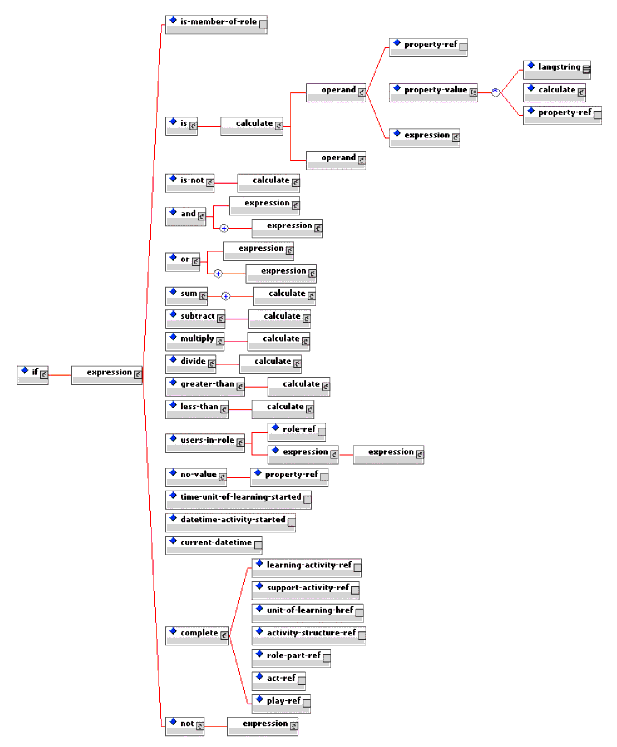
3.2.11 Information Table '{expression}'
See previous diagram, {expression} is a schema group.
3.2.12 Information Table '{calculate}'
See previous diagram, {calculate} is a schema group.
| {calculate} | |||||
|---|---|---|---|---|---|
| No. | Name | Explanation | Reqd | Mult | Type |
| 0.1 | {operand} (*) | A schema group. | M | 1 | group |
| 0.2 | {operand} (*) | See above | M | 1 | group |
3.2.13 Information Table '{operand}'
See previous diagram, {operand} is a schema group.
3.2.14 Information Table 'when-condition-true'
The element when-condition-true is added to the content model of complete-act, which was already extended with the element when-property-value-is-set.
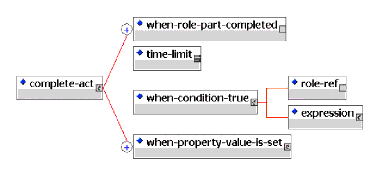
3.2.15 Information Table 'show & hide'
The elements show and hide have identical content models:

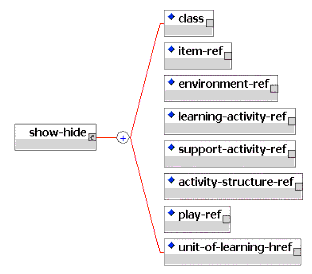
| {show-hide} | |||||
|---|---|---|---|---|---|
| No. | Name | Explanation | Reqd | Mult | Type |
| 0.1 | class (*) | Indicates that elements with a certain class attribute value must be shown or hidden, depending on the context of the element (in show or hide). The class attribute is a global attribute and may be set in resources of type 'imsldcontent' and is available on the environment elements in the learning-design model. Note that the classes can be used for style sheet like functions (e.g. set visibility), but they can also have a semantic classification purpose (just as in HTML) not connected to style sheets or automated processing at all. It is used to identify classes of common objects in order to manipulate them once. | M | 1 | empty |
| 0.1.1 | class | The class attribute refers to the value of class attributes available in learning-design or content elements. Contains a CDATA string. Just as in HTML more than one class may be specified in one CDATA string, each separated with a blank space. The priority order for classes is the same as specified in the CSS specification (see http://www.w3.org/style/css ). Any element can in principle have the class attribute. 'Class' is a global defined W3C attribute for HTML 4.0 and XHTML [LD14]. This attribute assigns a class name or set of class names to an element. Any number of elements may be assigned the same class name or names. Multiple class names must be separated by white space characters. The class element can be used for semantic grouping of elements and be manipulated by IMSLD conditions and stylesheets. When sending a learning object to a web client, include the class attribute and value(s). | O | 1 | string |
| 0.1.2 | title | When the content is collapsed (see 'with-control') a title has to be given. The title is provided in the 'title' attribute on the class element. | O | 1 | string |
| 0.1.3 | with-control | Boolean: when true the content elements are hidden, but in the user-interface a collapse and expand control (like the [+] controls in Windows Explorer) is provided. With this control a user can decide to hide or show the content in the element him or herself. | O | 1 | boolean |
| 0.2 | item-ref (*) | Refers to the identifier of an item in the design context. | M | 1 | empty |
| 0.2.1 | ref | Refers to an identifier within the learning design. | M | 1 | IDREF |
| 0.3 | environment-ref | Refers to an environment in this package. | M | 1 | empty |
| 0.3.1 | ref | See above | M | 1 | IDREF |
| 0.4 | learning-activity-ref | Refers to a learning-activity. The element can be used as an operand in a calculation or expression. | M | 1 | empty |
| 0.4.1 | ref | See above | M | 1 | IDREF |
| 0.5 | support-activity-ref | Refers to a support-activity. The element can be used as an operand in a calculation or expression. | M | 1 | empty |
| 0.5.1 | ref | See above | M | 1 | IDREF |
| 0.6 | activity-structure-ref | Reference to an activity-structure. | M | 1 | empty |
| 0.6.1 | ref | See above | M | 1 | IDREF |
| 0.7 | play-ref (*) | Reference to a play. | M | 1 | empty |
| 0.7.1 | ref | See above | M | 1 | IDREF |
| 0.8 | unit-of-learning-href | The element can be used as an operand in a calculation or expression. This element is used to reference the appropriate elements of an external unit-of-learning (uol). This may be contained in the same package (the href is then a relative URI) or a resource pointing to a unit-of-learning outside of the package (the href is an absolute URI). It requires the use of a fragment identifier (#ID) added to the file reference. This is used, in the same way that an IDREF is used internally in an XML document, to point to the ID of an activity-structure, learning-activity, support-activity or environment element contained in the referenced external unit-of-learning. Note: this is equivalent to a simple or 'bare name' XPointer, which has the format: URI#ID and is the XML equivalent of an HTML fragment identifier. In XML Schema this format is supported by the anyURI construct. | M | 1 | empty |
| 0.8.1 | href | Refers to a URI. | M | 1 | anyURI |
3.2.16 Information Table 'global elements'
There are four global elements defined in the IMSLD Specification:
In Level B these elements are all empty. The global elements must each be used separately - that is without the container element global-elements, within any XML content schema (like XHTML). The element global-elements has no other function than temporary grouping the different global elements. Note: global elements are not part of the learning-design model! Use the standard namespace.
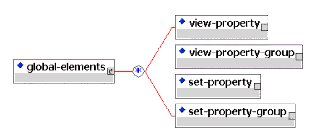
3.2.17 Global Attribute 'class'
Conditions can show or hide elements with the attribute class. This attribute is a global attribute - defined by the W3C in the context of Cascading Style Sheets (CSS) - that is available at the following elements within the learning-design model:
Outside the context of learning design it can be added to any XML content schema. It is available on all elements in XHTML. Conditions do not only affect elements with the class attribute within the learning design, but also in the content, when this content is of resource type 'imsldcontent'.
3.2.18 Datatypes
The following datatypes are used in the property declaration. The format of each datatype is specified:
- Boolean: Represents binary logic, true or false (aliases: yes/no; 1/0). NB: like all other datatypes, booleans can have <no-value>.
- Integer: Represents the standard mathematical concept of integer numbers, representing whole positive and negative numbers (including zero), ranging from: -9223372036854775898 to 922372036854775807 (alias: longinteger).
- Real: Represents the standard mathematical concept representing arbitrary precision decimal numbers, and must be capable of handling a number to 18 decimal places at least.
- String: Represents any legal character strings. The minimal maximum number of characters is 2000.
- File: Represents any binary file as datatype. The property stores this file.
- Uri: Represents an URI according to the IETF's RFC 2396. Note: according to the W3C only URI should be used in future and not URL or URN. (see: http://www.w3.org/TR/uri-clarification/).
- Datetime: Specifies the date and time in the form: CCYY-MM-DDThh:mm:ss. CC is the century; YY is the year (year 0000 is prohibited); MM is the month; dd is the day. T is the date/time separator; hh are the hours; mm are the minutes; ss are the seconds. (see ISO 8601). There is also an optional timezone separator. Partial productions of the lexical expression are not allowed.
- Duration: Specifies an amount of time: the duration of an event in relative terms (e.g. the duration given the start datetime of the run of a unit-of-learning. The format - also used in the W3C XML schema specification - is:
PnYnMnDTnHnMnS where:
P is the designator that must always be present.
n is a variable where an integer is filled in.
nY represents the number of years.
nM represents the number of month.
nD represents the number of days.
T is the date/time separator which must always be present when representing time.
nH is the number of hours.
nM is the number of minutes.
nS is the number of seconds.
Example: P2Y0M1DT20H10M55S. Meaning that the duration is: 2 years and 0 month and 1 day and 20 hours and 10 minutes and 55 seconds. Limited forms of lexical production are also allowed: For example, a duration of 40 minutes is expressed as PT40M; a duration of 30 days is P30D. - Text: represents any legal character strings. The minimal maximum number of characters is 64000 (about 10 pages of A4 text).
3.2.19 Restriction Types
For properties, certain restrictions on the data values can be specified. The restriction types are:
- length: constrains the length of the property value of a textual datatype (string, text or uri) in terms of the number of characters that it can have.
- minLength: constrains the minimum number of characters that a property of textual datatype can have.
- maxLength: constrains the maximum number of characters that a property of textual datatype can have.
- enumeration: constrains the value of a property to a specific value (use for value alternative lists).
- maxInclusive: constrains the value of an ordered (integer, real, datetime) property to a specific inclusive upper bound.
- minInclusive: constrains the value of a ordered property to a specific inclusive lower bound.
- maxExclusive: constrains the value of a ordered property to a specific exclusive upper bound.
- minExclusive: constrains the value of a ordered property to a specific exclusive lower bound.
- totalDigits: constrains the value of a decimal property to a specific number of digits it must contain.
- fractionDigits: constrains the value of a decimal property to the maximum number of digits it may have after the decimal point.
- pattern: constrains the literals comprising the value of a property to a pattern defined by a regular expression.
3.3 Level C Information Model
Level C adds the capability for a learning designer to specify the sending of messages and setting of new activities based on certain events. The runtime system, or 'user-agent' is expected to support a notification mechanism. Notifications are event-driven mechanisms, which can be directed towards elements in the system or to human users.
Notifications affect the following content models of Level B elements:
- The on-completion model is extended with a notification element.
- The then model is extended with a notification element.
- Global elements set-property and set-property-group are both extended with a notification element.
3.3.1 Conceptual Model
Figure 3.3 provides the conceptual UML model for Level C. The grey marked class is added to the model of Level B.
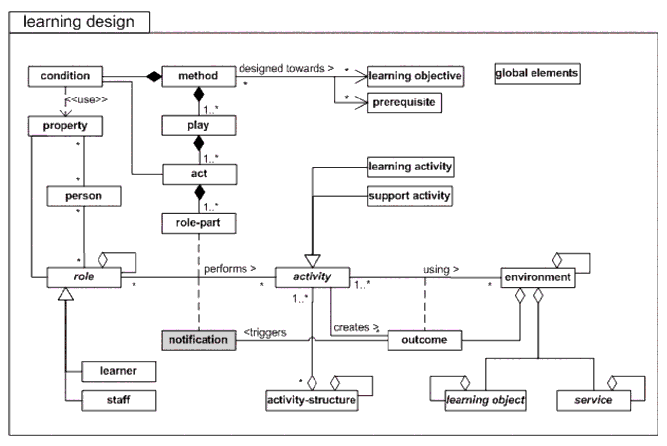
3.3.2 Information Table 'notification'

3.3.3 Extension of 'on-completion'
Notifications are added to the on-completion model:
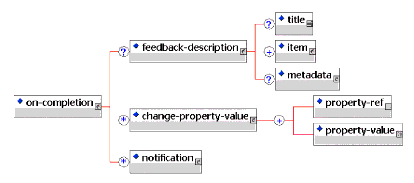
3.3.4 Extension of 'then'
Notifications are added to the then model:
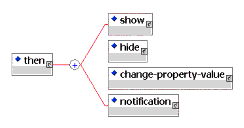
3.3.5 Extension of 'global elements'
Notifications are added to the global-elements:
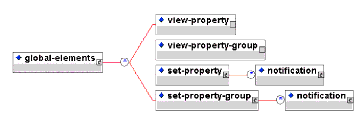
4. Behavioral Model
4.1 Behavioral Model Overview
There are two broad parts of the Learning Design behavioral model:
4.1.1 Instantiation
There are two main sub-parts to instantiation, in addition to the instantiation of the unit of learning itself:
4.1.1.1 Instantiating Roles
As a learning design specifies Roles but no specific individuals playing these roles, the main part of instantiating a learning design is the association of particular people with the roles specified in the design. Learning Design Level B Properties may have to be initialized for the various Roles.
4.1.1.2 Instantiating Services
Once the roles are known, generic services can be set up for or with actual members according to the roles associated with the use of the service, taking into account the permissions accorded to each role.
4.1.2 Runtime
The three different Learning Design levels provide increasing levels of sophistication to the runtime behavior of a unit of learning.
4.1.2.1 Learning Design Level A
For Level A, runtime also divides into two broad aspects:
Activity-structure Sequence and Selection
An Activity-structure may contain as sub-elements any combination of Activity references, Activity Structure references, and/or Unit of Learning external references. Mechanisms are provided for determining how these are to be delivered.
For Learning Design Level A, an activity-structure element contains three attributes that affect sequencing behavior:
- Structure-type
This has a fixed vocabulary: {sequence, selection}.
This determines whether the sub-elements are to be delivered as a sequence or as a selection. A selection is a structure where users may select and complete the activities contained in any order. As activity-structures may be nested, selections may be nested within other sequences or selections. - Number-to-select
This is an integer. It determines the number of sub-elements that are to be delivered before the structure-type selection is considered completed. If the structure-type is selection and the number-to-select is 1, then (any) one of the sub-elements is to be delivered. If the number-to-select is not set (or equals the number of sub-elements), then they must all be delivered but in any order chosen by the user. - Sort
This has a fixed vocabulary of {as-is, visibility-order}
The attribute 'sort' determines the sort-order in relation to the visibility. Default the order in which activities are made visible is in the order specified in the activity-selection structure. When the value is set to 'visibility-order', activities are presented in the order they were made visible by means of conditions or notifications. This can be thought of as imitating a kind of inbox where new activities are 'posted' (made visible) and hence become available over time to users playing associated roles. This is only supported in Levels B and C.
1EdTech Learning Design Level B extends the control options of an Activity-structure by adding Properties and Conditions, while Level C adds the Notification mechanism, which can be used to create dynamic sequencing.
Method
The method governs the running of (the learning design in) a Unit-of-Learning. A Method has one or more plays. If there is more than one play, they represent logically independent parts of the learning design. The plays are therefore always run concurrently. They are always available to their participating actors while the unit-of-learning is live.
A play has one or more acts. The acts always run in sequence. This is a basic, top-level, linear sequencing method analogous to the sequence of acts in a play.
An act has one or more role-parts. These are associated with one and only one role, specifying the part that this role plays in the act and some activity type which describes the actions that have to be performed and the learning resources that are available for this. A role can be played by one or more actors (e.g., actual persons playing the role of learners or support staff). Role-parts are always run concurrently, enabling multiple actors to participate in the same act. A role-part associates a role with either an activity or with an environment, which contains one or more learning objects or services. The association is always made by a reference to a role, and to an activity or environment element held in the components section.
complete-activity = "activity completion rule". This is part of the learning and support activity declarations and specifies when an activity is completed. In Level A completion can either by user-choice, or on reaching a time-limit. In Level B it is extended with when-property-value-is-set.
on-completion specifies actions that are to be executed on completion of the activity. In Level A it contains only one element, feedback-description which references content to be displayed to the user when they complete the activity. On-completion is further extended by the Level B change-property-value element, and by the Level C notification element.
4.1.2.2 Learning Design Level B
Level B includes Properties and Conditions. Conditions are used to personalize the presentation of the unit-of-learning. All conditions are pre-conditions defined at design time and must be evaluated during a run:
- When entering the unit of learning (new session).
- Every time the value of a property has been changed. This applies only to the following situations:
These properties include properties, which are available in the expression, but are set automatically (e.g., time-unit-of-learning-started).
An action is performed (fired) according to the success (true) or failure (false) of the condition. The action is to show or hide various objects, to change a property value, or to notify a role.
The show and hide actions set the visibility attribute (isvisible) of different objects: activities, environments, items, plays, activity-structures, units-of-learning, and different classes of objects (set with the 'class' attribute).
Properties belong to roles (local-role properties), the individual persons in the role (local-personal and global-personal properties), to the run of a unit of learning (local properties) or are global (global properties). They are of five different types and can be collected into property-groups. A property-group can also contain other property-groups, thus allowing arbitrary tree structures to be created.
Properties can be personal or non-personal
Personal properties are key to personalizing a learning design. Given that many actors can play the same role, personal properties, while defined as a part of the role, are assigned to the individual dossier (learning profile or learning record) of each person playing that role. They can then take on separate values for each person according to their state and outcomes when playing that role.
Non-personal properties can be fixed global properties (same value for every person, independent of role or unit-of-learning) or local properties that belong the run of a unit of learning and affect all users, either playing that role, or participating in the unit of learning, respectively. The local properties are always 'local', relating to a particular instance or run of a unit of learning (see next).
Properties can also be local or global
Local properties are those created during a particular run of a unit of learning and cease to exist when the unit of learning terminates. They are thus under the complete control of the learning designer who can determine their name, their data type, and the values to be assigned under given conditions.
Global properties persist beyond the duration of the run of a unit of learning. While these can be used by a learning designer to persist value across runs and across different units of learning, they can also be used to access values of persistent learner information. This however is beyond the scope of the Learning Design Specification, and it would look instead to LIP and more immediately Accessibility to provide elements and value types for these global properties.
The five different types of property are:
- Local property, alias: run-property.
This property has the same value in a run for every user. The property is owned by the run of the unit-of-learning. The property has an identifier that can be used to refer to it in this unit-of-learning-package. Operations can refer to this identifier to operate on its value. - Local personal property
This property can have a different value for every user in all the roles for a run of the unit-of-learning. The property is owned by the user in the context of a run of the unit-of-learning, specifying a value per user. The property has an identifier that can be used to refer to it in this unit-of-learning-package. Operations can refer to this identifier to operate on its value. - Local role property, alias: group-property.
This property has the same value for every user in the specified role during the run of a unit-of-learning. The property is owned by the role in the run of the unit-of-learning. The property has an identifier that can be used to refer to it in this unit-of-learning-package. Operations can refer to this identifier to operate on the value. - Global personal property, alias: portfolio-property
This property can have a different value for every user, independent of the different runs of units of learning (its specifies the portfolio of the user).The property is owned by the person. The property has an identifier that can be used to refer to it in any unit-of-learning-package. Operations can refer to this identifier to operate on the value. - Global property
This property is a globally unique property, which stores one value, independent of user, units-of-learning and role. The property has an identifier that can be used to refer to it in any unit-of-learning-package. Operations can refer to this identifier to operate on the value.
4.1.2.3 Learning Design Level C
Level C adds notification. A notification happens after an event, which is known by the runtime environment. Examples of events, which can trigger a notification, include the completion of an activity, an expression evaluates to true, or a property value is set.
A runtime notification can set the visibility of an activity, which is then activated for a role. If a runtime notification to a particular role sets the isvisible property of a given activity to true, this activity is immediately made available to the role, regardless of any other setting in act, sequence, or condition.
A notification is of the highest priority, meaning that an otherwise invisible item will be made visible and accessible to the user.
The runtime system sends notification messages to roles (affecting all actors playing the role). Notifications are triggered either when certain conditions are met, or when an actor, in a role (typically support staff) with appropriate permissions, sends one. At runtime, depending on the implementation, it may be possible to select a particular actor as the recipient of a notification, but this would be a runtime decision and not a design-time decision as actors are not known at design time. Support activities can select from which actors, playing a given role, it is acceptable to receive notifications from e.g., only the learners in the tutor's tutor group.
A runtime system should keep track of the originator of the notification and make this visible to the receiver of the notification. This context could be used when launching the associated (support) activity, making a choice for an actor superfluous and enabling a sort of challenge/response interaction.
Depending on the implementation, an e-mail message can be sent to the user, notifying them that a new activity has arrived (with a link to that activity contained in the message). The subject field can contain a specific value (otherwise a standard message will be sent).
A notification can be inserted in external vocabularies (after an event like set-property). However, the content must then be provided in the package (because it contains references to identifiers in the package). When the identifier cannot be resolved, the notification is ignored (but does not prevent the xhtml content being presented).
4.1.3 Hierarchy of Control
There are several structures in the Learning Design Specification that have an influence on the visibility of learning activities or other entities. This could mean that there are conflicting visibilities from different mechanisms. To solve possible conflicts there is a hierarchy of control:
notify (LD Level C) a runtime notification can set the visibility of an activity which is then activated.
acts (LD Level A) determine whether, when, and for what roles an activity, resource structure, or item is to be used.
sequence (LD Level A) is a type of activity-structure and sets the order of completion for the activities in the sequence. This resets the isvisible attribute settings, regardless of conditions and isvisible attribute initial values.
condition (LD Level B) may reset the isvisible property of an activity, resource structure, or item, regardless of its current setting.
isvisible (LD Level A) attribute determines whether an activity, resource structure, or item is displayed to the learner.
This means that 'isvisible' values can be overruled by conditions; conditions can be overruled by sequences; sequences by acts; and acts by notifications. This means that notifications - as the strongest mechanism - can make all types of activities visible that are defined in the components section, independent of any statement in the method section.
A method can be expressed as a table:
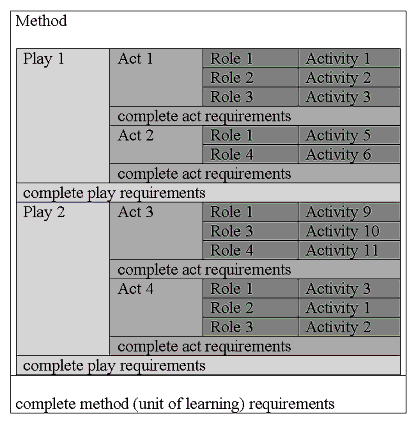
For example a play can specify the following:
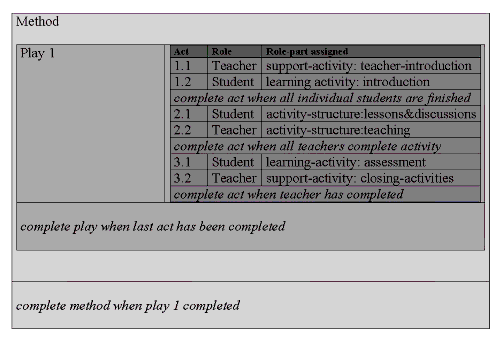
This is represented in a Learning Design Method as follows:
<method>
   <play id="play1">
      <act id="act1">
         <role-part id="part11"><role-ref ref="Teacher"/><support-activity-ref ref="teacher-introduction"/></role-part>
         <role-part id="part12"><role-ref ref="Student"/><learning-activity-ref ref="introduction"/></role-part>
         <complete-act><when-role-part-completed ref="part11"/></complete-act>
      </act>
      <act id="act2">
         <role-part id="part21"><role-ref ref="Student"/><activity-structure-ref ref="lessons&discussions"/></role-part>
         <role-part id="part22"><role-ref ref="Teacher"/><activity-structure-ref ref="teaching"/></role-part>
         <complete-act><when-role-part-completed ref="part22"/></complete-act>
      </act>
      <act id="act3">
         <role-part id="part31"><role-ref ref="Student"/><learning-activity-ref ref="assessment"/></role-part>
         <role-part id="part32"><role-ref ref="Teacher"/><support-activity-ref ref="closing-activities"/></role-part>
         <complete-act><when-role-part-completed ref="part32"/></complete-act>
      </act>
      <complete-play><when-last-act-completed/></complete-play>
   </play>
   <complete-unit-of-learning><when-play-completed ref="play1"/> </complete-unit-of-learning>
</method>
Note: id in the example is short for 'identifier'. The specific names of the identifiers are arbitrary.
Translated in text this means: When entering the unit of learning the play starts with act number 1. All persons assigned to the role 'Teacher' get the support-activity 'teacher-introduction'. At the same time all persons assigned to the role 'Student' get a learning activity called 'introduction'.
Act number 1 is completed when all persons in the role Student have completed the introduction. Than act 2 starts by assigning an activity-structure called 'lessons & discussions' to the persons in the role Student and assigning at the same time the activity structure 'teaching' to the Teachers. This act is closed when the teacher completes the act (assuming there is a restriction of one person in the teacher role). Than act 3 starts. Etcetera. The play is closed when the last act has been completed.
More than one play can be specified in a method. These plays run in parallel, independent from each other. This is a necessary facility when modelling more complex designs.
Instead of a table a UML activity diagram or a Gantt Chart or (relative) timetable can be used. These means can be a handy starting point for the design.
A UML activity diagram, using a swimlane for each role is illustrated in Figure 4.1.

A Gantt Chart is illustrated in Figure 4.2:
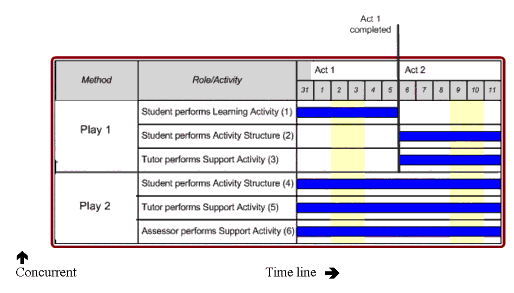
4.2 Instantiating a Unit of Learning
A unit of learning, including a learning design, can be used many times on the same or different systems, in the same or in different training organizations or educational institutions. Each time an instance is created, the runtime service will need to create a certain amount of runtime specific data structures, such as runtime identifier, start-time etc., in order to support the instance and its life-cycle.
A number of steps are needed to translate an 1EdTech Learning Design XML document into a live 'course' that a student (and teacher) interact with through, for instance, a browser. These steps have to be implemented in an 1EdTech Learning Design 'user agent' or runtime delivery system. It is necessary to specify which medium is to be used to publish the unit (typically the Web, but a unit of learning could be delivered through some other medium or a combination of different media), what media specific elements (video, audio, pictures, etc.) there are, and the availability of support for them, what language is to used, who will participate, and in what roles, the start and end date for the run. Any services, such as announcement channels, chat, or discussions forums have to be set up with the actors that are playing the various roles and their 'service permissions' set, as specified in the design. Also, database fields have to be set up to track the values of the properties of the participants and to maintain their 'dossiers'.
Some of this information is defined in the 1EdTech Learning Design Specification but implementers are likely to want to provide additional runtime information.
4.3 Setting Up by Instantiating Roles and Services
The instance will also be intended for use with particular persons. It will therefore also need to be supplied with information about the people who will be playing the roles of learners and support staff.
For 1EdTech Learning Design Level B, when assigning a person to a role, any properties belonging to a person need to be located in his/her dossier. Any local personal properties, ascribed by the role that each person plays, need to be set up and their default values, if any, set. Role properties, which apply to all members playing that Role, also need to be set up, as do properties that belong to the unit of learning, which apply to all persons playing any role within the unit of learning. There are also global properties, which persist across all units of learning and users, that have to be located and instantiated if this has not been done already.
Once the participants and their roles are known, the services, which depend on this information, can be set up. A unit of learning may be pre-scanned to discover these services and instances of these services set up and allocated a (runtime) URL. An example would be a discussion forum that is dedicated to a particular instance of a unit of learning or to a particular activity within a unit of learning. Within such a forum, different roles may have different permissions with respect to reading, writing, deleting, and editing entries. The 1EdTech Learning Design Specification provides a format for this kind of information, enabling the setup of such services to be automated.
4.4 Activation Process
When activating a unit of learning, the method element has to be located within the unit of learning. There must always be one but only one method element. This and its sub-elements control the behavior of the unit of learning as a whole, coordinating the activities of the players in the various roles and their use of resources.
This creates a 'learning flow', similar to the coordination of activities in a workflow groupware system (but not to the passage of documents in a document-oriented workflow system).
Functionally, a method is made up of one or more play elements. Play elements are functionally independent and run in parallel, so each play element has to be instantiated when the unit of learning is first initialized.
The terminology used to describe the various sub-parts of a Method, Play, Act, Role, and Role-part are drawn from the metaphor of theatre, with the Environment equivalent to the stage set and stage props. The Method, Plays, Acts, and Role-parts are all nested within each other, providing three levels within a Method.
At the top level, the method consists of the 2 elements, play and complete-unit-of-learning. The latter, as described in the Completion Rules section that follows, holds both the condition on which the unit-of-learning is completed and optional actions to be taken when it is completed.
On initialization, all play elements are made active for the members of the roles that participate in it.
Play elements unfold in a series of one or more acts, which are always run in sequence. No act is made visible to the role/s that play a part in it until the previous act has completed. This factor can be used to synchronize the activities of those playing roles within the play.
The activities associated with the roles within a play may have complex sequencing, so it is possible to have a 'one-act' play which has internally complex sequencing, as long as the activities of the players do not need synchronizing (e.g., when the use of a learning resource is completed, all participants move to a discussion forum).
A play has an identifier and an isvisible property. It also has a title and metadata. The act or acts constitute the main body of the play, and the complete-play specifies the conditions of completion and the optional actions to be taken when the play is complete.
Although within an act there may be complex sequencing, and there may be only one active act, if there is more than one act within a play, the acts are run in sequence.
Thus acts can be used as synchronization points, either waiting for all players to finish before starting the next, or forcing an end when a certain number of players have finished, when terminated by a support staff member or under some other condition. All role participants in the next act may then start together at the same time, subject to their being simultaneously logged into the runtime service. When the last act is completed, the unit of learning is also complete.
An act brings together one or more role-parts. This is the mechanism that allows more than one role to perform at the same time. Therefore role-parts within an act are always run in parallel.
Role-parts enable several users, playing the same or different roles, to participate in the same act. Each role-part associates exactly one role with exactly one type of activity (including the performance of another unit-of-learning and activity-structures), or with one environment (equivalent to an organization in Content Packaging). Multiple role-parts within one act, are performed concurrently.
The same role can be associated with different activities or environments in different role-parts, and the same activity or environment can be associated with different roles in different role-parts. However, the same role may only be referenced once in the same act. If multiple activities or environments need to be associated for the same role an activity-structure or wrapper environment should be used.
When an act within a play is activated, all the role-parts in the act go 'on-stage' or become live. Depending on the implementation, players of the roles referenced by the role-parts may then have their associated activities (or environments) made visible in their 'activity-tree' and any content associated with the activity made accessible. However, if an activity or items isvisible attribute is set to 'false', the link in the activity-tree might be made visible, but the content not made accessible.
4.5 Completion Rules
At every level within a method, it is possible to specify the rules when a role-part, act, play, or unit-of-learning is completed. It is expected that the runtime system keep a record of the completion status of these different entities. The completion status can be retrieved using certain constructs in this specification.
At the lowest level within a method role-parts have to be completed. The activity which a role-part references may be a learning-activity, a support-activity, an activity-structure, or (sub) unit-of-learning. They are completed when the complete-activity conditions are met (for learning/support activities), or when an activity-structure is completed or when a referenced unit of learning is completed.
Activity-structures, while they may include (sub)activity-structures and (sub)unit-of-learning references, ultimately resolve down to basic learning or support activities. An activity-structure with type set to sequence is completed when the last referenced entity is completed. An activity-structure with type set to selection is completed when all the containing referenced entities are completed or when the number of entities set in number-to-select are completed. The completion of an activity-structure or (sub)unit-of-learning is thus determined by the completion of the 'atomic' learning and support activities contained within it. Where there are sub-structures, their completion in turn is 'rolled up' from the completion of their constituent parts.
The completion of an 'atomic' learning or support activity is determined either by user choice or when a time limit is reached (Level A). When no explicit completion rule is specified the completion is set to unlimited, meaning that it is always completed. In Learning Design Level A, the next three levels up, act, play, and unit-of-learning, each have three completion options.
At the next level up from a role-part, an act is completed either when one or more referenced role-parts are completed, or by user choice, or when a time limit is reached. At the next level up again, a play is completed either when the last (final) act is completed, or by user choice or when a time limit is reached. Finally, at the top level, the unit-of-learning is completed either when one or more referenced plays are completed, or by user choice, or when a time limit is reached.
Note: Completion of a higher-level element, by either user choice or time limit, terminates all lower level components contained within it.
Learning Design Level B adds the when-property-value-is-set option as an addition to the three above Level A options for the completion of an act, a play, and a unit-study. The when-property-value-is-set element contains a property-reference and a property-value. When the referenced property is set to the value specified in the property-value, the condition evaluates to true and the act, play, or unit-study is set to completed.
The completion conditions for the act, play, and unit-of-learning are all the same, with the exception of the first condition which is unique to each.
Level B adds the further option of completion being triggered by a property being set to a specified value. The when-property-value-is-set completion condition is triggered when the specified property is set to the specified value. The property value to test against can be specified either as a literal value, as a calculated value, or as the value of another property.
4.6 On Completion
When a learning activity, support activity, act, play, or unit-of-learning is completed, actions to be performed are contained in the on-completion element. The on-completion options are the same for a learning activity, a support activity, an act, a play, and a unit-of-learning. A role-part is considered complete when its referenced activities are complete and has no on-completion element of its own. Likewise, an activity-structure is considered complete when its constituent sub activities are completed and has no on-completion element of its own.
In Learning Design Level A, the only task that can be specified to be carried out on completion is that of providing feedback to the user through the feedback-description element. This points to a resource where the feedback description can be found. After completion of an activity this Web page is to be displayed to the user.
Learning Design Level B adds the option of changing one or more property values through the change-property-value element. The change-property-value element (also) contains a property-reference and a property-value. This specifies that on completion, the referenced property is to be set to the value specified in the property-value.
Learning Design Level C adds the option of sending one or more notifications. (See the Behavioral Model Overview for a description of Notifications).
4.7 Recording Outcomes and their Mapping to 1EdTech LIP
The results or outcomes of each learner's activities in the Unit of Learning will typically be recorded and maintained by the runtime service. The learning design presupposes some form of 'dossier' or learner record that is used to hold and maintain the various personal properties that are part of Learning Design Level B. Local personal properties need to be maintained only for the duration of the unit of learning, although this could run across multiple sessions, which together might span many days. Global personal properties are intended to persist indefinitely and should become part of a learner's permanent learning record.
The learning design does not specify how properties and their values and their aggregation for each learner should be recorded by the runtime service.
However it is worth noting that the 1EdTech Learning Design properties and property groups map directly into the 1EdTech LIP Specification's Activities and Evaluations elements. This means that the 1EdTech LIP Specification can be used to transport the outcomes generated by learners in their use of units of learning between different systems should this be needed.
5. Extensibility
The XML binding of a Learning Design may be extended through the use of XML Namespaces and XML Schemas, to allow developers the most flexibility possible. Elements that contain data types (e.g., string, integer) and elements with a "closed" data model may not be extended. Extensions must provide references (via namespacing) to the source of the extensions.
The information model already indicate placeholders, which could be replaced and/or extended with other schemas.
There are at least two cases where extensions can cause problems for developers. The first case is when interoperability with other content packaging tools and vendors is required. Custom extensions must then be agreed upon between individual parties making global interoperability very difficult. The second case is when a developer wishes to add extensions and also provide or alter a schema that will allow document validation. Each schema (DTD, XSD) requires a different approach to handle extensions that can be validated.
Appendix A - Glossary
In this document, the following terms are used with these associated specific meanings. If you are used to a different usage for the term, or a different term for what is being defined, please translate accordingly as you read. The terms defined here are no part of the learning design vocabulary as they are specified in the conceptual model elsewhere in this text.
| Announcement Conference | An announcement is a message sent to users to inform them about new events or relevant information. Announcements are declared in the environment/service/conference object with the conference-type set to 'announcement'. |
| Asynchronous Conference | Asynchronous conferences are group-messaging systems that use a store (inbox) for incoming messages. These are normally ordered in (nested) topics (conferences). The most primitive asynchronous conferencing system is internet news (nntp). |
| Attribute | An attribute is a parameter to an element declared in the DTD. An attribute's type and value range, including a possible default value, are defined in the DTD. |
| Document | A document is a stream of data that, after being combined with any other streams it references, is structured such that it holds information contained within elements that are organized as defined in the associated DTD. |
| DTD | A DTD, or document type definition, is a collection of XML declarations that, as a collection, defines the legal structure, elements, and attributes that are available for use in a document that complies to the DTD. |
| Element | An element is a document-structuring unit declared in the DTD. The element's content model is defined in the DTD, and additional semantics may be defined in the prose description of the element. |
| Facilities | Functionality includes elements, attributes, and the semantics associated with those elements and attributes. An implementation supporting that functionality is said to provide the necessary facilities. |
| Implementation | An implementation is a system that provides collection of facilities and services that supports this specification. |
| Parsing | Parsing is the act whereby a document is scanned, and the information contained within the document is filtered into the context of the elements in which the information is structured. |
| Property Operation | A term used to refer to one of the following operations on properties or property groups: set-property, view-property, set-property-group, view-property-group, change-property-value. |
| Rendering | Rendering is the act whereby the information in a document is presented. This presentation is done in the form most appropriate to the environment (e.g. aurally, visually, in print). |
| Run of a Unit of Learning | A unit-of-learning describes a class of possible instances. These instances of a unit of learning are called a 'run'. In a run, concrete persons are bound to the roles defined in the unit of learning and a concrete start date of the learning process is defined. The same unit of learning with the same identifier can have an unlimited number of runs. When having the same identifier it is expected to have exactly the same structure and content. The identifier of the units of learning discriminates between versions of content and structure (learning design). Note that the runtime system is also likely to create separate identifiers for each runtime instance. This however is an implementation design issue. |
| Runtime | The facility used to interpret the 1EdTech LD Specification for users. |
| Synchronous Conference | Synchronous conferences are group communication systems which enables groups to communicate and work with each other in real time. Mostly through a variety of media, but the most primitive once use one media type (e.g. chat and telephone conferences). More complex systems combine synchronous and asynchronous conferences. These are also classified here as synchronous conferencing systems. |
| URI | Unique Resource Identifier. Specification from IETF, annotated by W3C (see references). In this DTD URIs are used in the meaning of the W3C annotation. This annotation does not make a strict distinction between URLs and URNs. Every URI can be a URL and a URN depending on implementation specific conventions. URIs can be absolute or relative. Absolute URIs are global, relative URIs are local. For resources with local URIs it is expected that the resource is available in the unit-of-learning package when the resource is dependent on one or more files. |
| User Agent | A user agent is an implementation that retrieves and processes IMSLD documents. It is identical to a runtime system. It is indifferent where processing takes place: at the client or server side. |
| Validation | Validation is a process whereby documents are verified against the associated DTD, ensuring that the structure, use of elements, and the use of attributes are consistent with the definitions in the DTD. |
| Web Content | Is a data type for a specific resource: any content which could be hosted in, or launched within a Web browser, like html, xml, flash, applets, text processor/spreadsheet files, etcetera. Whether files are launched in the browser which cannot be hosted in the browser, depends on the user client. etcetera. Webcontent does not necessarily have to be well-formed XML (e.g., HTML is not). |
| Well-Formed | A document is well-formed when it is structured according to the rules defined in Section 2.1 of the XML 1.0 Recommendation (http://www.w3.org/TR/xhtml1/#sec-well-formed). Basically, this definition states that elements, delimited by their start and end tags, are nested properly within one another. |
Appendix B - User Agent Compliance
Learning Design offers three levels of compliance, referred to as Levels A, B, and C. Level A builds on 1EdTech Content Packaging. Therefore compliance with level A implies support for all 1EdTech Content Packaging constructs. Learning design Level B builds on Level A. Therefore compliance with Level B also implies compliance with Level A. Similarly, Level C builds on Level B. Therefore compliance with Level C implies compliance with Levels B and A.
A user agent is IMSLD compliant when it has facilities for all of the elements and attributes specified in the XML Schema provided for Profile 3, 4, or 5 (see next appendix) in conformance with the descriptions contained in this specification. For compliance at each Level, 1EdTech expects certain runtime behaviors from a user agent:
B.1 - Level A Compliance
- A unit-of-learning-package has all the files needed to create one or more runs from this unit-of-learning. The URI of a unit-of-learning identifies the package uniquely, including the update versioning.
During the run of a unit-of-learning-package the learning-design may not be updated, but the organization structure and the physical local files delivered in the package may be updated without affecting the run status for users.
When a new version of the local files and/or the learning-design has been created, a new URI has to be created for the unit-of-learning-package. Depending on the implementation several types of information can be stored in the URI (e.g. identifier + type + version). During the run, the new package with the new URI can be published over the run (updating resources and files) or a new run can be created. Facilities to import, publish, set start-dates, manage users in roles, update existing runs and create new runs are expected to be provided with the runtime system. - When interpreting IMSLD, the runtime reads the learning-design/method/play element structure (called 'play'). When more than one play is specified these are interpreted concurrently. A play has one or more acts and an act has one or more role-parts. At every level there are explicit rules specified how a role-part, act, play and unit-of-learning is completed. It is expected that the runtime keeps record of the completion status of these different entities. The completion status is retrieved by some IMSLD constructs.
The role-part completion has to be derived from activity completions or unit-of-learning completion (when the role-part refers to a unit-of-learning). When no explicit completion rule is specified the completion is set to unlimited, meaning that it is always completed. - Per play the acts are interpreted in the order specified. Only one act per play can have the focus at any time, starting with the first act in the play. When the act is completed, the next act gets the focus, until all the acts in the play are completed.
- The role-parts specify which roles should be able to access what activities. When there is more then one role-part in a play, the role-parts are accessible concurrently by the different roles.
- Every user that is in runtime bound to a role should have access to the activities that are made accessible and visible for that role. Users can be bound to roles at runtime (new users added, existing users deleted).
- When a role is tagged to allow for the creation of new roles, the visibility rules and the users for the parent are applied to the children. Within these rules the creator of the new role is allowed to regroup the existing users in the parent role over the newly created roles.
- The isvisible attribute on elements is interpreted as the initial visibility value. (Level B Conditions and Level C Notifications can change this value to true, when show then applies, or to false, when hide then applies).
- Meta-data of the learning-design are always accessible in the user-interface. In the user-interface specification a format for all the elements has to be specified. When not specified it is shown in the format [element-name]: [element-value].
- Meta-data of other elements can be made accessible and visible, depending on the user-interface design (implementation dependent).
- The title of the learning design is always made visible somewhere in the user interface and can never be changed by templates.
- Other title elements can be rendered in the interface when needed in the implementation. Templates can overrule the existing value.
- The learning-design/learning-objectives/item(s) and /prerequisites/items(s) must be accessible for all the roles, at all times in the user-interface. They may require a user-action (e.g. opening a menu, clicking a button or link). They must semantically be presented as learning objectives respectively prerequisites.
- A user must always be aware in which role he/she is in. When a user is assigned to more than one role, he/she must be able to see to which roles he/she is assigned and be able to switch roles at any time. The information-for-role/item(s) must always be accessible with the roles for a user.
- Learning-activities and support-activities are rendered in the user-interface in such a way that users always know in which learning activity they are (by rendering the activity title), where it fits in the sequence or selection of a series of activities, what the activity-description is, which learning-objectives and prerequisites are connected, which environment (and content of the environment) is connected, how to complete the activity (including controls when needed) and have access to any feedback-description on completion of an item.
- When activity-structures are presented to the user, the user-agent must interpret an activity-structure with structure-type=sequence in such a way that: the content of the 'information' element is made visible to the users, the connected environment (and its content) is available for the user and the activities are made accessible one by one in the specified sequence. The next comes available when the previous one is completed. An activity-selection is presented in such a way that the user sees the 'information', the connected environment and can access all the containing activities including a cue to inform the user when restrictions are set on the maximum number of items to be selected. The sequence is completed when the last activity or unit of learning in the row is completed (including sub-sequences or sub-selections). Activity-structures with type=selection are completed when the user has completed the number of items that should be completed (when the number-to-select is not set, all the activities in the selection must be completed). In all situations a user must see what type of activity (learning, support, substructure or unit-of-learning) he/she can access at the moment he/she sees the link to the activity.
- Support activities can be recurrent for every user in the supported role (when the role-ref is specified), the user-interface must represent this fact and make explicit at any time for which user or group of users the support-activity is performed. The user may select one or more of the users in the supported role.
- Environments are connected to activities, activity-structures or roles (in a role-part). When an activity-description is visible, always the connected environment (including the content structure of the environment) must be made visible. It must be possible to access and see the activity-description and the content of one of the objects or services within the environment at the same time.
- Every learning-object or service in the environment has its own design requirements. The implementer is free to implement the learning-objects and services, taking care of the representation of all the elements and the functionality they represent as described with the elements in this information model.
- Resources are not shown directly in the user-interface. They define the collection of resources where the 'item' elements in the learning-design refers to. Locally defined resources and files (by using relative URIs in the href) are expected to be present in the unit-of-learning-package. Absolute URIs refer to resources outside of the package. A change of an external resource does not affect the unit-of-learning-package (the package is not aware of the presence and change of external resources).
- The element 'item' occurs at different places in the information model. The items are referring to resources in the unit of learning package. The content of the resources must be rendered in the user-interface in such a way that the content itself is visible, including the item structure when there is more then one item. Also the item titles must be visualized. Providing a table of content and sectioned text can do the latter.
The nesting level of the items must be made visible to the user (e.g. by providing nested headings).
B.2 - Level B Compliance
- Conditions work within the scope of an act that has the focus, plus the history acts. Conditions can never make activities visible, which are not specified in one of the role-parts of the current act in the current plays. So in priority the acts have a higher priority then the conditions.
- Conditions are evaluated any time the user accesses trees or content, when the system has an online connection. But only those conditions have to be evaluated which affect the selected content or trees. Also only those conditions have to be evaluated which refer to properties in the IF expression, which values have been changed after the last time the same property value was accessed by the user.
- The user-agent is expected to keep record of property-values and property-definitions for users and roles in a so-called 'dossier'. There are several types of properties.
Local properties are stored with a scope local to the run of a unit of learning. They are defined and used in the unit-of-learning. Global properties are accessible outside the context of a unit of learning (e.g., by more than one unit of learning). They can be defined in one unit of learning en used in another one. In IMSLD global properties can be defined. Runtimes are expected to control whether a defined global property URI already exists or not. Global properties - once defined - may never change definition. So when the property already exists the definition is ignored.
Personal properties are owned by a person (local or global) and role properties are owned by a role (local or global). Dossier properties are defined and/or declared (for already defined global properties) under learning-design/roles/properties and operated upon with property-operation elements (view-property, set-property, conditions, etc.). User-agents are expected to operate on properties in a secure manner and with a maximum performance (to be detailed by the implementer).
When a property value changes a Level C notification may be sent to a role (depending on the declaration).
B.3 - Level C Compliance
- When a notification is sent, the connected activity is always made visible to the users in the role indicated by the notification. If the role is playing a role-part in the current act (which has the focus), the activity is made visible within the structure (tree) of the current act. If the role is not included in the current or an earlier act, the activity is added to the tree as a separate node directly above or below the activities from the current act. The user is to be alerted when a new notification has arrived.
- Notifications have a higher priority than acts and acts have a higher priority than sequences. Sequences have a higher priority than conditions.
- When there are conflicting show and hide conditions, the rule is that show is of a higher priority then hide (and will overrule the hide).
About This Document
| Title | 1EdTech Learning Design Information Model |
| Editors | Rob Koper (Open University of the Netherlands), Bill Olivier (CETIS/JISC), Thor Anderson (1EdTech) |
| Team Co-Leads | Chuck Barritt (Cisco), Katy Campbell (University of Alberta/Industry Canada) |
| Version | 1.0 |
| Version Date | 20 January 2003 |
| Status | Final Specification |
| Summary | This document describes the conceptual, information, and behavioral models of the 1EdTech Learning Design Specification. |
| Revision Information | 20 January 2003 |
| Purpose | Defines the 1EdTech Learning Design Information Model. |
| Document Location | http://www.imsglobal.org/learningdesign/ldv1p0/imsld_infov1p0.html |
List of Contributors
The following individuals contributed to the development of this document:
Revision History
Index
C
conceptual model 1, 2, 3, 4, 5, 6, 7
content package 1, 2, 3, 4, 5, 6, 7, 8, 9, 10, 11
E
elements
act 1, 2
activities 1, 2
activity-structure 1, 2
components 1, 2, 3
environments 1, 2
learning-activity 1, 2
learning-design 1, 2
method 1
notification 1, 2, 3
play 1, 2
roles 1, 2
service 1, 2
support-activity 1
EML 1, 2, 3, 4
L
level A 1, 2, 3, 4, 5, 6, 7, 8, 9, 10, 11, 12, 13, 14, 15, 16, 17, 18, 19, 20, 21, 22, 23, 24
level B 1, 2, 3, 4, 5, 6, 7, 8, 9, 10, 11, 12, 13, 14, 15, 16, 17, 18, 19, 20, 21, 22, 23, 24, 25, 26, 27, 28, 29, 30
level C 1, 2, 3, 4, 5, 6, 7, 8, 9, 10, 11, 12, 13, 14, 15
LOM 1, 2, 3, 4
M
meta-data 1, 2, 3, 4, 5, 6, 7, 8, 9, 10, 11, 12, 13, 14, 15, 16
P
pedagogical 1, 2, 3, 4, 5, 6, 7
S
SCORM 1, 2
simple sequencing 1, 2, 3, 4, 5, 6, 7
U
UML 1, 2, 3, 4, 5, 6, 7, 8, 9
unit of learning 1, 2, 3, 4, 5, 6, 7, 8, 9, 10, 11, 12, 13, 14, 15, 16, 17, 18, 19, 20, 21, 22, 23, 24, 25, 26, 27, 28, 29, 30
URI 1, 2, 3, 4, 5, 6, 7, 8, 9, 10, 11, 12, 13, 14
X
XML 1, 2, 3, 4, 5, 6, 7, 8, 9, 10, 11, 12, 13, 14, 15, 16, 17, 18, 19, 20, 21
1EdTech Consortium, Inc. ("1EdTech") is publishing the information contained in this 1EdTech Learning Design Information Model ("Specification") for purposes of scientific, experimental, and scholarly collaboration only.
1EdTech makes no warranty or representation regarding the accuracy or completeness of the Specification.
This material is provided on an "As Is" and "As Available" basis.
The Specification is at all times subject to change and revision without notice.
It is your sole responsibility to evaluate the usefulness, accuracy, and completeness of the Specification as it relates to you.
1EdTech would appreciate receiving your comments and suggestions.
Please contact 1EdTech through our website at http://www.imsglobal.org
Please refer to Document Name: 1EdTech Learning Design Information Model Revision: 20 January 2003